Description
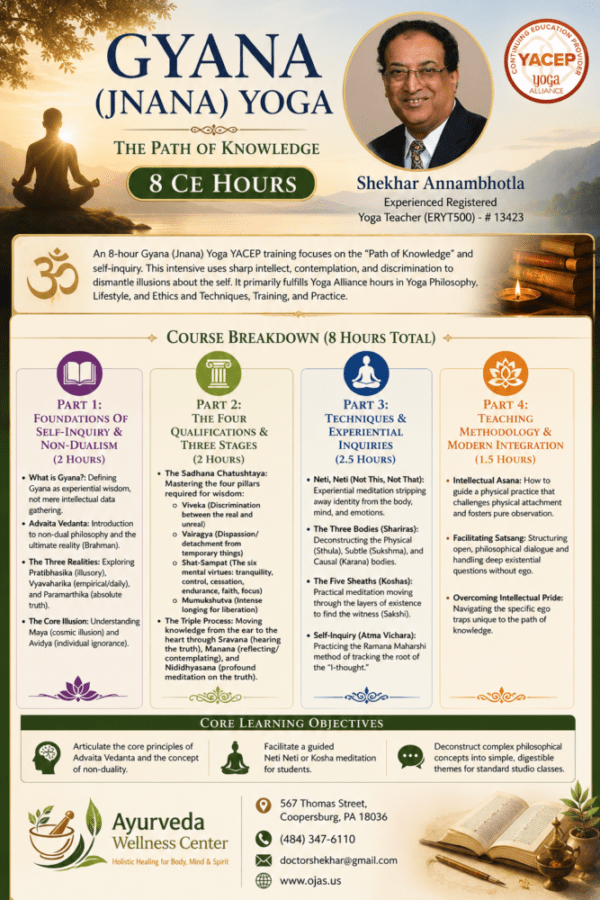
Gyana (Jnana) Yoga Training
8 CE Hours
Instructor: Shekhar Annambhotla
Experienced Registered Yoga Teacher (ERYT500) – # 13423
Ayurveda Wellness Center
567 Thomas Street, Coopersburg, PA 18036
Phone: (484) 347-6110
Email: doctorshekhar@gmail.com
Website: www.ojas.us
An 8-hour Gyana (Jnana) Yoga YACEP training focuses on the “Path of Knowledge” and self-inquiry. This intensive uses sharp intellect, contemplation, and discrimination to dismantle illusions about the self. It primarily fulfills Yoga Alliance hours in Yoga Philosophy, Lifestyle, and Ethics and Techniques, Training, and Practice.
Here is a structured syllabus blueprint for an 8-hour Gyana Yoga intensive:
Jnana is a Sanskrit term that translates to “knowledge” or “wisdom”. In Hindu and Buddhist traditions, it refers to profound spiritual insight and transformative awareness of the ultimate nature of reality, which leads the practitioner toward enlightenment and liberation (moksha).
In Hindu philosophy, Jnana is central to Jnana Yoga (the path of knowledge), one of the classic paths to spiritual liberation alongside Karma Yoga (action) and Bhakti Yoga (devotion). It involves direct experiential realization of the supreme reality (Brahman) rather than mere intellectual study.
The practice is heavily detailed in ancient scriptures like the Upanishads and the Bhagavad Gita. It typically rests on four pillars:
- Viveka: Discernment between reality and illusion.
- Vairagya: Detachment from worldly pleasures and pains.
- Shat-sampat: Six mental virtues, including calmness, tolerance, and focus.
- Mumukshutva: An intense desire for spiritual freedom
Course Breakdown (8 Hours Total)
Part 1: Foundations of Self-Inquiry & Non-Dualism (2 Hours)
- What is Gyana?: Defining Gyana as experiential wisdom, not mere intellectual data gathering.
- Advaita Vedanta: Introduction to non-dual philosophy and the ultimate reality (Brahman).
- The Three Realities: Exploring Pratibhasika (illusory), Vyavaharika (empirical/daily), and Paramarthika (absolute truth).
- The Core Illusion: Understanding Maya (cosmic illusion) and Avidya (individual ignorance).
Part 2: The Four Qualifications & Three Stages (2 Hours)
- The Sadhana Chatushtaya: Mastering the four pillars required for wisdom:
- Viveka (Discrimination between the real and unreal)
- Vairagya (Dispassion/detachment from temporary things)
- Shat-Sampat (The six mental virtues: tranquility, control, cessation, endurance, faith, focus)
- Mumukshutva (Intense longing for liberation)
- The Triple Process: Moving knowledge from the ear to the heart through Sravana (hearing the truth), Manana (reflecting/contemplating), and Nididhyasana (profound meditation on the truth).
Part 3: Techniques & Experiential Inquiries (2.5 Hours)
- Neti, Neti (Not This, Not That): Experiential meditation stripping away identity from the body, mind, and emotions.
- The Three Bodies (Shariras): Deconstructing the Physical (Sthula), Subtle (Sukshma), and Causal (Karana) bodies.
- The Five Sheaths (Koshas): Practical meditation moving through the layers of existence to find the witness (Sakshi).
- Self-Inquiry (Atma Vichara): Practicing the Ramana Maharshi method of tracking the root of the “I-thought.”
Part 4: Teaching Methodology & Modern Integration (1.5 Hours)
- Intellectual Asana: How to guide a physical practice that challenges physical attachment and fosters pure observation.
- Facilitating Satsang: Structuring open, philosophical dialogue and handling deep existential questions without ego.
- Overcoming Intellectual Pride: Navigating the specific ego traps unique to the path of knowledge.
Core Learning Objectives
- Articulate the core principles of Advaita Vedanta and the concept of non-duality.
- Facilitate a guided Neti Neti or Kosha meditation for students.
- Deconstruct complex philosophical concepts into simple, digestible themes for standard studio classes