Description
Hypothyroidism
Ayurveda Wellness Center, 567 Thomas Street, Coopersburg, PA 18036
Email: doctorshekhar@gmail.com
Phone: (484) 347-6110
Web: www.ojas.us
Thank you for your interest in an Ayurvedic Wellness Consultation!
We are delighted that you have chosen to take this important step toward improving your health and well-being through the wisdom of Ayurveda. We look forward to supporting you on your wellness journey.
To schedule your consultation, please complete the online consultation request form and submit it along with your payment using the link below:
Ayurvedic Wellness Consultation Request Form:
https://www.cognitoforms.com/Ayurveda4/AyurvedicWellnessConsultationRequest
Once we receive your completed form and payment, a member of our team will contact you to confirm your appointment and provide any additional information you may need.
If you have any questions before your consultation, please don’t hesitate to reach out. We are here to help and are honored to be part of your path to better health.
We look forward to meeting you and helping you achieve greater balance, vitality, and wellness.
With warm regards,
Ayurveda Wellness Center
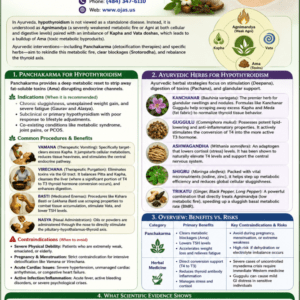
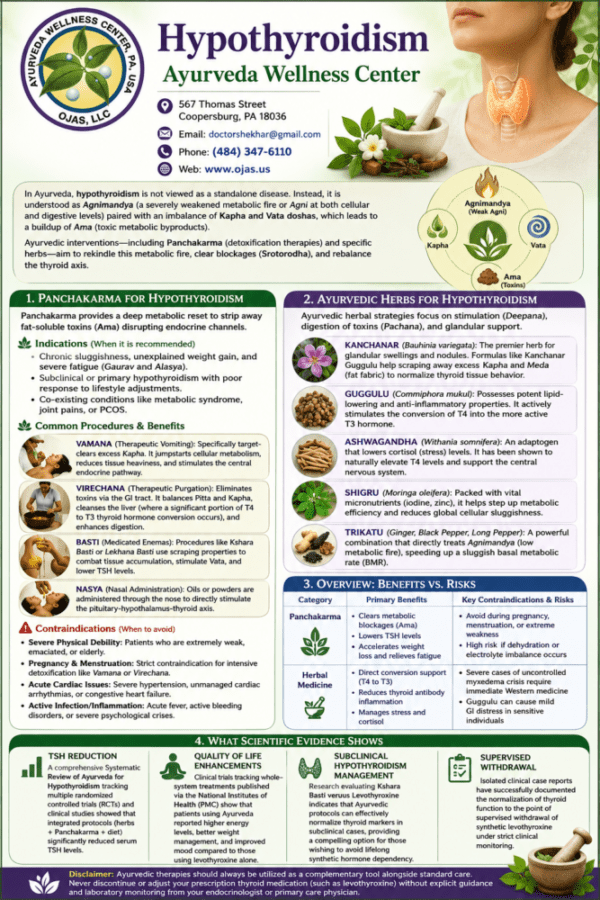
In Ayurveda, hypothyroidism is not viewed as a standalone disease. Instead, it is understood as Agnimandya (a severely weakened metabolic fire or Agni at both cellular and digestive levels) paired with an imbalance of Kapha and Vata doshas, which leads to a buildup of Ama (toxic metabolic byproducts).
Ayurvedic interventions—including Panchakarma (detoxification therapies) and specific herbs—aim to rekindle this metabolic fire, clear blockages (Srotorodha), and rebalance the thyroid axis.
- Panchakarma for Hypothyroidism
Panchakarma provides a deep metabolic reset to strip away fat-soluble toxins (Ama) disrupting endocrine channels.
Indications (When it is recommended)
- Chronic sluggishness, unexplained weight gain, and severe fatigue (Gaurav and Alasya).
- Subclinical or primary hypothyroidism with poor response to lifestyle adjustments.
- Co-existing conditions like metabolic syndrome, joint pains, or PCOS.
Common Procedures & Benefits
- Vamana (Therapeutic Vomiting): Specifically target-clears excess Kapha. It jumpstarts cellular metabolism, reduces tissue heaviness, and stimulates the central endocrine pathway.
- Virechana (Therapeutic Purgation): Eliminates toxins via the GI tract. It balances Pitta and Kapha, cleanses the liver (where a significant portion of T4 to T3 thyroid hormone conversion occurs), and enhances digestion.
- Basti (Medicated Enemas): Procedures like Kshara Basti or Lekhana Basti use scraping properties to combat tissue accumulation, stimulate Vata, and lower TSH levels.
- Nasya (Nasal Administration): Oils or powders are administered through the nose to directly stimulate the pituitary-hypothalamus-thyroid axis.
Contraindications (When to avoid)
- Severe Physical Debility: Patients who are extremely weak, emaciated, or elderly.
- Pregnancy & Menstruation: Strict contraindication for intensive detoxification like Vamana or Virechana.
- Acute Cardiac Issues: Severe hypertension, unmanaged cardiac arrhythmias, or congestive heart failure.
- Active Infection/Inflammation: Acute fever, active bleeding disorders, or severe psychological crises.
- Ayurvedic Herbs for Hypothyroidism
Ayurvedic herbal strategies focus on stimulation (Deepana), digestion of toxins (Pachana), and glandular support.
- Kanchanar (Bauhinia variegata): The premier herb for glandular swellings and nodules. Formulas like Kanchanar Guggulu help scraping away excess Kapha and Meda (fat fabric) to normalize thyroid tissue behavior.
- Guggulu (Commiphora mukul): Possesses potent lipid-lowering and anti-inflammatory properties. It actively stimulates the conversion of T4 into the more active T3 hormone.
- Ashwagandha (Withania somnifera): An adaptogen that lowers cortisol (stress) levels. It has been shown to naturally elevate T4 levels and support the central nervous system.
- Shigru (Moringa oleifera): Packed with vital micronutrients (iodine, zinc), it helps step up metabolic efficiency and reduces global cellular sluggishness.
- Trikatu (Ginger, Black Pepper, Long Pepper): A powerful combination that directly treats Agnimandya (low metabolic fire), speeding up a sluggish basal metabolic rate (BMR).
- Overview: Benefits vs. Risks
| Category | Primary Benefits | Key Contraindications & Risks |
| Panchakarma | • Clears metabolic blockages (Ama) • Lowers TSH levels • Accelerates weight loss and relieves fatigue | • Avoid during pregnancy, menstruation, or extreme weakness • High risk if dehydration or electrolyte imbalance occurs |
| Herbal Medicine | • Direct conversion support (T4 to T3) • Reduces thyroid antibody inflammation • Manages stress and cortisol | • Severe cases of uncontrolled myxedema crisis require immediate Western medicine • Guggulu can cause mild GI distress in sensitive individuals |
- What Scientific Evidence Shows
Clinical studies are verifying that whole-system Ayurveda offers measurable relief for thyroid patients:
- TSH Reduction: A comprehensive Systematic Review of Ayurveda for Hypothyroidism tracking multiple randomized controlled trials (RCTs) and clinical studies showed that integrated protocols (herbs + Panchakarma + diet) significantly reduced serum TSH levels.
- Quality of Life Enhancements: Clinical trials tracking whole-system treatments published via the National Institutes of Health (PMC) show that patients using Ayurveda reported higher energy levels, better weight management, and improved mood compared to those using levothyroxine alone.
- Subclinical Hypothyroidism Management: Research evaluating Kshara Basti versus Levothyroxine indicates that Ayurvedic protocols can effectively normalize thyroid markers in subclinical cases, providing a compelling option for those wishing to avoid lifelong synthetic hormone dependency.
- Supervised Withdrawal: Isolated clinical case reports have successfully documented the normalization of thyroid function to the point of supervised withdrawal of synthetic levothyroxine under strict clinical monitoring.
Disclaimer: Ayurvedic therapies should always be utilized as a complementary tool alongside standard care. Never discontinue or adjust your prescription thyroid medication (such as levothyroxine) without explicit guidance and laboratory monitoring from your endocrinologist or primary care physician.