Description
Migraine
Ayurveda Wellness Center, 567 Thomas Street, Coopersburg, PA 18036
Email: doctorshekhar@gmail.com
Phone: (484) 347-6110
Web: www.ojas.us
Thank you for your interest in an Ayurvedic Wellness Consultation!
We are delighted that you have chosen to take this important step toward improving your health and well-being through the wisdom of Ayurveda. We look forward to supporting you on your wellness journey.
To schedule your consultation, please complete the online consultation request form and submit it along with your payment using the link below:
Ayurvedic Wellness Consultation Request Form:
https://www.cognitoforms.com/Ayurveda4/AyurvedicWellnessConsultationRequest
Once we receive your completed form and payment, a member of our team will contact you to confirm your appointment and provide any additional information you may need.
If you have any questions before your consultation, please don’t hesitate to reach out. We are here to help and are honored to be part of your path to better health.
We look forward to meeting you and helping you achieve greater balance, vitality, and wellness.
With warm regards,
Ayurveda Wellness Center
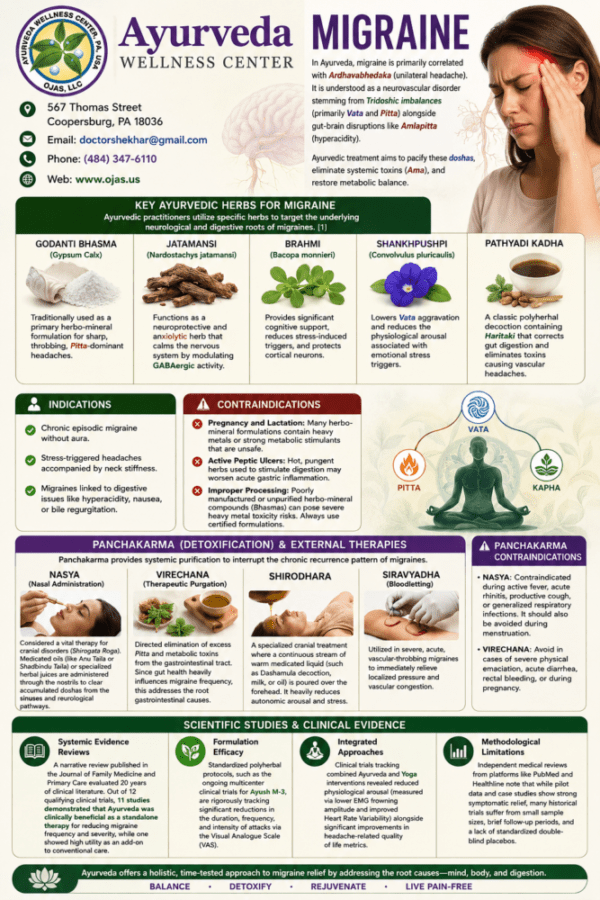
In Ayurveda, migraine is primarily correlated with Ardhavabhedaka (unilateral headache). It is understood as a neurovascular disorder stemming from Tridoshic imbalances (primarily Vata and Pitta) alongside gut-brain disruptions like Amlapitta (hyperacidity).
Ayurvedic treatment aims to pacify these doshas, eliminate systemic toxins (Ama), and restore metabolic balance.
Key Ayurvedic Herbs for Migraine
Ayurvedic practitioners utilize specific herbs to target the underlying neurological and digestive roots of migraines.
- Godanti Bhasma (Gypsum Calx): Traditionally used as a primary herbo-mineral formulation for sharp, throbbing, Pitta-dominant headaches.
- Jatamansi (Nardostachys jatamansi): Functions as a neuroprotective and anxiolytic herb that calms the nervous system by modulating GABAergic activity.
- Brahmi (Bacopa monnieri): Provides significant cognitive support, reduces stress-induced triggers, and protects cortical neurons.
- Shankhpushpi (Convolvulus pluricaulis): Lowers Vata aggravation and reduces the physiological arousal associated with emotional stress triggers.
- Pathyadi Kadha: A classic polyherbal decoction containing Haritaki that corrects gut digestion and eliminates toxins causing vascular headaches.
📌 Indications
- Chronic episodic migraine without aura.
- Stress-triggered headaches accompanied by neck stiffness.
- Migraines linked to digestive issues like hyperacidity, nausea, or bile regurgitation.
⚠️ Contraindications
- Pregnancy and Lactation: Many herbo-mineral formulations contain heavy metals or strong metabolic stimulants that are unsafe.
- Active Peptic Ulcers: Hot, pungent herbs used to stimulate digestion may worsen acute gastric inflammation.
- Improper Processing: Poorly manufactured or unpurified herbo-mineral compounds (Bhasmas) can pose severe heavy metal toxicity risks. Always use certified formulations.
Panchakarma (Detoxification) & External Therapies
Panchakarma provides systemic purification to interrupt the chronic recurrence pattern of migraines.
- Nasya (Nasal Administration): Considered a vital therapy for cranial disorders (Shirogata Roga). Medicated oils (like Anu Taila or Shadbindu Taila) or specialized herbal juices are administered through the nostrils to clear accumulated doshas from the sinuses and neurological pathways.
- Virechana (Therapeutic Purgation): Directed elimination of excess Pitta and metabolic toxins from the gastrointestinal tract. Since gut health heavily influences migraine frequency, this addresses the root gastrointestinal causes.
- Shirodhara: A specialized cranial treatment where a continuous stream of warm medicated liquid (such as Dashamula decoction, milk, or oil) is poured over the forehead. It heavily reduces autonomic arousal and stress.
- Siravyadha (Bloodletting): Utilized in severe, acute, vascular-throbbing migraines to immediately relieve localized pressure and vascular congestion.
⚠️ Panchakarma Contraindications
- Nasya: Contraindicated during active fever, acute rhinitis, productive cough, or generalized respiratory infections. It should also be avoided during menstruation.
- Virechana: Avoid in cases of severe physical emaciation, acute diarrhea, rectal bleeding, or during pregnancy.
Scientific Studies & Clinical Evidence
Modern clinical research has begun validating Ayurvedic methodologies, though limitations still exist.
- Systemic Evidence Reviews: A narrative review published in the Journal of Family Medicine and Primary Care evaluated 20 years of clinical literature. Out of 12 qualifying clinical trials, 11 studies demonstrated that Ayurveda was clinically beneficial as a standalone therapy for reducing migraine frequency and severity, while one showed high utility as an add-on to conventional care.
- Formulation Efficacy: Standardized polyherbal protocols, such as the ongoing multicenter clinical trials for Ayush M-3, are rigorously tracking significant reductions in the duration, frequency, and intensity of attacks via the Visual Analogue Scale (VAS).
- Integrated Approaches: Clinical trials tracking combined Ayurveda and Yoga interventions revealed reduced physiological arousal (measured via lower EMG frowning amplitude and improved Heart Rate Variability) alongside significant improvements in headache-related quality of life metrics.
- Methodological Limitations: Independent medical reviews from platforms like PubMed and Healthline note that while pilot data and case studies show strong symptomatic relief, many historical trials suffer from small sample sizes, brief follow-up periods, and a lack of standardized double-blind placebos.