Description
Gut Health
Ayurveda Wellness Center,
567 Thomas Street, Coopersburg, PA 18036
Email: doctorshekhar@gmail.com
Phone: (484) 347-6110
Web: www.ojas.us
Thank you for your interest in an Ayurvedic Wellness Consultation!
We are delighted that you have chosen to take this important step toward improving your health and well-being through the wisdom of Ayurveda. We look forward to supporting you on your wellness journey.
To schedule your consultation, please complete the online consultation request form and submit it along with your payment using the link below:
Ayurvedic Wellness Consultation Request Form:
https://www.cognitoforms.com/Ayurveda4/AyurvedicWellnessConsultationRequest
Once we receive your completed form and payment, a member of our team will contact you to confirm your appointment and provide any additional information you may need.
If you have any questions before your consultation, please don’t hesitate to reach out. We are here to help and are honored to be part of your path to better health.
We look forward to meeting you and helping you achieve greater balance, vitality, and wellness.
With warm regards,
Ayurveda Wellness Center
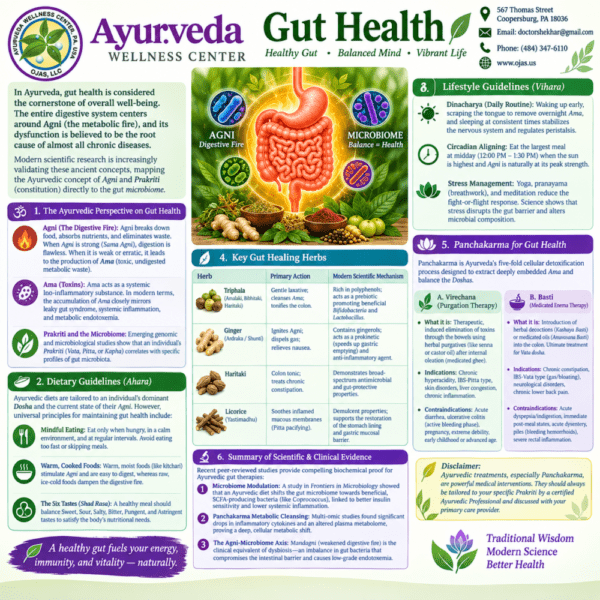
In Ayurveda, gut health is considered the cornerstone of overall well-being. The entire digestive system centers around Agni (the metabolic fire), and its dysfunction is believed to be the root cause of almost all chronic diseases.
Modern scientific research is increasingly validating these ancient concepts, mapping the Ayurvedic concept of Agni and Prakriti (constitution) directly to the gut microbiome.
- The Ayurvedic Perspective on Gut Health
- Agni (The Digestive Fire): Agni breaks down food, absorbs nutrients, and eliminates waste. When Agni is strong (Sama Agni), digestion is flawless. When it is weak or erratic, it leads to the production of Ama (toxic, undigested metabolic waste).
- Ama (Toxins): Ama acts as a systemic pro-inflammatory substance. In modern terms, the accumulation of Ama closely mirrors leaky gut syndrome, systemic inflammation, and metabolic endotoxemia.
- Prakriti and the Microbiome: Emerging genomic and microbiological studies show that an individual’s Prakriti (Vata, Pitta, or Kapha) correlates with specific profiles of gut microbiota.
- Dietary Guidelines (Ahara)
Ayurvedic diets are tailored to an individual’s dominant Dosha and the current state of their Agni. However, universal principles for maintaining gut health include:
- Mindful Eating: Eat only when hungry, in a calm environment, and at regular intervals. Avoid eating too fast or skipping meals.
- Warm, Cooked Foods: Warm, moist foods (like kitchari, a split-mung dal and rice porridge) stimulate Agni and are easy to digest, whereas raw, ice-cold foods dampen the digestive fire.
- The Six Tastes (Shad Rasa): A healthy meal should balance Sweet, Sour, Salty, Bitter, Pungent, and Astringent tastes to satisfy the body’s nutritional needs.
- Lifestyle Guidelines (Vihara)
- Dinacharya (Daily Routine): Waking up early, scraping the tongue to remove overnight Ama, and sleeping at consistent times stabilizes the nervous system and regulates peristalsis.
- Circadian Aligning: Eat the largest meal at midday (12:00 PM – 1:30 PM) when the sun is highest and Agni is naturally at its peak strength.
- Stress Management: Yoga, pranayama (breathwork), and meditation reduce the fight-or-flight response. Science shows that stress disrupts the gut barrier and alters microbial composition.
- Key Gut Healing Herbs
| Herb | Primary Action | Modern Scientific Mechanism |
| Triphala (Amalaki, Bibhitaki, Haritaki) | Gentle laxative; cleanses Ama; tonifies the colon. | Rich in polyphenols; acts as a prebiotic promoting beneficial Bifidobacteria and Lactobacillus. |
| Ginger (Ardraka / Shunti) | Ignites Agni; dispels gas; relieves nausea. | Contains gingerols; acts as a prokinetic (speeds up gastric emptying) and anti-inflammatory agent. |
| Haritaki | Colon tonic; treats chronic constipation. | Demonstrates broad-spectrum antimicrobial and gut-protective properties. |
| Licorice (Yastimadhu) | Soothes inflamed mucous membranes (Pitta pacifying). | Demulcent properties; supports the restoration of the stomach lining and gastric mucosal barrier. |
- Panchakarma for Gut Health
Panchakarma is Ayurveda’s five-fold cellular detoxification process designed to extract deeply embedded Ama and balance the Doshas. For gut issues, two primary therapies are utilized:
- Virechana (Purgation Therapy)
- What it is: The therapeutic, induced elimination of toxins through the bowels using herbal purgatives (like senna or castor oil) after days of internal oleation (drinking medicated ghee).
- Indications: Chronic hyperacidity, IBS-Pitta type, skin disorders, liver congestion, and chronic inflammation.
- Contraindications: Acute diarrhea, ulcerative colitis (active bleeding phase), pregnancy, extreme debility, and early childhood or advanced age.
- Basti (Medicated Enema Therapy)
- What it is: The introduction of herbal decoctions (Kashaya Basti) or medicated oils (Anuvasana Basti) into the colon. It is considered the ultimate treatment for Vata dosha, which resides in the colon.
- Indications: Chronic constipation, IBS-Vata type (gas/bloating), neurological disorders, and chronic lower back pain.
- Contraindications: Acute indigestion, immediate post-meal states, acute dysentery, piles (bleeding hemorrhoids), and severe inflammation of the rectum.
- Summary of Scientific & Clinical Evidence
Recent peer-reviewed studies provide compelling biochemical proof for Ayurvedic gut therapies:
- Microbiome Modulation: A landmark study published in Frontiers in Microbiology showed that a traditional Ayurvedic diet shifts the gut microbiome profile towards beneficial, short-chain fatty acid (SCFA) producing bacteria (like Coprococcus), which are highly linked to improved insulin sensitivity and lower systemic inflammation.
- Panchakarma Metabolic Cleansing: Multi-omic studies monitoring individuals undergoing Panchakarma found significant drops in systemic inflammatory cytokines and an altered plasma metabolome, proving that these therapies do induce a deep, cellular metabolic shift.
- The Agni-Microbiome Axis: Researchers have noted that Mandagni (weakened digestive fire) is the clinical equivalent of dysbiosis—an imbalance in gut bacteria that compromises intestinal barrier integrity and causes low-grade metabolic endotoxemia.
Disclaimer: Ayurvedic treatments, especially Panchakarma, are powerful medical interventions. They should always be tailored to your specific Prakriti by a certified Ayurvedic Professional and discussed with your primary care provider.