Description
Parkinson’s Disease
Ayurveda Wellness Center,
567 Thomas Street, Coopersburg, PA 18036
Email: doctorshekhar@gmail.com
Phone: (484) 347-6110
Web: www.ojas.us
Thank you for your interest in an Ayurvedic Wellness Consultation!
We are delighted that you have chosen to take this important step toward improving your health and well-being through the wisdom of Ayurveda. We look forward to supporting you on your wellness journey.
To schedule your consultation, please complete the online consultation request form and submit it along with your payment using the link below:
Ayurvedic Wellness Consultation Request Form:
https://www.cognitoforms.com/Ayurveda4/AyurvedicWellnessConsultationRequest
Once we receive your completed form and payment, a member of our team will contact you to confirm your appointment and provide any additional information you may need.
If you have any questions before your consultation, please don’t hesitate to reach out. We are here to help and are honored to be part of your path to better health.
We look forward to meeting you and helping you achieve greater balance, vitality, and wellness.
With warm regards,
Ayurveda Wellness Center
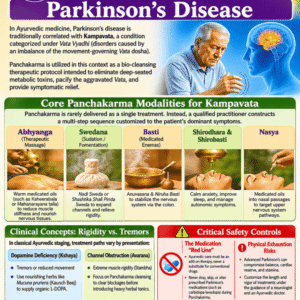
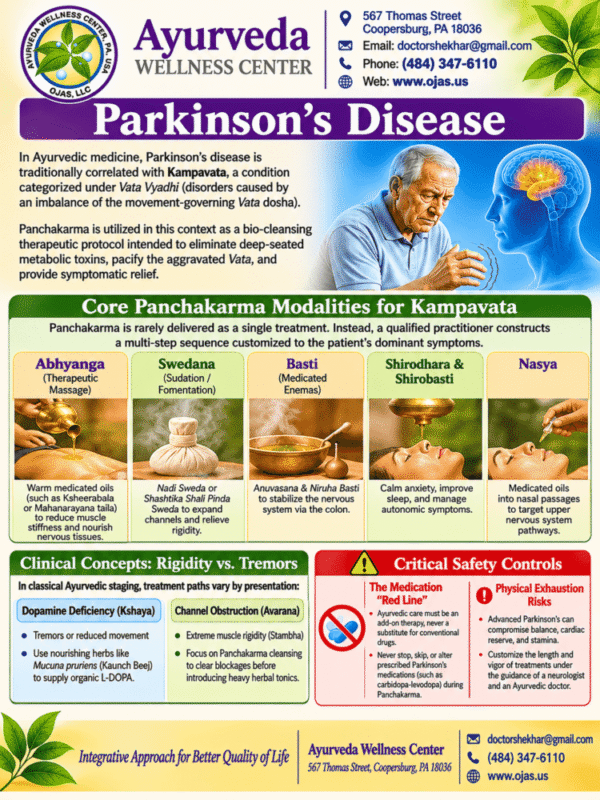
In Ayurvedic medicine, Parkinson’s disease is traditionally correlated with Kampavata, a condition categorized under Vata Vyadhi (disorders caused by an imbalance of the movement-governing Vata dosha). Panchakarma is utilized in this context as a bio-cleansing therapeutic protocol intended to eliminate deep-seated metabolic toxins, pacify the aggravated Vata, and provide symptomatic relief.
An overview of how Panchakarma is clinically structured for Parkinson’s disease highlights the primary modalities, mechanics, and essential safety guardrails:
🌀 Core Panchakarma Modalities for Kampavata
Panchakarma is rarely delivered as a single treatment. Instead, a qualified practitioner constructs a multi-step sequence customized to the patient’s dominant symptoms (such as rigidity vs. tremors):
- Abhyanga (Therapeutic Massage): Full-body, synchronized manual therapy utilizing specific warm, medicated oils (such as Ksheerabala or Mahanarayana taila). This serves as Snehana (oleation) to reduce localized muscle stiffness, nourish depleted neurological tissues, and improve peripheral circulation.
- Swedana (Sudation/Fomentation): Thermal therapies, such as Nadi Sweda (localized steam) or Shashtika Shali Pinda Sweda (massage with boluses of medicated rice boiled in milk and herbs). This step is designed to expand body channels (Srotas), liquefy deep-seated toxins, and relieve neuromuscular rigidity.
- Basti (Medicated Enemas): Considered the definitive cornerstone of Vata management. It utilizes alternating courses of Anuvasana Basti (oil-based enemas) and Niruha Basti (herbal decoction enemas). In Ayurvedic theory, the colon is the primary seat of Vata; targeting it is believed to help stabilize systemic nervous system functions.
- Shirodhara & Shirobasti: Focuses directly on the head. Shirodhara involves a continuous, rhythmic pouring of warm medicated oil across the forehead, while Shirobasti secures oil within a leather cap fitted to the scalp. These modalities are primarily leveraged to calm autonomic hyper-reactivity, manage anxiety, and improve sleep disturbances associated with Parkinson’s.
- Nasya (Nasal Administration): The introduction of medicated drops or oils into the nasal passages. This is utilized to directly stimulate the upper central nervous system pathing, targeting facial masking and vocal speech irregularities.
🧠 Clinical Concepts: Rigidity vs. Tremors
In classical Ayurvedic staging, treatment paths vary strictly by how the disease presents:
- Dopamine Deficiency (Kshaya): Presenting primarily as a shortage of movement, weakness, or tremors. Regimens favor highly nourishing, heavy herbs (like Mucuna pruriens or Kaunch Beej) to supply organic L-DOPA.
- Channel Obstruction (Avarana): Often presenting as extreme, unyielding muscle rigidity (Stambha), where metabolic blockages prevent normal neurological signals from firing cleanly. Adding natural L-DOPA immediately to this presentation is often ineffective. Protocols focus heavily on active Panchakarma cleansing to clear the blockages before introducing heavy herbal tonics.
⚠️ Critical Safety Controls
- The Medication “Red Line”: Traditional Ayurvedic care must be integrated as a complementary add-on therapy, never an alternative or substitute for conventional drugs. Never stop, skip, or alter prescribed conventional Parkinson’s medications (such as carbidopa-levodopa) during Panchakarma.
- Physical Exhaustion Risks: Advanced Parkinson’s can compromise balance, cardiac reserve, and stamina. Intensive Panchakarma cleansing can be physically exhausting. The length and vigor of treatments must be specifically adapted to match the patient’s mobility level and cardiovascular health under the combined guidance of a neurologist and an Ayurvedic doctor
Disclaimer: Ayurvedic treatments, especially Panchakarma, are powerful medical interventions. They should always be tailored to your specific Prakriti by a certified Ayurvedic Professional and discussed with your primary care provider.