Description
Shiatsu Massage Therapy
45 minutes: $175
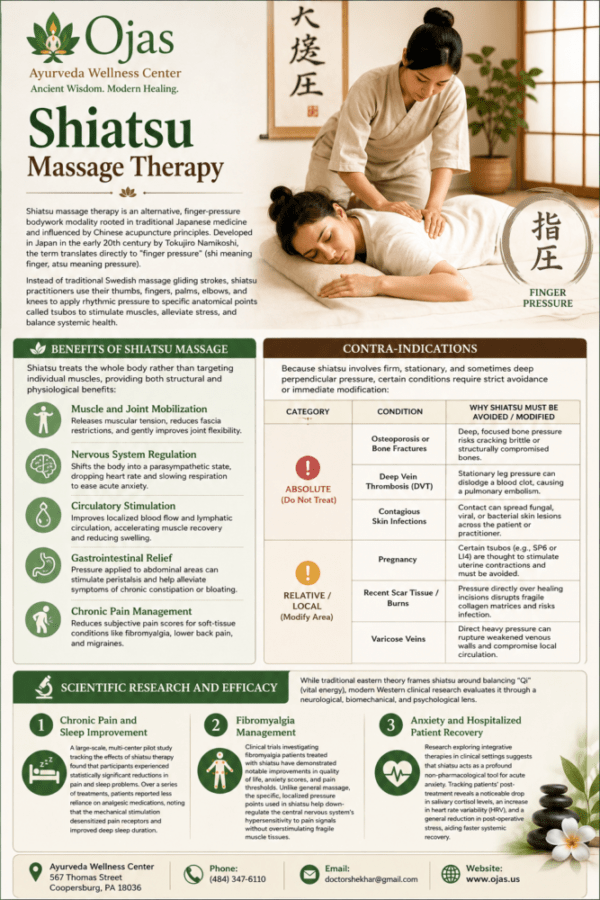
Shiatsu massage therapy is an alternative, finger-pressure bodywork modality rooted in traditional Japanese medicine and influenced by Chinese acupuncture principles. Developed in Japan in the early 20th century by Tokujiro Namikoshi, the term translates directly to “finger pressure” (shi meaning finger, atsu meaning pressure).
Instead of traditional Swedish massage gliding strokes, shiatsu practitioners use their thumbs, fingers, palms, elbows, and knees to apply rhythmic pressure to specific anatomical points called tsubos to stimulate muscles, alleviate stress, and balance systemic health.
Benefits of Shiatsu Massage
Shiatsu treats the whole body rather than targeting individual muscles, providing both structural and physiological benefits:
- Muscle and Joint Mobilization: Releases muscular tension, reduces fascia restrictions, and gently improves joint flexibility.
- Nervous System Regulation: Shifts the body into a parasympathetic state, dropping heart rate and slowing respiration to ease acute anxiety.
- Circulatory Stimulation: Improves localized blood flow and lymphatic circulation, accelerating muscle recovery and reducing swelling.
- Gastrointestinal Relief: Pressure applied to abdominal areas can stimulate peristalsis and help alleviate symptoms of chronic constipation or bloating.
- Chronic Pain Management: Reduces subjective pain scores for soft-tissue conditions like fibromyalgia, lower back pain, and migraines.
Contra-indications
Because shiatsu involves firm, stationary, and sometimes deep perpendicular pressure, certain conditions require strict avoidance or immediate modification:
| Category | Condition | Why Shiatsu Must Be Avoided / Modified |
| Absolute (Do Not Treat) | Osteoporosis or Bone Fractures | Deep, focused bone pressure risks cracking brittle or structurally compromised bones. |
| Deep Vein Thrombosis (DVT) | Stationary leg pressure can dislodge a blood clot, causing a pulmonary embolism. | |
| Contagious Skin Infections | Contact can spread fungal, viral, or bacterial skin lesions across the patient or practitioner. | |
| Relative / Local (Modify Area) | Pregnancy | Certain tsubos (e.g., SP6 or LI4) are thought to stimulate uterine contractions and must be avoided. |
| Recent Scar Tissue / Burns | Pressure directly over healing incisions disrupts fragile collagen matrices and risks infection. | |
| Varicose Veins | Direct heavy pressure can rupture weakened venous walls and compromise local circulation. |
Scientific Research and Efficacy
While traditional eastern theory frames shiatsu around balancing “Qi” (vital energy), modern Western clinical research evaluates it through a neurological, biomechanical, and psychological lens.
- Chronic Pain and Sleep Improvement
A large-scale, multi-center pilot study tracking the effects of shiatsu therapy found that participants experienced statistically significant reductions in pain and sleep problems. Over a series of treatments, patients reported less reliance on analgesic medications, noting that the mechanical stimulation desensitized pain receptors and improved deep sleep duration.
- Fibromyalgia Management
Clinical trials investigating fibromyalgia patients treated with shiatsu have demonstrated notable improvements in quality of life, anxiety scores, and pain thresholds. Unlike general massage, the specific, localized pressure points used in shiatsu help down-regulate the central nervous system’s hypersensitivity to pain signals without overstimulating fragile muscle tissues.
- Anxiety and Hospitalized Patient Recovery
Research exploring integrative therapies in clinical settings suggests that shiatsu acts as a profound non-pharmacological tool for acute anxiety. Tracking patients’ post-treatment reveals a noticeable drop in salivary cortisol levels, an increase in heart rate variability (HRV), and a general reduction in post-operative stress, aiding faster systemic recovery.