Description
35-Day Pancha Karma
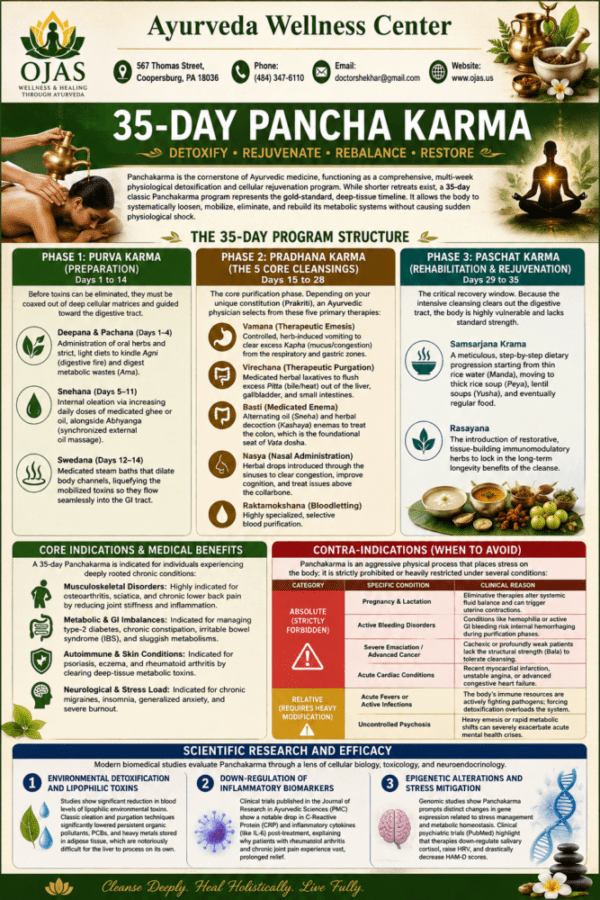
Panchakarma is the cornerstone of Ayurvedic medicine, functioning as a comprehensive, multi-week physiological detoxification and cellular rejuvenation program. While shorter retreats exist, a 35-day classic Panchakarma program represents the gold-standard, deep-tissue timeline. It allows the body to systematically loosen, mobilize, eliminate, and rebuild its metabolic systems without causing sudden physiological shock.
The 35-Day Program Structure
A 35-day timeline is mathematically partitioned into three distinct operational phases to ensure clinical safety and efficacy:
Phase 1: Purva Karma (Preparation) — Days 1 to 14
Before toxins can be eliminated, they must be coaxed out of deep cellular matrices and guided toward the digestive tract.
- Deepana & Pachana (Days 1–4): Administration of oral herbs and strict, light diets to kindle Agni (digestive fire) and digest metabolic wastes (Ama).
- Snehana (Days 5–11): Internal oleation via increasing daily doses of medicated ghee or oil, alongside Abhyanga (synchronized external oil massage) to lubricate bodily channels.
- Swedana (Days 12–14): Medicated steam baths that dilate body channels, liquefying the mobilized toxins so they flow seamlessly into the GI tract.
Phase 2: Pradhana Karma (The 5 Core Cleansings) — Days 15 to 28
The core purification phase. Depending on your unique constitution (Prakriti), an Ayurvedic physician selects from these five primary therapies:
- Vamana (Therapeutic Emesis): Controlled, herb-induced vomiting to clear excess Kapha (mucus/congestion) from the respiratory and gastric zones.
- Virechana (Therapeutic Purgation): Medicated herbal laxatives to flush excess Pitta (bile/heat) out of the liver, gallbladder, and small intestines.
- Basti (Medicated Enema): Alternating oil (Sneha) and herbal decoction (Kashaya) enemas to treat the colon, which is the foundational seat of Vata dosha.
- Nasya (Nasal Administration): Herbal drops introduced through the sinuses to clear congestion, improve cognition, and treat issues above the collarbone.
- Raktamokshana (Bloodletting): Highly specialized, selective blood purification
Phase 3: Paschat Karma (Rehabilitation & Rejuvenation) — Days 29 to 35
The critical recovery window. Because the intensive cleansing clears out the digestive tract, the body is highly vulnerable and lacks standard strength.
- Samsarjana Krama: A meticulous, step-by-step dietary progression starting from thin rice water (Manda), moving to thick rice soup (Peya), lentil soups (Yusha), and eventually regular food.
- Rasayana: The introduction of restorative, tissue-building immunomodulatory herbs to lock in the long-term longevity benefits of the cleanse.
Core Indications & Medical Benefits
A 35-day Panchakarma is indicated for individuals experiencing deeply rooted chronic conditions:
- Musculoskeletal Disorders: Highly indicated for osteoarthritis, sciatica, and chronic lower back pain by reducing joint stiffness and inflammation.
- Metabolic & GI Imbalances: Indicated for managing type-2 diabetes, chronic constipation, irritable bowel syndrome (IBS), and sluggish metabolisms.
- Autoimmune & Skin Conditions: Indicated for psoriasis, eczema, and rheumatoid arthritis by clearing deep-tissue metabolic toxins.
- Neurological & Stress Load: Indicated for chronic migraines, insomnia, generalized anxiety, and severe burnout.
Contra-indications (When to Avoid)
Panchakarma is an aggressive physical process that places stress on the body; it is strictly prohibited or heavily restricted under several conditions:
| Category | Specific Condition | Clinical Reason |
| Absolute (Strictly Forbidden) | Pregnancy & Lactation | Eliminative therapies alter systemic fluid balance and can trigger uterine contractions. |
| Active Bleeding Disorders | Conditions like hemophilia or active GI bleeding risk internal hemorrhaging during purification phases. | |
| Severe Emaciation / Advanced Cancer | Cachexic or profoundly weak patients lack the structural strength (Bala) to tolerate cleansing. | |
| Acute Cardiac Conditions | Recent myocardial infarction, unstable angina, or advanced congestive heart failure. | |
| Relative (Requires Heavy Modification) | Acute Fevers or Active Infections | The body’s immune resources are actively fighting pathogens; forcing detoxification overloads the system. |
| Uncontrolled Psychosis | Heavy emesis or rapid metabolic shifts can severely exacerbate acute mental health crises. |
Scientific Research and Efficacy
Modern biomedical studies evaluate Panchakarma through a lens of cellular biology, toxicology, and neuroendocrinology.
- Environmental Detoxification and Lipophilic Toxins
A well-known longitudinal study tracking individuals before and after a multi-day Panchakarma program demonstrated a significant reduction in blood levels of lipophilic (fat-soluble) environmental toxins. The research found that classic oleation and purgation techniques significantly lowered persistent organic pollutants, PCBs, and heavy metals stored in adipose tissue, which are notoriously difficult for the liver to process on its own.
- Down-regulation of Inflammatory Biomarkers
Clinical trials published in the Journal of Research in Ayurvedic Sciences (and indexed via PMC) have evaluated systemic inflammation markers before and after treatment. The data confirms a notable drop in C-Reactive Protein (CRP) and inflammatory cytokines (like IL-6) post-treatment, explaining why patients with rheumatoid arthritis and chronic joint pain experience vast, prolonged relief.
- Epigenetic Alterations and Stress Mitigation
Genomic studies evaluating intensive Ayurvedic interventions show that Panchakarma prompts distinct changes in gene expression related to stress management and metabolic homeostasis. Furthermore, clinical psychiatric trials published on PubMed highlight that the physical therapies down-regulate salivary cortisol, raise heart rate variability (HRV), and drastically decrease score metrics on the Hamilton Depression Rating Scale (HAM-D)
The provided Panchakarma cancellation policy outlines specific financial penalties and credits based on when a cancellation notice is submitted. The policy structures its fees strictly around the mandatory 50% upfront deposit rather than the total program cost.
Below is a clear structural breakdown of how this policy applying to your registration:
💳 Registration & Arrival Payments
- At Registration: A mandatory 50% deposit of the total Panchakarma program cost is due immediately to secure your dates.
- Upon Arrival: The remaining 50% balance is due in full. Once paid at arrival, this final amount is completely non-refundable.
📅 Cancellation Timelines & Financial Penalties
If you must cancel your program prior to your arrival date, your 50% deposit will be handled based on the following three distinct windows:
| Cancellation Window | Processing Fee (Kept by Center) | Remaining Balance Allocation |
| 30+ Days before start | 10% of your deposit is withheld | Credited toward a future program |
| 21 to 30 Days before start | 20% of your deposit is withheld | Credited toward a future program |
| Less than 21 Days before start | 100% of your deposit is withheld | Zero credit; the entire deposit is forfeited |
🧮 Hypothetical Scenario (For Clarity)
If your total Panchakarma program cost is $2,000, your upfront deposit at registration is $1,000. If you cancel:
- 35 days out: The center keeps $100 (10% of deposit). You receive a $900 credit for a future program.
- 25 days out: The center keeps $200 (20% of deposit). You receive an $800 credit for a future program.
- 15 days out: The center keeps the full $1,000 deposit. You receive zero credit.
If you would like help calculating the exact processing fees and future program credits for a specific package price, or if you need to review the scheduling availability for a future date, please let me know.