Description
Raja Yoga Training
8 CE Hours
Instructor: Shekhar Annambhotla
Experienced Registered Yoga Teacher (ERYT500) – # 13423
Ayurveda Wellness Center
567 Thomas Street, Coopersburg, PA 18036
Phone: (484) 347-6110
Email: doctorshekhar@gmail.com
Website: www.ojas.us
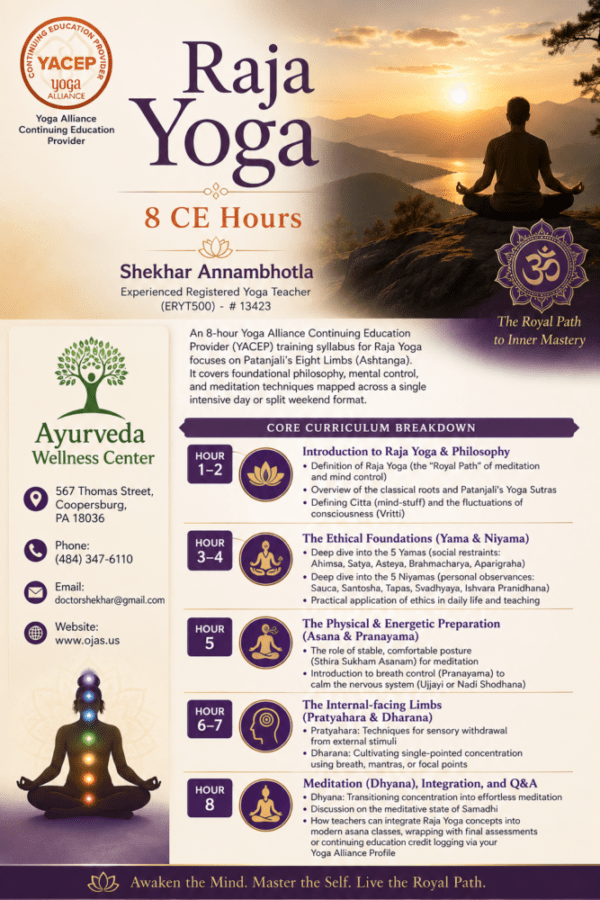
An 8-hour Yoga Alliance Continuing Education Provider (YACEP) training syllabus for Raja Yoga focuses on Patanjali’s Eight Limbs (Ashtanga). It covers foundational philosophy, mental control, and meditation techniques mapped across a single intensive day or split weekend format.
Raja Yoga (literally “Royal Yoga” or the “Royal Path”) is the ultimate path of meditation and mental control, famously systematized by the sage Patanjali in the Yoga Sutras. Unlike styles focused primarily on physical postures, Raja Yoga views the body merely as a vehicle to stabilize the mind, achieve deep concentration, and ultimately attain spiritual liberation (Samadhi).
The Core Framework: The Eight Limbs (Ashtanga)
Raja Yoga is structurally identical to Classical Yoga and is practiced through eight sequential stages outlined by Patanjali. The first four limbs prepare the physical and physiological body, while the final four focus strictly on mastering the mind:
- 1. Yama: Social ethics and restraints (e.g., non-violence, truthfulness, non-stealing).
- 2. Niyama: Personal practices and disciplines (e.g., purity, contentment, self-study).
- 3. Asana: Physical postures. In Raja Yoga, these are practiced purely to create a steady, comfortable seat for prolonged meditation.
- 4. Pranayama: Regulation of breath and life-force energy.
- 5. Pratyahara: Withdrawal of the senses from external distractions.
- 6. Dharana: Focused concentration on a single point or object.
- 7. Dhyana: Sustained, uninterrupted meditation.
- 8. Samadhi: Complete absorption, self-realization, and mental liberation.
Core Curriculum Breakdown
- Hour 1–2: Introduction to Raja Yoga & Philosophy
- Definition of Raja Yoga (the “Royal Path” of meditation and mind control)
- Overview of the classical roots and Patanjali’s Yoga Sutras
- Defining Citta (mind-stuff) and the fluctuations of consciousness (Vritti)
- Hour 3–4: The Ethical Foundations (Yama & Niyama)
- Deep dive into the 5 Yamas (social restraints: Ahimsa, Satya, Asteya, Brahmacharya, Aparigraha)
- Deep dive into the 5 Niyamas (personal observances: Sauca, Santosha, Tapas, Svadhyaya, Ishvara Pranidhana)
- Practical application of ethics in daily life and teaching
- Hour 5: The Physical & Energetic Preparation (Asana & Pranayama)
- The role of stable, comfortable posture (Sthira Sukham Asanam) for meditation
- Introduction to breath control (Pranayama) to calm the nervous system (Ujjayi or Nadi Shodhana)
- Hour 6–7: The Internal-facing Limbs (Pratyahara & Dharana)
- Pratyahara: Techniques for sensory withdrawal from external stimuli
- Dharana: Cultivating single-pointed concentration using breath, mantras, or focal points
- Hour 8: Meditation (Dhyana), Integration, and Q&A
- Dhyana: Transitioning concentration into effortless meditation
- Discussion on the meditative state of Samadhi
- How teachers can integrate Raja Yoga concepts into modern asana classes, wrapping with final assessments or continuing education credit logging via your Yoga Alliance Profile