Description
ITP – Immune Thrombocytopenia
Ayurveda Wellness Center, 567 Thomas Street, Coopersburg, PA 18036
Email: doctorshekhar@gmail.com
Phone: (484) 347-6110
Web: www.ojas.us
Thank you for your interest in an Ayurvedic Wellness Consultation!
We are delighted that you have chosen to take this important step toward improving your health and well-being through the wisdom of Ayurveda. We look forward to supporting you on your wellness journey.
To schedule your consultation, please complete the online consultation request form and submit it along with your payment using the link below:
Ayurvedic Wellness Consultation Request Form:
https://www.cognitoforms.com/Ayurveda4/AyurvedicWellnessConsultationRequest
Once we receive your completed form and payment, a member of our team will contact you to confirm your appointment and provide any additional information you may need.
If you have any questions before your consultation, please don’t hesitate to reach out. We are here to help and are honored to be part of your path to better health.
We look forward to meeting you and helping you achieve greater balance, vitality, and wellness.
With warm regards,
Ayurveda Wellness Center
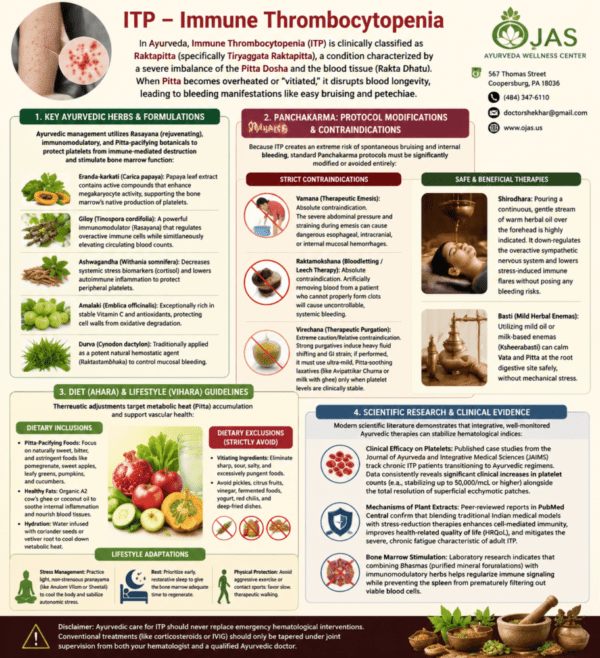
In Ayurveda, Immune Thrombocytopenia (ITP) is clinically classified as Raktapitta (specifically Tiryaggata Raktapitta), a condition characterized by a severe imbalance of the Pitta Dosha and the blood tissue (Rakta Dhatu). When Pitta becomes overheated or “vitiated,” it disrupts blood longevity, leading to bleeding manifestations like easy bruising and petechiae.
- Key Ayurvedic Herbs & Formulations
Ayurvedic management utilizes Rasayana (rejuvenating), immunomodulatory, and Pitta-pacifying botanicals to protect platelets from immune-mediated destruction and stimulate bone marrow function:
- Eranda-karkati (Carica papaya): Papaya leaf extract contains active compounds that enhance megakaryocyte activity, supporting the bone marrow’s native production of platelets.
- Giloy (Tinospora cordifolia): A powerful immunomodulator (Rasayana) that regulates overactive immune cells while simultaneously elevating circulating blood counts.
- Ashwagandha (Withania somnifera): Decreases systemic stress biomarkers (cortisol) and lowers autoimmune inflammation to protect peripheral platelets.
- Amalaki (Emblica officinalis): Exceptionally rich in stable Vitamin C and antioxidants, protecting cell walls from oxidative degradation.
- Durva (Cynodon dactylon): Traditionally applied as a potent natural hemostatic agent (Raktastambhaka) to control mucosal bleeding.
- Panchakarma: Protocol Modifications & Contraindications
Because ITP creates an extreme risk of spontaneous bruising and internal bleeding, standard Panchakarma protocols must be significantly modified or avoided entirely:
Strict Contraindications
- Vamana (Therapeutic Emesis): Absolute contraindication. The severe abdominal pressure and straining during emesis can cause dangerous esophageal, intracranial, or internal mucosal hemorrhages.
- Raktamokshana (Bloodletting / Leech Therapy): Absolute contraindication. Artificially removing blood from a patient who cannot properly form clots will cause uncontrollable, systemic bleeding.
- Virechana (Therapeutic Purgation): Extreme caution/Relative contraindication. Strong purgatives induce heavy fluid shifting and GI strain; if performed, it must use ultra-mild, Pitta-soothing laxatives (like Avipattikar Churna or milk with ghee) only when platelet levels are clinically stable.
Safe & Beneficial Therapies
- Shirodhara: Pouring a continuous, gentle stream of warm herbal oil over the forehead is highly indicated. It down-regulates the overactive sympathetic nervous system and lowers stress-induced immune flares without posing any bleeding risks
- Basti (Mild Herbal Enemas): Utilizing mild oil or milk-based enemas (Ksheerabasti) can calm Vata and Pitta at the root digestive site safely, without mechanical stress.
- Diet (Ahara) & Lifestyle (Vihara) Guidelines
Therapeutic adjustments target metabolic heat (Pitta) accumulation and support vascular health:
Dietary Inclusions
- Pitta-Pacifying Foods: Focus on naturally sweet, bitter, and astringent foods like pomegranate, sweet apples, leafy greens, pumpkins, and cucumbers.
- Healthy Fats: Organic A2 cow’s ghee or coconut oil to soothe internal inflammation and nourish blood tissues.
- Hydration: Water infused with coriander seeds or vetiver root to cool down metabolic heat.
Dietary Exclusions (Strictly Avoid)
- Vitiating Ingredients: Eliminate sharp, sour, salty, and excessively pungent foods. Avoid pickles, citrus fruits, vinegar, fermented foods, yogurt, red chilis, and deep-fried dishes.
Lifestyle Adaptations
- Stress Management: Practice light, non-strenuous pranayama (like Anulom Vilom or Sheetali) to cool the body and stabilize autonomic stress.
- Rest: Prioritize early, restorative sleep to give the bone marrow adequate time to regenerate.
- Physical Protection: Avoid aggressive exercise or contact sports; favor slow, therapeutic walking.
- Scientific Research & Clinical Evidence
Modern scientific literature demonstrates that integrative, well-monitored Ayurvedic therapies can stabilize hematological indices:
- Clinical Efficacy on Platelets: Published case studies from the Journal of Ayurveda and Integrative Medical Sciences (JAIMS) track chronic ITP patients transitioning to Ayurvedic regimens. Data consistently reveals significant clinical increases in platelet counts (e.g., stabilizing up to 50,000/mcL or higher) alongside the total resolution of superficial ecchymotic patches.
- Mechanisms of Plant Extracts: Peer-reviewed reports in PubMed Central confirm that blending traditional Indian medical models with stress-reduction therapies enhances cell-mediated immunity, improves health-related quality of life (HRQoL), and mitigates the severe, chronic fatigue characteristic of adult ITP.
- Bone Marrow Stimulation: Laboratory research indicates that combining Bhasmas (purified mineral formulations) with immunomodulatory herbs helps regularize immune signaling while preventing the spleen from prematurely filtering out viable blood cells.
Disclaimer: Ayurvedic care for ITP should never replace emergency hematological interventions. Conventional treatments (like corticosteroids or IVIG) should only be tapered under joint supervision from both your hematologist and a qualified Ayurvedic doctor