Description
Alzheimer’s disease (AD)
Ayurveda Wellness Center, 567 Thomas Street, Coopersburg, PA 18036
Email: doctorshekhar@gmail.com
Phone: (484) 347-6110
Web: www.ojas.us
Thank you for your interest in an Ayurvedic Wellness Consultation!
We are delighted that you have chosen to take this important step toward improving your health and well-being through the wisdom of Ayurveda. We look forward to supporting you on your wellness journey.
To schedule your consultation, please complete the online consultation request form and submit it along with your payment using the link below:
Ayurvedic Wellness Consultation Request Form:
https://www.cognitoforms.com/Ayurveda4/AyurvedicWellnessConsultationRequest
Once we receive your completed form and payment, a member of our team will contact you to confirm your appointment and provide any additional information you may need.
If you have any questions before your consultation, please don’t hesitate to reach out. We are here to help and are honored to be part of your path to better health.
We look forward to meeting you and helping you achieve greater balance, vitality, and wellness.
With warm regards,
Ayurveda Wellness Center
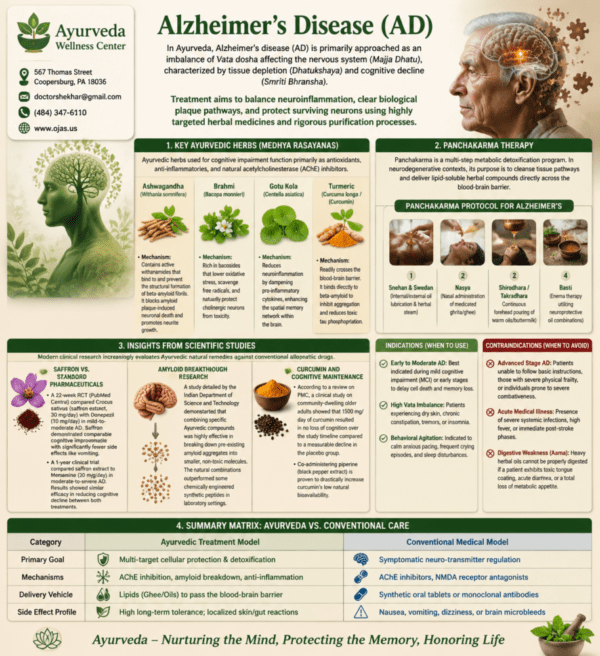
In Ayurveda, Alzheimer’s disease (AD) is primarily approached as an imbalance of Vata dosha affecting the nervous system (Majja Dhatu), characterized by tissue depletion (Dhatukshaya) and cognitive decline (Smriti Bhransha).
Treatment aims to balance neuroinflammation, clear biological plaque pathways, and protect surviving neurons using highly targeted herbal medicines and rigorous purification processes.
- Key Ayurvedic Herbs (Medhya Rasayanas)
Ayurvedic herbs used for cognitive impairment function primarily as antioxidants, anti-inflammatories, and natural acetylcholinesterase (AChE) inhibitors.
- Ashwagandha (Withania somnifera):
- Mechanism: Contains active withanamides that bind to and prevent the structural formation of beta-amyloid fibrils. It blocks amyloid plaque-induced neuronal death and promotes neurite growth.
- Brahmi (Bacopa monnieri):
- Mechanism: Rich in bacosides that lower oxidative stress, scavenge free radicals, and naturally protect cholinergic neurons from toxicity.
- Gotu Kola (Centella asiatica):
- Mechanism: Reduces neuroinflammation by dampening pro-inflammatory cytokines, enhancing the spatial memory network within the brain.
- Turmeric (Curcuma longa / Curcumin):
- Mechanism: Readily crosses the blood-brain barrier. It binds directly to beta-amyloid to inhibit aggregation and reduces toxic tau phosphorylation.
- Panchakarma Therapy
Panchakarma is a multi-step metabolic detoxification program. In neurodegenerative contexts, its purpose is to cleanse tissue pathways and deliver lipid-soluble herbal compounds directly across the blood-brain barrier.
Panchakarma Protocol for Alzheimer’s
- Snehan & Swedan (Internal/external oil lubrication & herbal steam)
- Nasya (Nasal administration of medicated ghrita/ghee)
- Shirodhara / Takradhara (Continuous forehead pouring of warm oils/buttermilk)
- Basti (Enema therapy utilizing neuroprotective oil combinations)
Indications (When to use)
- Early to Moderate AD: Best indicated during mild cognitive impairment (MCI) or early stages to delay cell death and memory loss.
- High Vata Imbalance: Patients experiencing dry skin, chronic constipation, tremors, or insomnia.
- Behavioral Agitation: Indicated to calm anxious pacing, frequent crying episodes, and sleep disturbances.
Contraindications (When to avoid)
- Advanced Stage AD: Patients unable to follow basic instructions, those with severe physical frailty, or individuals prone to severe combativeness
- Acute Medical Illness: Presence of severe systemic infections, high fever, or immediate post-stroke phases.
- Digestive Weakness (Aama): Heavy herbal oils cannot be properly digested if a patient exhibits toxic tongue coating, acute diarrhea, or a total loss of metabolic appetite.
- Insights from Scientific Studies
Modern clinical research increasingly evaluates Ayurvedic natural remedies against conventional allopathic drugs.
- Saffron vs. Standard Pharmaceuticals:
- A 22-week randomized controlled trial (RCT) published on PubMed Central compared Crocus sativus (saffron extract, 30 mg/day) directly with Donepezil (10 mg/day) in mild-to-moderate AD. Saffron demonstrated comparable cognitive improvements to the conventional drug, with significantly fewer side effects like vomiting.
- A longer 1-year clinical trial compared saffron extract to Memantine (20 mg/day) in moderate-to-severe AD. Results showed similar efficacy in reducing cognitive decline between both treatments.
- Amyloid Breakthrough Research:
- A study detailed by the Indian Department of Science and Technology demonstrated that combining specific Ayurvedic compounds was highly effective in breaking down pre-existing amyloid aggregates into smaller, non-toxic molecules. The natural combinations outperformed some chemically engineered synthetic peptides in laboratory settings.
- Curcumin and Cognitive Maintenance:
- According to a review on PMC, a clinical study on community-dwelling older adults showed that 1500 mg/day of curcumin resulted in no loss of cognition over the study timeline compared to a measurable decline in the placebo group. Co-administering piperine (black pepper extract) is proven to drastically increase curcumin’s low natural bioavailability.
- Summary Matrix: Ayurveda vs. Conventional Care
| Category | Ayurvedic Treatment Model | Conventional Medical Model |
| Primary Goal | Multi-target cellular protection & detoxification | Symptomatic neuro-transmitter regulation |
| Mechanisms | AChE inhibition, amyloid breakdown, anti-inflammation | AChE inhibitors, NMDA receptor antagonists |
| Delivery Vehicle | Lipids (Ghee/Oils) to pass the blood-brain barrier | Synthetic oral tablets or monoclonal antibodies |
| Side Effect Profile | High long-term tolerance; localized skin/gut reactions | Nausea, vomiting, dizziness, or brain microbleeds |