Description
Acne
Ayurveda Wellness Center, 567 Thomas Street, Coopersburg, PA 18036
Email: doctorshekhar@gmail.com
Phone: (484) 347-6110
Web: www.ojas.us
Thank you for your interest in an Ayurvedic Wellness Consultation!
We are delighted that you have chosen to take this important step toward improving your health and well-being through the wisdom of Ayurveda. We look forward to supporting you on your wellness journey.
To schedule your consultation, please complete the online consultation request form and submit it along with your payment using the link below:
Ayurvedic Wellness Consultation Request Form:
https://www.cognitoforms.com/Ayurveda4/AyurvedicWellnessConsultationRequest
Once we receive your completed form and payment, a member of our team will contact you to confirm your appointment and provide any additional information you may need.
If you have any questions before your consultation, please don’t hesitate to reach out. We are here to help and are honored to be part of your path to better health.
We look forward to meeting you and helping you achieve greater balance, vitality, and wellness.
With warm regards,
Ayurveda Wellness Center
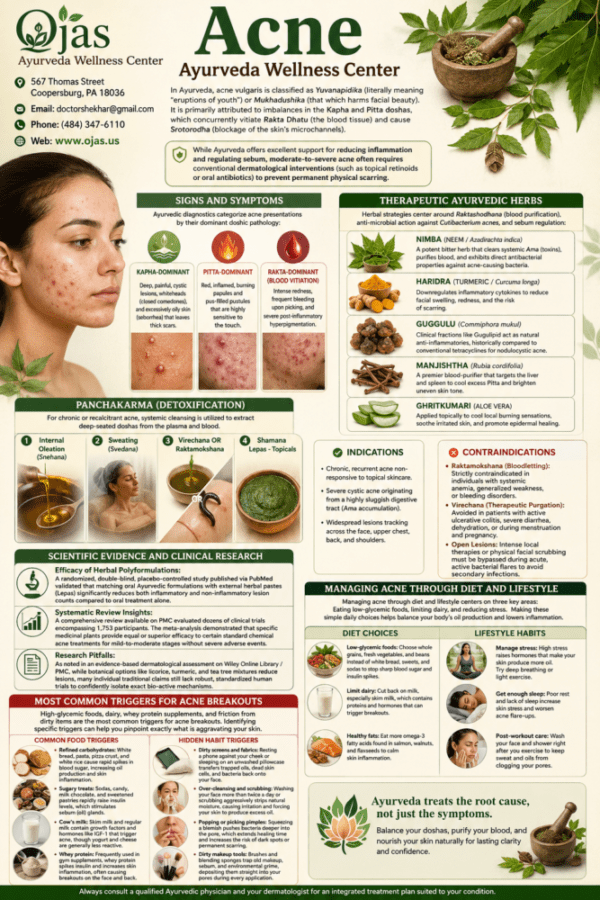
In Ayurveda, acne vulgaris is classified as Yuvanapidika (literally meaning “eruptions of youth”) or Mukhadushika (that which harms facial beauty). It is primarily attributed to imbalances in the Kapha and Pitta doshas, which concurrently vitiate Rakta Dhatu (the blood tissue) and cause Srotorodha (blockage of the skin’s microchannels).
While Ayurveda offers excellent support for reducing inflammation and regulating sebum, moderate-to-severe acne often requires conventional dermatological interventions (such as topical retinoids or oral antibiotics) to prevent permanent physical scarring.
Signs and Symptoms
Ayurvedic diagnostics categorize acne presentations by their dominant doshic pathology:
- Kapha-Dominant: Deep, painful, cystic lesions, whiteheads (closed comedones), and excessively oily skin (seborrhea) that leaves thick scars.
- Pitta-Dominant: Red, inflamed, burning papules and pus-filled pustules that are highly sensitive to the touch.
- Rakta-Dominant (Blood Vitiation): Intense redness, frequent bleeding upon picking, and severe post-inflammatory hyperpigmentation.
Therapeutic Ayurvedic Herbs
Herbal strategies center around Raktashodhana (blood purification), anti-microbial action against Cutibacterium acnes, and sebum regulation:
- Nimba (Neem / Azadirachta indica): A potent bitter herb that clears systemic Ama (toxins), purifies blood, and exhibits direct antibacterial properties against acne-causing bacteria.
- Haridra (Turmeric / Curcuma longa): Downregulates inflammatory cytokines to reduce facial swelling, redness, and the risk of scarring.
- Guggulu (Commiphora mukul): Clinical fractions like Gugulipid act as natural anti-inflammatories, historically compared to conventional tetracyclines for nodulocystic acne.
- Manjistha (Rubia cordifolia): A premier blood-purifier that targets the liver and spleen to cool excess Pitta and brighten uneven skin tone.
- Ghritkumari (Aloe vera): Applied topically to cool local burning sensations, soothe irritated skin, and promote epidermal healing.
Panchakarma (Detoxification)
For chronic or recalcitrant acne, systemic cleansing is utilized to extract deep-seated doshas from the plasma and blood.
- Internal Oleation / Snehana
- Sweating / Svedana
- Virechana OR Raktamokshana
- Shamana Lepas – Topicals
Indications
- Chronic, recurrent acne non-responsive to topical skincare.
- Severe cystic acne originating from a highly sluggish digestive tract (Ama accumulation).
- Widespread lesions tracking across the face, upper chest, back, and shoulders.
Contraindications
- Raktamokshana (Bloodletting): Strictly contraindicated in individuals with systemic anemia, generalized weakness, or bleeding disorders.
- Virechana (Therapeutic Purgation): Avoided in patients with active ulcerative colitis, severe diarrhea, dehydration, or during menstruation and pregnancy.
- Open Lesions: Intense local therapies or physical facial scrubbing must be bypassed during acute, active bacterial flares to avoid secondary infections.
Scientific Evidence and Clinical Research
Modern dermatological research increasingly cross-references traditional botanical interventions:
- Efficacy of Herbal Polyformulations: A randomized, double-blind, placebo-controlled study published via PubMed validated that matching oral Ayurvedic formulations with external herbal pastes (Lepas) significantly reduces both inflammatory and non-inflammatory lesion counts compared to oral treatment alone.
- Systematic Review Insights: A comprehensive review available on PMC evaluated dozens of clinical trials encompassing 1,753 participants. The meta-analysis demonstrated that specific medicinal plants provide equal or superior efficacy to certain standard chemical acne treatments for mild-to-moderate stages without severe adverse events.
- Research Pitfalls: As noted in an evidence-based dermatological assessment on Wiley Online Library / PMC, while botanical options like licorice, turmeric, and tea tree mixtures reduce lesions, many individual traditional claims still lack robust, standardized human trials to confidently isolate exact bio-active mechanisms.