Description
IBS – Irritable Bowel Syndrome
Ayurveda Wellness Center, 567 Thomas Street, Coopersburg, PA 18036
Email: doctorshekhar@gmail.com
Phone: (484) 347-6110
Web: www.ojas.us
Thank you for your interest in an Ayurvedic Wellness Consultation!
We are delighted that you have chosen to take this important step toward improving your health and well-being through the wisdom of Ayurveda. We look forward to supporting you on your wellness journey.
To schedule your consultation, please complete the online consultation request form and submit it along with your payment using the link below:
Ayurvedic Wellness Consultation Request Form:
https://www.cognitoforms.com/Ayurveda4/AyurvedicWellnessConsultationRequest
Once we receive your completed form and payment, a member of our team will contact you to confirm your appointment and provide any additional information you may need.
If you have any questions before your consultation, please don’t hesitate to reach out. We are here to help and are honored to be part of your path to better health.
We look forward to meeting you and helping you achieve greater balance, vitality, and wellness.
With warm regards,
Ayurveda Wellness Center
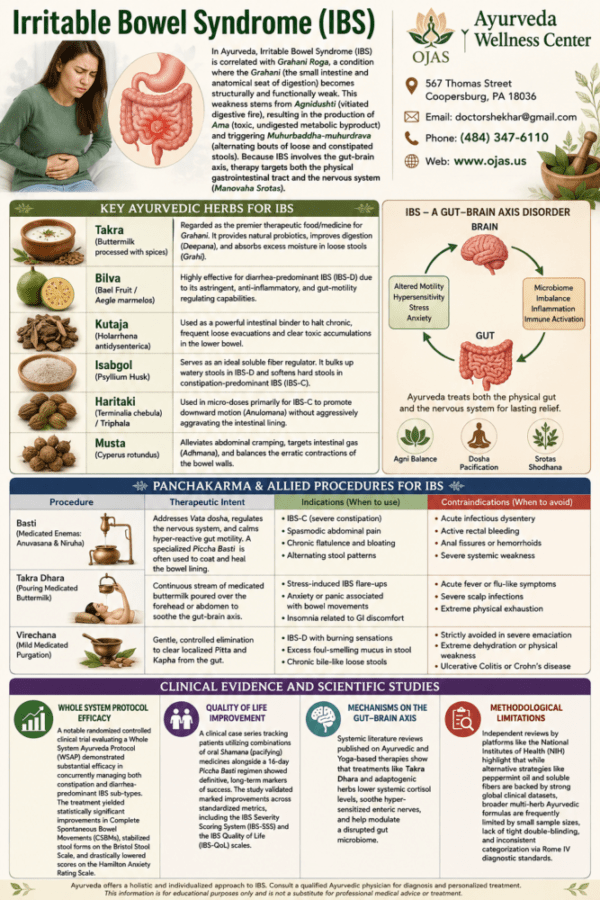
In Ayurveda, Irritable Bowel Syndrome (IBS) is correlated with Grahani Roga, a condition where the Grahani (the small intestine and anatomical seat of digestion) becomes structurally and functionally weak. This weakness stems from Agnidushti (vitiated digestive fire), resulting in the production of Ama (toxic, undigested metabolic byproduct) and triggering Muhurbaddha-muhurdrava (alternating bouts of loose and constipated stools). Because IBS involves the gut-brain axis, therapy targets both the physical gastrointestinal tract and the nervous system (Manovaha Srotas).
Key Ayurvedic Herbs for IBS
Herbal therapy for IBS is highly dependent on the predominant sub-type (Vata/Constipation, Pitta/Diarrhea, or Kapha/Mucus-heavy).
- Takra (Buttermilk processed with spices): Regarded as the premier therapeutic food/medicine for Grahani. It provides natural probiotics, improves digestion (Deepana), and absorbs excess moisture in loose stools (Grahi).
- Bilva (Bael Fruit / Aegle marmelos): Highly effective for diarrhea-predominant IBS (IBS-D) due to its astringent, anti-inflammatory, and gut-motility regulating capabilities.
- Kutaja (Holarrhena antidysenterica): Used as a powerful intestinal binder to halt chronic, frequent loose evacuations and clear toxic accumulations in the lower bowel.
- Isabgol (Psyllium Husk): Serves as an ideal soluble fiber regulator. It bulks up watery stools in IBS-D and softens hard stools in constipation-predominant IBS (IBS-C).
- Haritaki (Terminalia chebula) / Triphala: Used in micro-doses primarily for IBS-C to promote downward motion (Anulomana) without aggressively aggravating the intestinal lining.
- Musta (Cyperus rotundus): Alleviates abdominal cramping, targets intestinal gas (Adhmana), and balances the erratic contractions of the bowel walls.
Panchakarma & Allied Procedures for IBS
Because IBS features high gut hypersensitivity, intense or aggressive purification protocols are typically restricted. Gentle, nourishing, and localized treatments are favored instead.
| Procedure | Therapeutic Intent | Indications (When to use) | Contraindications (When to avoid) |
| Basti (Medicated Enemas: Anuvasana & Niruha) | Addresses Vata dosha, regulates the nervous system, and calms hyper-reactive gut motility. A specialized Piccha Basti is often used to coat and heal the bowel lining. | • IBS-C (severe constipation) • Spasmodic abdominal pain • Chronic flatulence and bloating • Alternating stool patterns | • Acute infectious dysentery • Active rectal bleeding • Anal fissures or hemorrhoids • Severe systemic weakness |
| Takra Dhara (Pouring Medicated Buttermilk) | Continuous stream of medicated buttermilk poured over the forehead or abdomen to soothe the gut-brain axis. | • Stress-induced IBS flare-ups • Anxiety or panic associated with bowel movements • Insomnia related to GI discomfort | • Acute fever or flu-like symptoms • Severe scalp infections • Extreme physical exhaustion |
| Virechana (Mild Medicated Purgation) | Gentle, controlled elimination to clear localized Pitta and Kapha from the gut. | • IBS-D with burning sensations • Excess foul-smelling mucus in stool • Chronic bile-like loose stools | • Strictly avoided in severe emaciation • Extreme dehydration or physical weakness • Ulcerative Colitis or Crohn’s disease |
Clinical Evidence and Scientific Studies
Modern peer-reviewed evidence evaluating traditional Ayurvedic approaches highlights the following:
- Whole System Protocol Efficacy: A notable randomized controlled clinical trial evaluating a Whole System Ayurveda Protocol (WSAP) demonstrated substantial efficacy in concurrently managing both constipation and diarrhea-predominant IBS sub-types. The treatment yielded statistically significant improvements in Complete Spontaneous Bowel Movements (CSBMs), stabilized stool forms on the Bristol Stool Scale, and drastically lowered scores on the Hamilton Anxiety Rating Scale.
- Quality of Life Improvement: A clinical case series tracking patients utilizing combinations of oral Shamana (pacifying) medicines alongside a 16-day Piccha Basti regimen showed definitive, long-term markers of success. The study validated marked improvements across standardized metrics, including the IBS Severity Scoring System (IBS-SSS) and the IBS Quality of Life (IBS-QoL) scales.
- Mechanisms on the Gut-Brain Axis: Systemic literature reviews published on Ayurvedic and Yoga-based therapies show that treatments like Takra Dhara and adaptogenic herbs lower systemic cortisol levels, soothe hyper-sensitized enteric nerves, and help modulate a disrupted gut microbiome.
- Methodological Limitations: Independent reviews by platforms like the National Institutes of Health (NIH) highlight that while alternative strategies like peppermint oil and soluble fibers are backed by strong global clinical datasets, broader multi-herb Ayurvedic formulas are frequently limited by small sample sizes, lack of tight double-blinding, and inconsistent categorization via Rome IV diagnostic standards.