Description
Amenorrhea
Ayurveda Wellness Center, 567 Thomas Street, Coopersburg, PA 18036
Email: doctorshekhar@gmail.com
Phone: (484) 347-6110
Web: www.ojas.us
Thank you for your interest in an Ayurvedic Wellness Consultation!
We are delighted that you have chosen to take this important step toward improving your health and well-being through the wisdom of Ayurveda. We look forward to supporting you on your wellness journey.
To schedule your consultation, please complete the online consultation request form and submit it along with your payment using the link below:
Ayurvedic Wellness Consultation Request Form:
https://www.cognitoforms.com/Ayurveda4/AyurvedicWellnessConsultationRequest
Once we receive your completed form and payment, a member of our team will contact you to confirm your appointment and provide any additional information you may need.
If you have any questions before your consultation, please don’t hesitate to reach out. We are here to help and are honored to be part of your path to better health.
We look forward to meeting you and helping you achieve greater balance, vitality, and wellness.
With warm regards,
Ayurveda Wellness Center
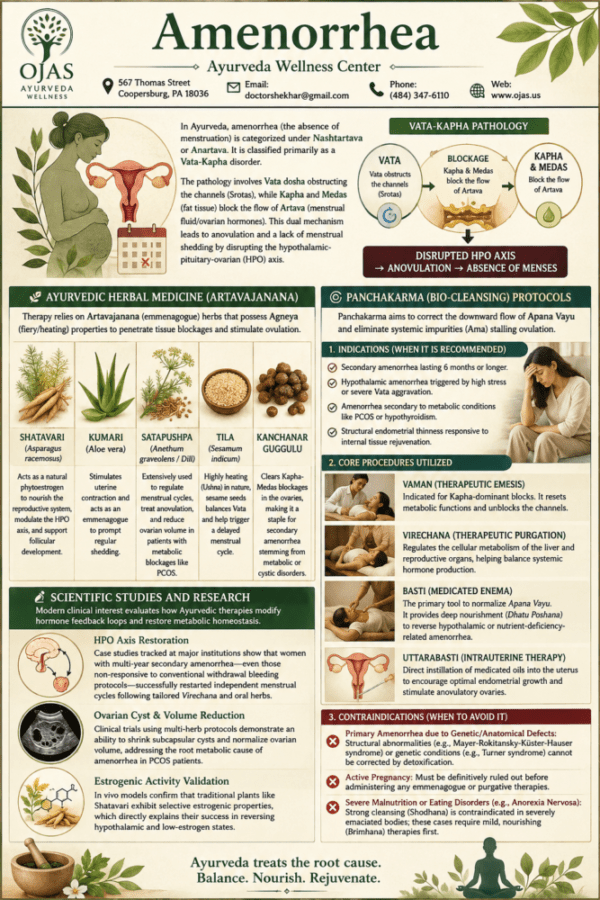
In Ayurveda, amenorrhea (the absence of menstruation) is categorized under Nashtartava or Anartava. It is classified primarily as a Vata-Kapha disorder. The pathology involves Vata dosha obstructing the channels (Srotas), while Kapha and Medas (fat tissue) block the flow of Artava (menstrual fluid/ovarian hormones). This dual mechanism leads to anovulation and a lack of menstrual shedding by disrupting the hypothalamic-pituitary-ovarian (HPO) axis.
🌿 Ayurvedic Herbal Medicine (Artavajanana)
Therapy relies on Artavajanana (emmenagogue) herbs that possess Agneya (fiery/heating) properties to penetrate tissue blockages and stimulate ovulation.
- Shatavari (Asparagus racemosus): Acts as a natural phytoestrogen to nourish the reproductive system, modulate the HPO axis, and support follicular development.
- Kumari (Aloe vera): Stimulates uterine contraction and acts as an emmenagogue to prompt regular shedding.
- Satapushpa (Anethum graveolens / Dill): Extensively used to regulate menstrual cycles, treat anovulation, and reduce ovarian volume in patients with metabolic blockages like PCOS.
- Tila (Sesamum indicum): Highly heating (Ushna) in nature, sesame seeds balances Vata and help trigger a delayed menstrual cycle.
- Kanchanar Guggulu: Clears Kapha-Medas blockages in the ovaries, making it a staple for secondary amenorrhea stemming from metabolic or cystic disorders.
🌀 Panchakarma (Bio-Cleansing) Protocols
Panchakarma aims to correct the downward flow of Apana Vayu and eliminate systemic impurities (Ama) stalling ovulation.
- Indications (When it is recommended)
- Secondary amenorrhea lasting 6 months or longer.
- Hypothalamic amenorrhea triggered by high stress or severe Vata aggravation.
- Amenorrhea secondary to metabolic conditions like PCOS or hypothyroidism.
- Structural endometrial thinness responsive to internal tissue rejuvenation.
- Core Procedures Utilized
- Vaman (Therapeutic Emesis): Indicated for Kapha-dominant blocks. It resets metabolic functions and unblocks the channels.
- Virechana (Therapeutic Purgation): Regulates the cellular metabolism of the liver and reproductive organs, helping balance systemic hormone production.
- Basti (Medicated Enema): The primary tool to normalize Apana Vayu. It provides deep nourishment (Dhatu Poshana) to reverse hypothalamic or nutrient-deficiency-related amenorrhea.
- Uttarabasti (Intrauterine Therapy): Direct instillation of medicated oils into the uterus to encourage optimal endometrial growth and stimulate anovulatory ovaries.
- Contraindications (When to avoid it)
- Primary Amenorrhea due to Genetic/Anatomical Defects: Structural abnormalities (e.g., Mayer-Rokitansky-Küster-Hauser syndrome) or genetic conditions (e.g., Turner syndrome) cannot be corrected by detoxification.
- Active Pregnancy: Must be definitively ruled out before administering any emmenagogue or purgative therapies.
- Severe Malnutrition or Eating Disorders (e.g., Anorexia Nervosa): Strong cleansing (Shodhana) is contraindicated in severely emaciated bodies; these cases require mild, nourishing (Brimhana) therapies first.
🔬 Scientific Studies and Research
Modern clinical interest evaluates how Ayurvedic therapies modify hormone feedback loops and restore metabolic homeostasis.
- HPO Axis Restoration: Case studies tracked at major institutions show that women with multi-year secondary amenorrhea—even those non-responsive to conventional withdrawal bleeding protocols—successfully restarted independent menstrual cycles following tailored Virechana and oral herbs.
- Ovarian Cyst & Volume Reduction: Clinical trials using multi-herb protocols demonstrate an ability to shrink subcapsular cysts and normalize ovarian volume, addressing the root metabolic cause of amenorrhea in PCOS patients.
- Estrogenic Activity Validation: In vivo models confirm that traditional plants like Shatavari exhibit selective estrogenic properties, which directly explains their success in reversing hypothalamic and low-estrogen states