Description
Migraine
5 days / $2500
Thank you for your interest in our Ayurveda Wellness Programs.
Each individual’s health condition will be thoroughly assessed during the initial Ayurvedic Wellness Consultation. Based on the consultation, a personalized wellness regimen and lifestyle protocol will be developed for you to follow at home. Depending on your specific health needs and progress, we may recommend a 5-day Wellness Program or an extended Panchakarma program of 7, 10, 14, 21, or 28 days.
To begin the process, please complete the Personalized Ayurvedic Wellness Consultation Request Form:
https://www.cognitoforms.com/Ayurveda4/AyurvedicWellnessConsultationRequest
Thank you very much. I look forward to working with you.
Warm regards,
Shekhar Annambhotla
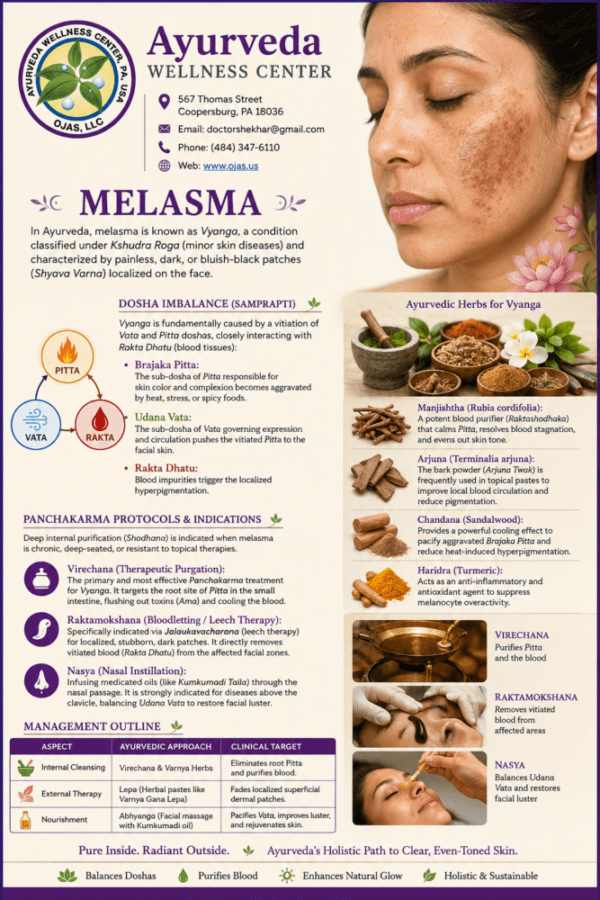
In Ayurveda, melasma is known as Vyanga, a condition classified under Kshudra Roga (minor skin diseases) and characterized by painless, dark, or bluish-black patches (Shyava Varna) localized on the face.
Dosha Imbalance (Samprapti)
Vyanga is fundamentally caused by a vitiation of Vata and Pitta doshas, closely interacting with Rakta Dhatu (blood tissues):
- Brajaka Pitta: The sub-dosha of Pitta responsible for skin color and complexion becomes aggravated by heat, stress, or spicy foods.
- Udana Vata: The sub-dosha of Vata governing expression and circulation pushes the vitiated Pitta to the facial skin.
- Rakta Dhatu: Blood impurities trigger the localized hyperpigmentation.
Panchakarma Protocols & Indications
Deep internal purification (Shodhana) is indicated when melasma is chronic, deep-seated, or resistant to topical therapies.
- Virechana (Therapeutic Purgation): The primary and most effective Panchakarma treatment for Vyanga. It targets the root site of Pitta in the small intestine, flushing out toxins (Ama) and cooling the blood.
- Raktamokshana (Bloodletting / Leech Therapy): Specifically indicated via Jalaukavacharana (leech therapy) for localized, stubborn, dark patches. It directly removes vitiated blood (Rakta Dhatu) from the affected facial zones.
- Nasya (Nasal Instillation): Infusing medicated oils (like Kumkumadi Taila) through the nasal passage. It is strongly indicated for diseases above the clavicle, balancing Udana Vata to restore facial luster.
Key Ayurvedic Herbs
Herbs used for Vyanga generally fall under Varnya Gana (complexion-enhancing herbs):
- Manjishtha (Rubia cordifolia): A potent blood purifier (Raktashodhaka) that calms Pitta, resolves blood stagnation, and evens out skin tone.
- Arjuna (Terminalia arjuna): The bark powder (Arjuna Twak) is frequently used in topical pastes to improve local blood circulation and reduce pigmentation.
- Chandana (Sandalwood): Provides a powerful cooling effect to pacify aggravated Brajaka Pitta and reduce heat-induced hyperpigmentation.
- Haridra (Turmeric): Acts as an anti-inflammatory and antioxidant agent to suppress melanocyte overactivity.
Management Outline
| Aspect | Ayurvedic Approach | Clinical Target |
| Internal Cleansing | Virechana & Varnya Herbs | Eliminates root Pitta and purifies blood. |
| External Therapy | Lepa (Herbal pastes like Varnya Gana Lepa) | Fades localized superficial dermal patches. |
| Nourishment | Abhyanga (Facial massage with Kumkumadi oil) | Pacifies Vata, improves luster, and rejuvenates skin. |
*This program is not evaluated by FDA and this program in not intended to diagnosis, treatment, cure or prevent any disease.