
Gut Health and the Microbiome: Manjiri Nadkarni

- 1 Section
- 1 Lesson
Getting started
1 Lesson
Manjiri Nadkarni, BAMS, MD (Ayu), RHN, NNCP, ONC™ is an Ayurvedic vaidya and integrative nutrition consultant with 15 years of clinical practice in Canada. She works at the intersection of Ayurvedic medicine and functional nutrition, specializing in digestive health, metabolic medicine, and oncology nutrition support. Manjiri serves as faculty for the Ayurveda Practitioner Program at Southern California University of Health Sciences (SCUHS), holds two peer-reviewed publications in AYU journal, and co-founded the Ayurveda Association of Canada. She sees clients in Sarnia, Ontario and virtually across Canada and internationally. Her core belief: food is medicine -- real food for your real body.
Gut Health and the Microbiome: Correlating Agni with Modern Gastroenterology
This is an excellent topic for an Ayurveda–modern medicine integrative lecture, particularly because contemporary gastroenterology increasingly recognizes the gut as an ecosystem involving digestion, microbial metabolism, immunity, the intestinal barrier, and the gut–brain axis. NIDDK describes the microbiome as participating in digestion, nutrient metabolism, immune regulation, inflammation, barrier function, and gut–brain signaling.
1. Agni: More Than "Digestive Fire"
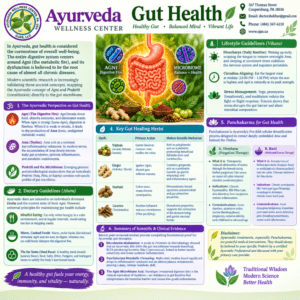
In Ayurveda, Agni can be presented as a functional concept encompassing the body's capacity to:
- Digest food
- Transform nutrients
- Absorb and assimilate
- Maintain metabolic balance
- Support tissue nourishment
- Participate in resistance to disease
- Maintain physiological homeostasis
Ayurveda describes Jatharagni as central to gastrointestinal digestion and recognizes Bhutagni and Dhatvagni as additional levels of transformation. Contemporary reviews emphasize that these Ayurvedic categories should be regarded as conceptual physiological frameworks rather than direct one-to-one anatomical equivalents.
2. Agni and the Gut Microbiome
A useful integrative model is:
| Ayurvedic concept | Modern gastroenterology/microbiome concept |
|---|---|
| Jatharagni | Gastrointestinal digestive processes |
| Agni | Integrated digestion, metabolism and host–microbial homeostasis |
| Samagni | Balanced digestive function and physiological homeostasis |
| Mandagni | Conceptual model of impaired digestive/metabolic function |
| Vishamagni | Variable/irregular digestive function |
| Tikshnagni | Excessively intense digestive pattern |
| Ama | Not equivalent to a specific biomedical substance; may be explored conceptually through incomplete digestion, altered metabolites, inflammation and dysbiosis |
| Grahani | Functional integrity of digestion, absorption and intestinal regulation |
| Agni–Manas relationship | Gut–brain axis |
| Dosha influences | Individual variability in GI function, motility, metabolism and response to diet |
Recent 2026 reviews specifically explore the relationship between Agni and gut microbiota, proposing that Agni may provide an Ayurvedic framework for understanding digestion and metabolic homeostasis, while acknowledging that direct scientific equivalence has not yet been established.
3. Where the Correlation Becomes Particularly Interesting
Diet → digestion → microbiome → metabolites → host response
Modern research shows that what we eat influences the intestinal microbial community. Microbes, in turn, produce metabolites and interact with intestinal epithelial cells and the immune system. These interactions can influence metabolic regulation, inflammation and the gut–brain axis.
This provides an interesting parallel to the Ayurvedic sequence:
Ahara → Agni → Ahara Rasa → Dhatu nourishment → Ojas/health
A modern interpretation could be expressed as:
Food → digestion & absorption → microbial metabolism → metabolites → immune/metabolic signaling → systemic health
The two models are not identical, but they ask remarkably similar high-level questions: How does food become nourishment, and how does digestive function influence the health of the whole person?
4. Agni, Ama and Dysbiosis
One of the most important distinctions for a scientifically responsible presentation is:
Ama should not simply be translated as "toxins" or equated directly with dysbiosis.
Some recent Ayurvedic literature proposes conceptual parallels between Ama, altered microbial metabolism, dysbiosis and inflammatory processes.
However, dysbiosis is a biomedical description of an altered microbial ecosystem, whereas Ama is an Ayurvedic pathological concept with a broader meaning.
Therefore, a stronger academic formulation is:
"Ama and dysbiosis may be studied as partially overlapping conceptual frameworks, but they are not scientifically synonymous."
5. The Gut–Brain Axis
This is perhaps one of the strongest bridges between the two disciplines.
Modern gastroenterology recognizes communication among:
Gut ↔ microbiota ↔ enteric nervous system ↔ immune system ↔ endocrine signaling ↔ brain
Ayurveda provides a broader functional framework involving Agni, Vata, Manas, Ahara and physiological balance.
Current research programs specifically examine microbiome involvement in gut–brain signaling, microbial metabolites, bile acids and host physiology.
6. A Proposed Integrative Clinical Framework
For an Ayurveda practitioner working alongside gastroenterologists, the discussion could move from "What is the patient's microbiome?" to a broader assessment:
Ayurveda
- Prakriti
- Vikriti
- Agni
- Koshta
- Ahara
- Vihara
- Mala
- Ama-related clinical features
- Manas/stress
- Sleep and daily routine
Modern gastroenterology
- GI symptoms
- Motility
- Digestion and absorption
- Intestinal barrier
- Inflammation
- Microbiome
- Metabolic markers
- Liver–gut axis
- Gut–brain axis
- Appropriate diagnostic testing
This creates a systems-biology approach rather than trying to force one medical vocabulary into the other.
7. The Important Scientific Caveat
The most defensible conclusion is not:
"Agni is the gut microbiome."
Rather:
"Agni is an Ayurvedic functional model of digestion and metabolism that may provide a useful conceptual framework for studying aspects of gastrointestinal, metabolic and host–microbial homeostasis."
Recent literature supports exploring this relationship, but also emphasizes that objective biomarkers and mechanistic studies are still needed to establish whether particular states of Agni correspond to measurable microbiome, metabolic or physiological signatures.
Want to submit a review? Login