Description
5 days / $2500
Thank you for your interest in our Ayurveda Wellness Programs.
Each individual’s health condition will be thoroughly assessed during the initial Ayurvedic Wellness Consultation. Based on the consultation, a personalized wellness regimen and lifestyle protocol will be developed for you to follow at home. Depending on your specific health needs and progress, we may recommend a 5-day Wellness Program or an extended Panchakarma program of 7, 10, 14, 21, or 28 days.
To begin the process, please complete the Personalized Ayurvedic Wellness Consultation Request Form:
https://www.cognitoforms.com/Ayurveda4/AyurvedicWellnessConsultationRequest
Thank you very much. I look forward to working with you.
Warm regards,
Shekhar Annambhotla
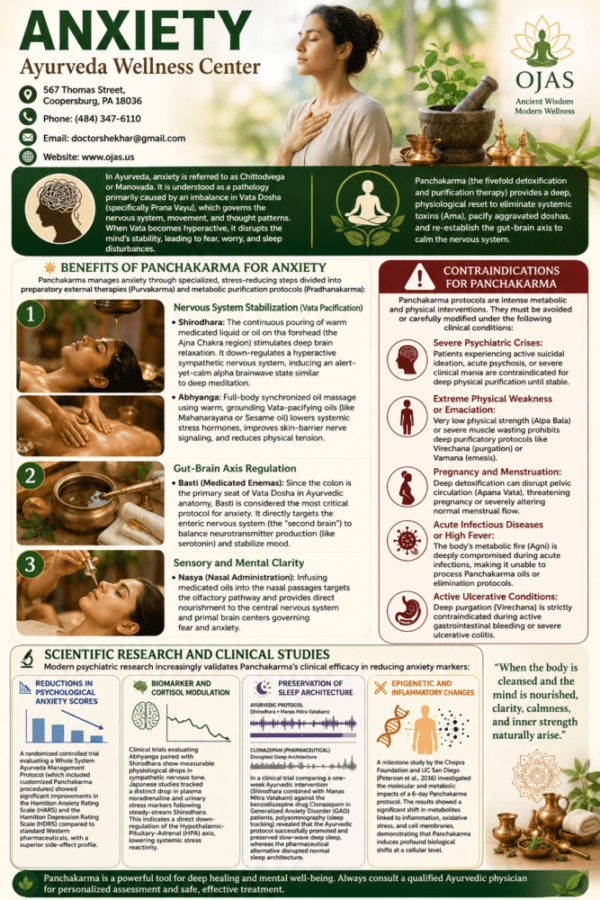
In Ayurveda, anxiety is referred to as Chittodvega or Manovada. It is understood as a pathology primarily caused by an imbalance in Vata Dosha (specifically Prana Vayu), which governs the nervous system, movement, and thought patterns. When Vata becomes hyperactive, it disrupts the mind’s stability, leading to fear, worry, and sleep disturbances.
Panchakarma (the fivefold detoxification and purification therapy) provides a deep, physiological reset to eliminate systemic toxins (Ama), pacify aggravated doshas, and re-establish the gut-brain axis to calm the nervous system.
🌟 Benefits of Panchakarma for Anxiety
Panchakarma manages anxiety through specialized, stress-reducing steps divided into preparatory external therapies (Purvakarma) and metabolic purification protocols (Pradhanakarma):
- Nervous System Stabilization (Vata Pacification)
- Shirodhara: The continuous pouring of warm medicated liquid or oil on the forehead (the Ajna Chakra region) stimulates deep brain relaxation. It down-regulates a hyperactive sympathetic nervous system, inducing an alert-yet-calm alpha brainwave state similar to deep meditation.
- Abhyanga: Full-body synchronized oil massage using warm, grounding Vata-pacifying oils (like Mahanarayana or Sesame oil) lowers systemic stress hormones, improves skin-barrier nerve signaling, and reduces physical tension.
- Gut-Brain Axis Regulation
- Basti (Herbal Enemas): Since the colon is the primary seat of Vata Dosha in Ayurvedic anatomy, Basti is considered the most critical protocol for anxiety. It directly targets the enteric nervous system (the “second brain”) to balance neurotransmitter production (like serotonin) and stabilize mood.
- Sensory and Mental Clarity
- Nasya (Nasal Administration): Infusing medicated oils into the nasal passages targets the olfactory pathway and provides direct nourishment to the central nervous system and primal brain centers governing fear and anxiety.
⚠️ Contraindications for Panchakarma
Panchakarma protocols are intense metabolic and physical interventions. They must be avoided or carefully modified under the following clinical conditions:
- Severe Psychiatric Crises: Patients experiencing active suicidal ideation, acute psychosis, or severe clinical mania are contraindicated for deep physical purification until stable.
- Extreme Physical Weakness or Emaciation: Very low physical strength (Alpa Bala) or severe muscle wasting prohibits deep purificatory protocols like Virechana (purgation) or Vamana (emesis).
- Pregnancy and Menstruation: Deep detoxification can disrupt pelvic circulation (Apana Vata), threatening pregnancy or severely altering normal menstrual flow.
- Acute Infectious Diseases or High Fever: The body’s metabolic fire (Agni) is deeply compromised during acute infections, making it unable to process Panchakarma oils or elimination protocols.
- Active Ulcerative Conditions: Deep purgation (Virechana) is strictly contraindicated during active gastrointestinal bleeding or severe ulcerative colitis.
🔬 Scientific Research and Clinical Studies
Modern psychiatric research increasingly validates Panchakarma’s clinical efficacy in reducing anxiety markers:
📉 Reductions in Psychological Anxiety Scores
A randomized controlled trial evaluating a Whole System Ayurveda Management Protocol (which included customized Panchakarma procedures) showed significant improvements in the Hamilton Anxiety Rating Scale (HARS) and the Hamilton Depression Rating Scale (HDRS) compared to standard Western pharmaceuticals, with a superior side-effect profile.
🧠 Biomarker and Cortisol Modulation
Clinical trials evaluating Abhyanga paired with Shirodhara show measurable physiological drops in sympathetic nervous tone. Japanese studies tracked a distinct drop in plasma noradrenaline and urinary stress markers following steady-stream Shirodhara. This indicates a direct down-regulation of the Hypothalamic-Pituitary-Adrenal (HPA) axis, lowering systemic stress reactivity.
💤 Preservation of Sleep Architecture
In a clinical trial comparing a one-week Ayurvedic intervention (Shirodhara combined with Manas Mitra Vatakam) against the benzodiazepine drug Clonazepam in Generalized Anxiety Disorder (GAD) patients, polysomnography (sleep tracking) revealed that the Ayurvedic protocol successfully promoted and preserved slow-wave deep sleep, whereas the pharmaceutical alternative disrupted normal sleep architecture.
🧬 Epigenetic and Inflammatory Changes
A milestone study by the Chopra Foundation and UC San Diego (Peterson et al., 2016) investigated the molecular and metabolic impacts of a 6-day Panchakarma protocol. The results showed a significant shift in metabolites linked to inflammation, oxidative stress, and cell membranes, demonstrating that Panchakarma induces profound biological shifts at a cellular level.
*This program is not evaluated by FDA and this program in not intended to diagnosis, treatment, cure or prevent any disease.