Description
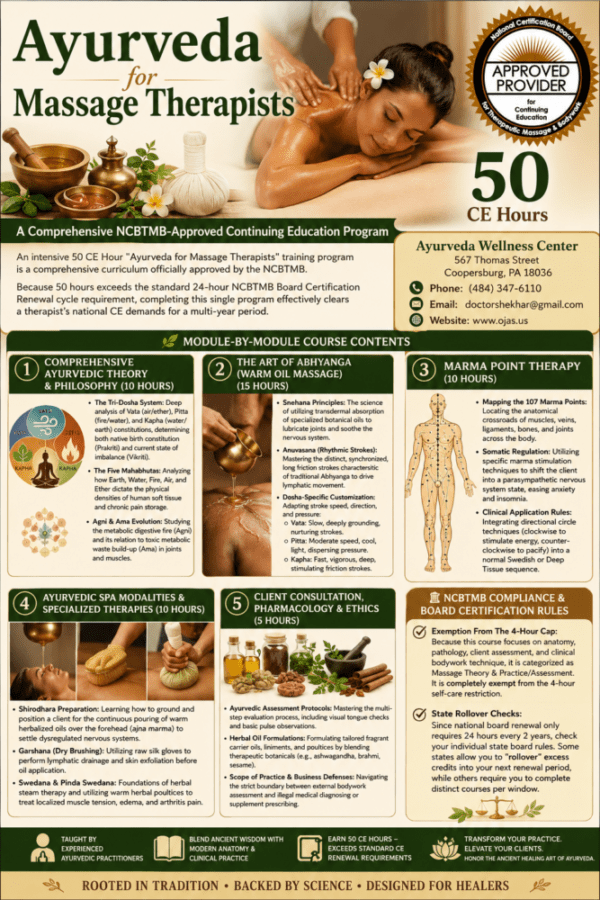
Ayurveda for Massage Therapists
50 CE Hours
An intensive 50 CE Hour “Ayurveda for Massage Therapists” training program is a comprehensive curriculum officially approved by the NCBTMB.
Because 50 hours exceeds the standard 24-hour NCBTMB Board Certification Renewal cycle requirement, completing this single program effectively clears a therapist’s national CE demands for a multi-year period.
🗺️ Module-by-Module Course Contents
Module 1: Comprehensive Ayurvedic Theory & Philosophy (10 Hours)
This block establishes the foundational diagnostic mindset required to transition a standard Western massage practice into an Eastern clinical setting.
- The Tri-Dosha System: Deep analysis of Vata (air/ether), Pitta (fire/water), and Kapha (water/earth) constitutions, determining both native birth constitution (Prakriti) and current state of imbalance (Vikriti).
- The Five Mahabhutas: Analyzing how Earth, Water, Fire, Air, and Ether dictate the physical densities of human soft tissue and chronic pain storage.
- Agni & Ama Evolution: Studying the metabolic digestive fire (Agni) and its relation to toxic metabolic waste build-up (Ama) in joints and muscles.
Module 2: The Art of Abhyanga (Warm Oil Massage) (15 Hours)
The core practical application module, focusing on traditional full-body warm oil sequences.
- Snehana Principles: The science of utilizing transdermal absorption of specialized botanical oils to lubricate joints and soothe the nervous system.
- Anuvasana (Rhythmic Strokes): Mastering the distinct, synchronized, long friction strokes characteristic of traditional Abhyanga to drive lymphatic movement.
- Dosha-Specific Customization: Adapting stroke speed, direction, and pressure:
- Vata: Slow, deeply grounding, nurturing strokes.
- Pitta: Moderate speed, cool, light, dispersing pressure.
- Kapha: Fast, vigorous, deep, stimulating friction strokes.
Module 3: Marma Point Therapy (10 Hours)
This segment bridges traditional acupressure with neuromuscular trigger point work.
- Mapping the 107 Marma Points: Locating the anatomical crossroads of muscles, veins, ligaments, bones, and joints across the body.
- Somatic Regulation: Utilizing specific marma stimulation techniques to shift the client into a parasympathetic nervous system state, easing anxiety and insomnia.
- Clinical Application Rules: Integrating directional circle techniques (clockwise to stimulate energy, counterclockwise to pacify) into a normal Swedish or Deep Tissue sequence.
Module 4: Ayurvedic Spa Modalities & Specialized Therapies (10 Hours)
Training in the distinct secondary therapies utilized in specialized wellness or luxury spa environments.
- Shirodhara Preparation: Learning how to ground and position a client for the continuous pouring of warm herbalized oils over the forehead (ajna marma) to settle dysregulated nervous systems.
- Garshana (Dry Brushing): Utilizing raw silk gloves to perform lymphatic drainage and skin exfoliation before oil application.
- Swedana & Pinda Swedana: Foundations of herbal steam therapy and utilizing warm herbal poultices to treat localized muscle tension, edema, and arthritis pain.
Module 5: Client Consultation, Pharmacology & Ethics (5 Hours)
The final hours focus on clinical intake, building customized formulations, and remaining legally sound.
- Ayurvedic Assessment Protocols: Mastering the multi-step evaluation process, including visual tongue checks and basic pulse observations.
- Herbal Oil Formulations: Formulating tailored fragrant carrier oils, liniments, and poultices by blending therapeutic botanicals (e.g., ashwagandha, brahmi, sesame).
- Scope of Practice & Business Defenses: Navigating the strict boundary between external bodywork assessment and illegal medical diagnosing or supplement prescribing.
📜 NCBTMB Compliance & Board Certification Rules
When submitting a massive 50-credit block for a board or state audit, strict structural
- Exemption From The 4-Hour Cap: Because this course focuses on anatomy, pathology, client assessment, and clinical bodywork technique, it is categorized as Massage Theory & Practice/Assessment. It is completely exempt from the 4-hour self-care restriction.
- State Rollover Checks: Since national board renewal only requires 24 hours every 2 years, check your individual state board rules. Some states allow you to “rollover” excess credits into your next renewal period, while others require you to complete distinct courses per window
💳 NCBTMB Provider Information
- Approved Provider Number: 451878-12
- CE Hours Awarded: 50 CEs
- Approval Body: National Certification Board for Therapeutic Massage & Bodywork (NCBTMB)
- Target Audience: Licensed Massage Therapists (LMTs), Certified Bodyworkers, and Estheticians.
- Certificate: Issued immediately upon successful completion of the course and practical evaluation.