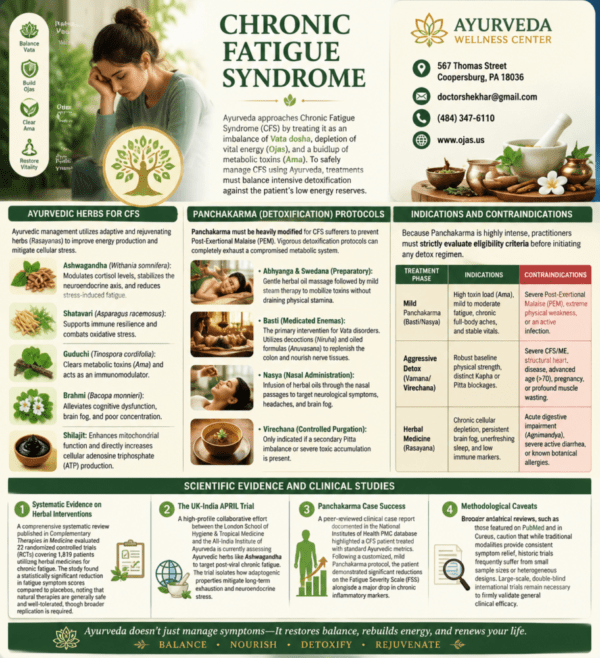

Description
Chronic Fatigue Syndrome
Ayurveda Wellness Center, 567 Thomas Street, Coopersburg, PA 18036
Email: doctorshekhar@gmail.com
Phone: (484) 347-6110
Web: www.ojas.us
Thank you for your interest in an Ayurvedic Wellness Consultation!
We are delighted that you have chosen to take this important step toward improving your health and well-being through the wisdom of Ayurveda. We look forward to supporting you on your wellness journey.
To schedule your consultation, please complete the online consultation request form and submit it along with your payment using the link below:
Ayurvedic Wellness Consultation Request Form:
https://www.cognitoforms.com/Ayurveda4/AyurvedicWellnessConsultationRequest
Once we receive your completed form and payment, a member of our team will contact you to confirm your appointment and provide any additional information you may need.
If you have any questions before your consultation, please don’t hesitate to reach out. We are here to help and are honored to be part of your path to better health.
We look forward to meeting you and helping you achieve greater balance, vitality, and wellness.
With warm regards,
Ayurveda Wellness Center
Ayurveda approaches Chronic Fatigue Syndrome (CFS) by treating it as an imbalance of Vata dosha, depletion of vital energy (Ojas), and a buildup of metabolic toxins (Ama). To safely manage CFS using Ayurveda, treatments must balance intensive detoxification against the patient’s low energy reserves.
Ayurvedic Herbs for CFS
Ayurvedic management utilizes adaptive and rejuvenating herbs (Rasayanas) to improve energy production and mitigate cellular stress.
- Ashwagandha (Withania somnifera): Modulates cortisol levels, stabilizes the neuroendocrine axis, and reduces stress-induced fatigue.
- Shatavari (Asparagus racemosus): Supports immune resilience and combats oxidative stress.
- Guduchi (Tinospora cordifolia): Clears metabolic toxins (Ama) and acts as an immunomodulator.
- Brahmi (Bacopa monnieri): Alleviates cognitive dysfunction, brain fog, and poor concentration.
- Shilajit: Enhances mitochondrial function and directly increases cellular adenosine triphosphate (ATP) production.
Panchakarma (Detoxification) Protocols
Panchakarma must be heavily modified for CFS sufferers to prevent Post-Exertional Malaise (PEM). Vigorous detoxification protocols can completely exhaust a compromised metabolic system.
- Abhyanga & Swedana (Preparatory): Gentle herbal oil massage followed by mild steam therapy to mobilize toxins without draining physical stamina.
- Basti (Medicated Enemas): The primary intervention for Vata disorders. Utilizes decoctions (Niruha) and oiled formulas (Anuvasana) to replenish the colon and nourish nerve tissues.
- Nasya (Nasal Administration): Infusion of herbal oils through the nasal passages to target neurological symptoms, headaches, and brain fog.
- Virechana (Controlled Purgation): Only indicated if a secondary Pitta imbalance or severe toxic accumulation is present.
Indications and Contraindications
Because Panchakarma is highly intense, practitioners must strictly evaluate eligibility criteria before initiating any detox regimen.
| Treatment Phase | Indications | Contraindications |
| Mild Panchakarma (Basti/Nasya) | High toxin load (Ama), mild to moderate fatigue, chronic full-body aches, and stable vitals. | Severe Post-Exertional Malaise (PEM), extreme physical weakness, or an active infection. |
| Aggressive Detox (Vamana/Virechana) | Robust baseline physical strength, distinct Kapha or Pitta blockages. | Severe CFS/ME, structural heart disease, advanced age (>70), pregnancy, or profound muscle wasting. |
| Herbal Medicine (Rasayana) | Chronic cellular depletion, persistent brain fog, unrefreshing sleep, and low immune markers. | Acute digestive impairment (Agnimandya), severe active diarrhea, or known botanical allergies. |
Scientific Evidence and Clinical Studies
Gold-standard, peer-reviewed clinical data focusing exclusively on Ayurveda for CFS is still scarce, but contemporary studies reveal a promising therapeutic trajectory:
- Systematic Evidence on Herbal Interventions: A comprehensive systematic review published in Complementary Therapies in Medicine evaluated 22 randomized controlled trials (RCTs) covering 1,819 patients utilizing herbal medicines for chronic fatigue. The study found a statistically significant reduction in fatigue symptom scores compared to placebos, noting that natural therapies are generally safe and well-tolerated, though broader replication is required.
- The UK-India APRIL Trial: A high-profile collaborative effort between the London School of Hygiene & Tropical Medicine and the All-India Institute of Ayurveda is currently assessing Ayurvedic herbs like Ashwagandha to target post-viral chronic fatigue. The trial isolates how adaptogenic properties mitigate long-term exhaustion and neuroendocrine stress.
- Panchakarma Case Success: A peer-reviewed clinical case report documented in the National Institutes of Health PMC database highlighted a CFS patient treated with standard Ayurvedic metrics. Following a customized, mild Panchakarma protocol, the patient demonstrated significant reductions on the Fatigue Severity Scale (FSS) alongside a major drop in chronic inflammatory markers.
- Methodological Caveats: Broader analytical reviews, such as those featured on PubMed and in Cureus, caution that while traditional modalities provide consistent symptom relief, historic trials frequently suffer from small sample sizes or heterogeneous designs. Large-scale, double-blind international trials remain necessary to firmly validate general clinical efficacy