Description
Chronic Stress – Prana Dushti
5 days / $2500
Thank you for your interest in our Ayurveda Wellness Programs.
Each individual’s health condition will be thoroughly assessed during the initial Ayurvedic Wellness Consultation. Based on the consultation, a personalized wellness regimen and lifestyle protocol will be developed for you to follow at home. Depending on your specific health needs and progress, we may recommend a 5-day Wellness Program or an extended Panchakarma program of 7, 10, 14, 21, or 28 days.
To begin the process, please complete the Personalized Ayurvedic Wellness Consultation Request Form:
https://www.cognitoforms.com/Ayurveda4/AyurvedicWellnessConsultationRequest
Thank you very much. I look forward to working with you.
Warm regards,
Shekhar Annambhotla
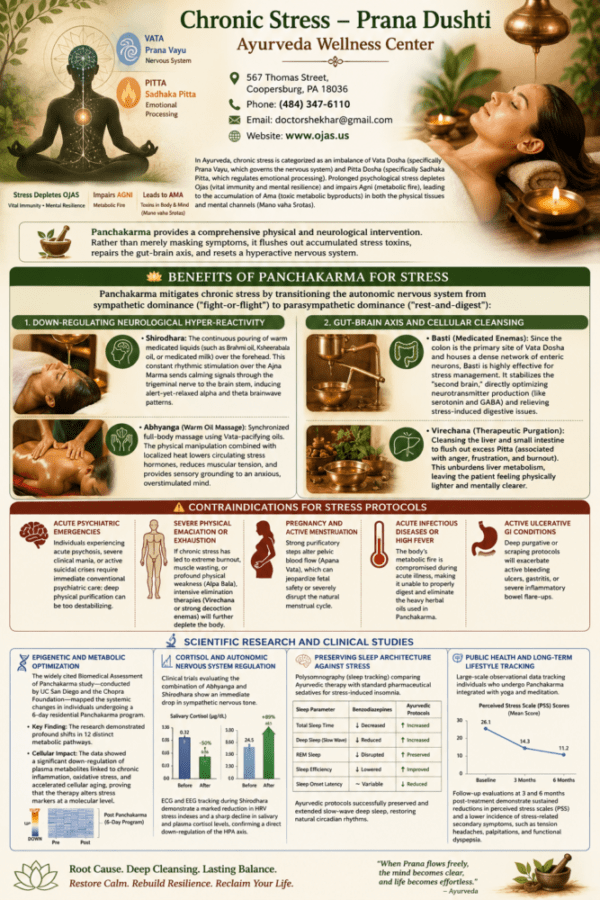
In Ayurveda, chronic stress is categorized as an imbalance of Vata Dosha (specifically Prana Vayu, which governs the nervous system) and Pitta Dosha (specifically Sadhaka Pitta, which regulates emotional processing). Prolonged psychological stress depletes Ojas (vital immunity and mental resilience) and impairs Agni (metabolic fire), leading to the accumulation of Ama (toxic metabolic byproducts) in both the physical tissues and mental channels (Mano vaha Srotas).
Panchakarma provides a comprehensive physical and neurological intervention. Rather than merely masking symptoms, it flushes out accumulated stress toxins, repairs the gut-brain axis, and resets a hyperactive nervous system.
🌟 Benefits of Panchakarma for Stress
Panchakarma mitigates chronic stress by transitioning the autonomic nervous system from sympathetic dominance (“fight-or-flight”) to parasympathetic dominance (“rest-and-digest”):
- Down-regulating Neurological Hyper-reactivity
- Shirodhara: The continuous pouring of warm medicated liquids (such as Brahmi oil, Ksheerabala oil, or medicated milk) over the forehead. This constant rhythmic stimulation over the Ajna Marma sends calming signals through the trigeminal nerve to the brain stem, inducing alert-yet-relaxed alpha and theta brainwave patterns.
- Abhyanga (Warm Oil Massage): Synchronized full-body massage using Vata-pacifying oils. The physical manipulation combined with localized heat lowers circulating stress hormones, reduces muscular tension, and provides sensory grounding to an anxious, overstimulated mind.
- Gut-Brain Axis and Cellular Cleansing
- Basti (Medicated Enemas): Since the colon is the primary site of Vata Dosha and houses a dense network of enteric neurons, Basti is highly effective for stress management. It stabilizes the “second brain,” directly optimizing neurotransmitter production (like serotonin and GABA) and relieving stress-induced digestive issues.
- Virechana (Therapeutic Purgation): Cleansing the liver and small intestine to flush out excess Pitta (associated with anger, frustration, and burnout). This unburdens liver metabolism, leaving the patient feeling physically lighter and mentally clearer.
⚠️ Contraindications for Stress Protocols
Because Panchakarma procedures demand significant physical and metabolic energy, they are strictly contraindicated or restricted under the following conditions:
- Acute Psychiatric Emergencies: Individuals experiencing acute psychosis, severe clinical mania, or active suicidal crises require immediate conventional psychiatric care; deep physical purification can be too destabilizing.
- Severe Physical Emaciation or Exhaustion: If chronic stress has led to extreme burnout, muscle wasting, or profound physical weakness (Alpa Bala), intensive elimination therapies (Virechana or strong decoction enemas) will further deplete the body.
- Pregnancy and Active Menstruation: Strong purificatory steps alter pelvic blood flow (Apana Vata), which can jeopardize fetal safety or severely disrupt the natural menstrual cycle.
- Acute Infectious Diseases or High Fever: The body’s metabolic fire is compromised during acute illness, making it unable to properly digest and eliminate the heavy herbal oils used in Panchakarma.
- Active Ulcerative GI Conditions: Deep purgative or scraping protocols will exacerbate active bleeding ulcers, gastritis, or severe inflammatory bowel flare-ups.
🔬 Scientific Research and Clinical Studies
Modern physiological and medical studies thoroughly document Panchakarma’s measurable impact on stress markers:
🧬 Epigenetic and Metabolic Optimization
The widely cited Biomedical Assessment of Panchakarma study—conducted by UC San Diego and the Chopra Foundation—mapped the systemic changes in individuals undergoing a 6-day residential Panchakarma program.
- Key Finding: The research demonstrated profound shifts in 12 distinct metabolic pathways.
- Cellular Impact: The data showed a significant down-regulation of plasma metabolites linked to chronic inflammation, oxidative stress, and accelerated cellular aging, proving that the therapy alters stress markers at a molecular level.
📉 Cortisol and Autonomic Nervous System Regulation
Clinical trials evaluating the combination of Abhyanga and Shirodhara show an immediate drop in sympathetic nervous tone. Electrocardiogram (ECG) and electroencephalogram (EEG) tracking during Shirodhara demonstrate a marked reduction in heart rate variability (HRV) stress indexes and a sharp decline in salivary and plasma cortisol levels, confirming a direct down-regulation of the Hypothalamic-Pituitary-Adrenal (HPA) axis.
🧠 Preserving Sleep Architecture against Stress
In clinical evaluations measuring the impact of Ayurvedic nervous system therapies against standard pharmaceutical sedatives (like Benzodiazepines) for stress-induced insomnia, polysomnography (sleep tracking) revealed a distinct difference. While pharmaceuticals often disrupt REM and deep sleep cycles, the Ayurvedic protocols successfully preserved and extended slow-wave deep sleep, restoring natural circadian rhythms.
📊 Public Health and Long-Term Lifestyle Tracking
Large-scale observational data tracking individuals who undergo Panchakarma integrated with yoga and meditation show sustained improvements in self-reported stress levels. Follow-up evaluations at 3 and 6 months post-treatment demonstrate sustained reductions in perceived stress scales (PSS) and a lower incidence of stress-related secondary symptoms, such as tension headaches, palpitations, and functional dyspepsia.
The provided Panchakarma cancellation policy outlines specific financial penalties and credits based on when a cancellation notice is submitted. The policy structures its fees strictly around the mandatory 50% upfront deposit rather than the total program cost.
Below is a clear structural breakdown of how this policy applying to your registration:
💳 Registration & Arrival Payments
- At Registration: A mandatory 50% deposit of the total Panchakarma program cost is due immediately to secure your dates.
- Upon Arrival: The remaining 50% balance is due in full. Once paid at arrival, this final amount is completely non-refundable.
📅 Cancellation Timelines & Financial Penalties
If you must cancel your program prior to your arrival date, your 50% deposit will be handled based on the following three distinct windows:
| Cancellation Window | Processing Fee (Kept by Center) | Remaining Balance Allocation |
| 30+ Days before start | 10% of your deposit is withheld | Credited toward a future program |
| 21 to 30 Days before start | 20% of your deposit is withheld | Credited toward a future program |
| Less than 21 Days before start | 100% of your deposit is withheld | Zero credit; the entire deposit is forfeited |
🧮 Hypothetical Scenario (For Clarity)
If your total Panchakarma program cost is $2,000, your upfront deposit at registration is $1,000. If you cancel:
- 35 days out: The center keeps $100 (10% of deposit). You receive a $900 credit for a future program.
- 25 days out: The center keeps $200 (20% of deposit). You receive an $800 credit for a future program.
- 15 days out: The center keeps the full $1,000 deposit. You receive zero credit.
If you would like help calculating the exact processing fees and future program credits for a specific package price, or if you need to review the scheduling availability for a future date, please let me know.
*These statements are not evaluated by Food and Drug Administration. These therapies are not intended to diagnose, treat, cure or prevent any disease.