Description
Craniosacral Therapy (CST)
45 minutes: $175
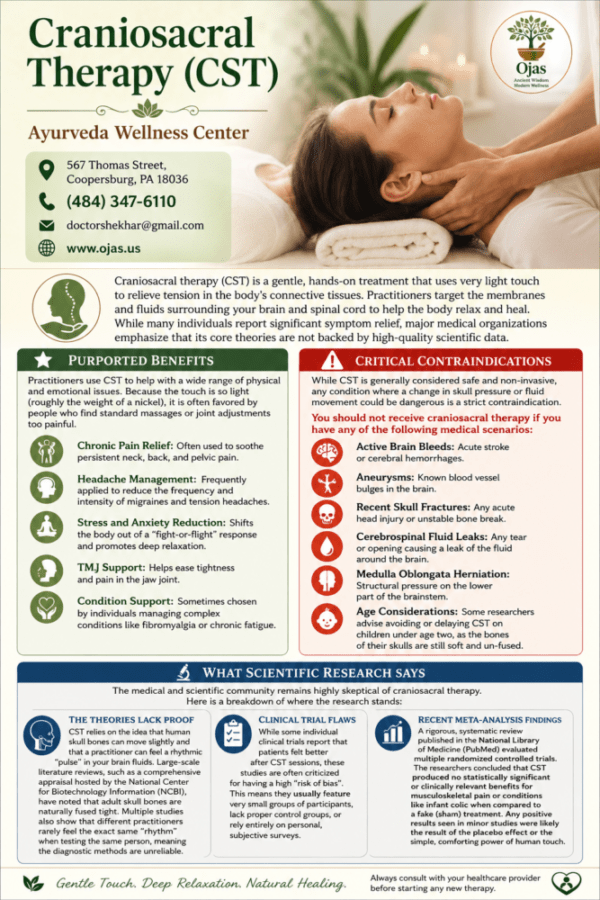
Craniosacral therapy (CST) is a gentle, hands-on treatment that uses very light touch to relieve tension in the body’s connective tissues. Practitioners target the membranes and fluids surrounding your brain and spinal cord to help the body relax and heal. While many individuals report significant symptom relief, major medical organizations emphasize that its core theories are not backed by high-quality scientific data.
🌟 Purported Benefits
Practitioners use CST to help with a wide range of physical and emotional issues. Because the touch is so light (roughly the weight of a nickel), it is often favored by people who find standard massages or joint adjustments too painful.
- Chronic Pain Relief: Often used to soothe persistent neck, back, and pelvic pain.
- Headache Management: Frequently applied to reduce the frequency and intensity of migraines and tension headaches.
- Stress and Anxiety Reduction: Shifts the body out of a “fight-or-flight” response and promotes deep relaxation.
- TMJ Support: Helps ease tightness and pain in the jaw joint.
- Condition Support: Sometimes chosen by individuals managing complex conditions like fibromyalgia or chronic fatigue.
⚠️ Critical Contraindications
While CST is generally considered safe and non-invasive, any condition where a change in skull pressure or fluid movement could be dangerous is a strict contraindication.
You should not receive craniosacral therapy if you have any of the following medical scenarios:
- Active Brain Bleeds: Acute stroke or cerebral hemorrhages.
- Aneurysms: Known blood vessel bulges in the brain.
- Recent Skull Fractures: Any acute head injury or unstable bone break.
- Cerebrospinal Fluid Leaks: Any tear or opening causing a leak of the fluid around the brain.
- Medulla Oblongata Herniation: Structural pressure on the lower part of the brainstem.
- Age Considerations: Some researchers advise avoiding or delaying CST on children under age two, as the bones of their skulls are still soft and un-fused.
🔬 What Scientific Research Says
The medical and scientific community remains highly skeptical of craniosacral therapy. Here is a breakdown of where the research stands:
The Theories Lack Proof
CST relies on the idea that human skull bones can move slightly and that a practitioner can feel a rhythmic “pulse” in your brain fluids. Large-scale literature reviews, such as a comprehensive appraisal hosted by the National Center for Biotechnology Information (NCBI), have noted that adult skull bones are naturally fused tight. Multiple studies also show that different practitioners rarely feel the exact same “rhythm” when testing the same person, meaning the diagnostic methods are unreliable.
Clinical Trial Flaws
While some individual clinical trials report that patients felt better after CST sessions, these studies are often criticized for having a high “risk of bias”. This means they usually feature very small groups of participants, lack proper control groups, or rely entirely on personal, subjective surveys.
Recent Meta-Analysis Findings
A rigorous, systematic review published in the National Library of Medicine (PubMed) evaluated multiple randomized controlled trials. The researchers concluded that CST produced no statistically significant or clinically relevant benefits for musculoskeletal pain or conditions like infant colic when compared to a fake (sham) treatment. Any positive results seen in minor studies were likely the result of the placebo effect or the simple, comforting power of human touch.