Description
Grave’s Disease
Ayurveda Wellness Center, 567 Thomas Street, Coopersburg, PA 18036
Email: doctorshekhar@gmail.com
Phone: (484) 347-6110
Web: www.ojas.us
Thank you for your interest in an Ayurvedic Wellness Consultation!
We are delighted that you have chosen to take this important step toward improving your health and well-being through the wisdom of Ayurveda. We look forward to supporting you on your wellness journey.
To schedule your consultation, please complete the online consultation request form and submit it along with your payment using the link below:
Ayurvedic Wellness Consultation Request Form:
https://www.cognitoforms.com/Ayurveda4/AyurvedicWellnessConsultationRequest
Once we receive your completed form and payment, a member of our team will contact you to confirm your appointment and provide any additional information you may need.
If you have any questions before your consultation, please don’t hesitate to reach out. We are here to help and are honored to be part of your path to better health.
We look forward to meeting you and helping you achieve greater balance, vitality, and wellness.
With warm regards,
Ayurveda Wellness Center
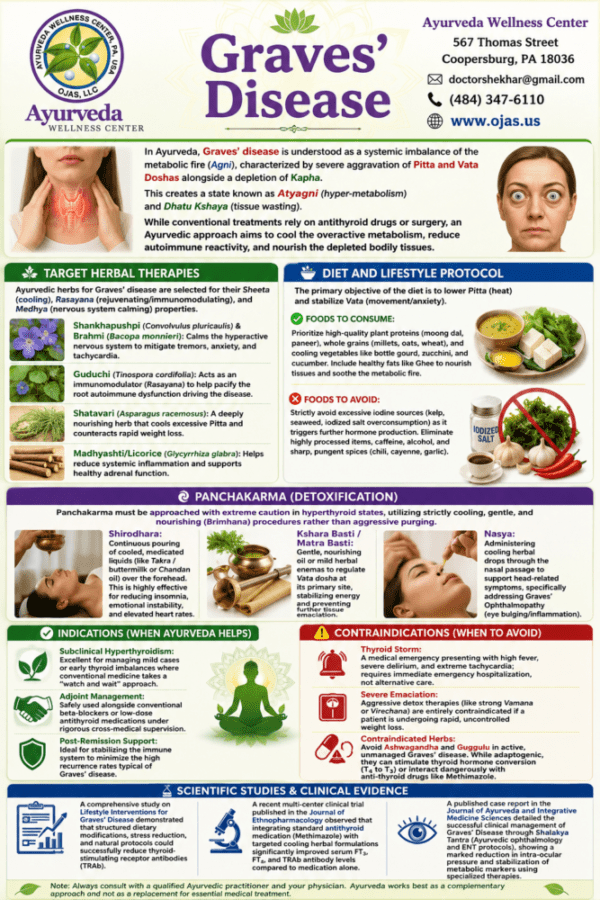
In Ayurveda, Graves’ disease is understood as a systemic imbalance of the metabolic fire (Agni), characterized by severe aggravation of Pitta and Vata Doshas alongside a depletion of Kapha.
This creates a state known as Atyagni (hyper-metabolism) and Dhatu Kshaya (tissue wasting).
While conventional treatments rely on antithyroid drugs or surgery, an Ayurvedic approach aims to cool the overactive metabolism, reduce autoimmune reactivity, and nourish the depleted bodily tissues.
🌿 Target Herbal Therapies
Ayurvedic herbs for Graves’ disease are selected for their Sheeta (cooling), Rasayana (rejuvenating/immunomodulating), and Medhya (nervous system calming) properties.
- Shankhapushpi (Convolvulus pluricaulis) & Brahmi (Bacopa monnieri): Calms the hyperactive nervous system to mitigate tremors, anxiety, and tachycardia.
- Guduchi (Tinospora cordifolia): Acts as an immunomodulator (Rasayana) to help pacify the root autoimmune dysfunction driving the disease.
- Shatavari (Asparagus racemosus): A deeply nourishing herb that cools excessive Pitta and counteracts rapid weight loss.
- Madhyashti/Licorice (Glycyrrhiza glabra): Helps reduce systemic inflammation and supports healthy adrenal function.
🥗 Diet and Lifestyle Protocol
The primary objective of the diet is to lower Pitta (heat) and stabilize Vata (movement/anxiety).
- Foods to Consume: Prioritize high-quality plant proteins (moong dal, paneer), whole grains (millets, oats, wheat), and cooling vegetables like bottle gourd, zucchini, and cucumber. Include healthy fats like Ghee to nourish tissues and soothe the metabolic fire.
- Foods to Avoid: Strictly avoid excessive iodine sources (kelp, seaweed, iodized salt overconsumption) as it triggers further hormone production. Eliminate highly processed items, caffeine, alcohol, and sharp, pungent spices (chili, cayenne, garlic).
🌀 Panchakarma (Detoxification)
Panchakarma must be approached with extreme caution in hyperthyroid states, utilizing strictly cooling, gentle, and nourishing (Brimhana) procedures rather than aggressive purging
- Shirodhara: Continuous pouring of cooled, medicated liquids (like Takra / buttermilk or Chandan oil) over the forehead. This is highly effective for reducing insomnia, emotional instability, and elevated heart rates.
- Kshara Basti / Matra Basti: Gentle, nourishing oil or mild herbal enemas to regulate Vata dosha at its primary site, stabilizing energy and preventing further tissue emaciation.
- Nasya: Administering cooling herbal drops through the nasal passage to support head-related symptoms, specifically addressing Graves’ Ophthalmopathy (eye bulging/inflammation).
⚠️ Indications vs. Contraindications
Indications (When Ayurveda Helps)
- Subclinical Hyperthyroidism: Excellent for managing mild cases or early thyroid imbalances where conventional medicine takes a “watch and wait” approach.
- Adjoint Management: Safely used alongside conventional beta-blockers or low-dose antithyroid medications under rigorous cross-medical supervision.
- Post-Remission Support: Ideal for stabilizing the immune system to minimize the high recurrence rates typical of Graves’ disease.
Contraindications (When to Avoid)
- Thyroid Storm: A medical emergency presenting with high fever, severe delirium, and extreme tachycardia; requires immediate emergency hospitalization, not alternative care.
- Severe Emaciation: Aggressive detox therapies (like strong Vamana or Virechana) are entirely contraindicated if a patient is undergoing rapid, uncontrolled weight loss.
- Contraindicated Herbs: Avoid Ashwagandha and Guggulu in active, unmanaged Graves’ disease. While adaptogenic, they can stimulate thyroid hormone conversion (T₄ to T₃) or interact dangerously with anti-thyroid drugs like Methimazole.
🔬 Scientific Studies & Clinical Evidence
Clinical validation specifically pairing traditional Ayurveda with Graves’ disease is expanding but limited; it is typically studied alongside broader traditional herbal systems:
- A comprehensive study on Lifestyle Interventions for Graves’ Disease demonstrated that structured dietary modifications, stress reduction, and natural protocols could successfully reduce thyroid-stimulating receptor antibodies (TRAb).
- A recent multi-center clinical trial published in the Journal of Ethnopharmacology observed that integrating standard antithyroid medication (Methimazole) with targeted cooling herbal formulations significantly improved serum FT₃, FT₄, and TRAb antibody levels compared to medication alone.
- A published case report in the Journal of Ayurveda and Integrative Medicine Sciences detailed the successful clinical management of Graves’ Disease through Shalakya Tantra (Ayurvedic ophthalmology and ENT protocols), showing a marked reduction in intra-ocular pressure and stabilization of metabolic markers using specialized therapies.