Description
Meditation Training
7 CE Hours
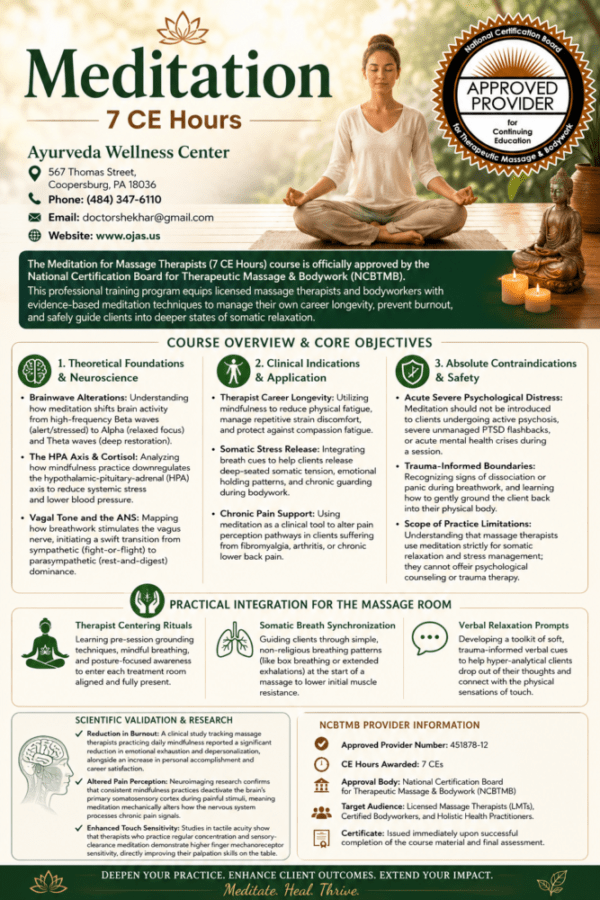
The Meditation for Massage Therapists (7 CE Hours) course is officially approved by the National Certification Board for Therapeutic Massage & Bodywork (NCBTMB). This professional training program equips licensed massage therapists and bodyworkers with evidence-based meditation techniques to manage their own career longevity, prevent burnout, and safely guide clients into deeper states of somatic relaxation.
🗺️ Course Overview & Core Objectives
This 7 Continuing Education (CE) hour curriculum bridges the gap between mindfulness practices and the physical demands of bodywork. It focuses on the neuroscience of meditation and its clinical application before, during, and after a massage session.
- Theoretical Foundations & Neuroscience
- Brainwave Alterations: Understanding how meditation shifts brain activity from high-frequency Beta waves (alert/stressed) to Alpha (relaxed focus) and Theta waves (deep restoration).
- The HPA Axis & Cortisol: Analyzing how mindfulness practice downregulates the hypothalamic-pituitary-adrenal (HPA) axis to reduce systemic stress and lower blood pressure.
- Vagal Tone and the ANS: Mapping how breathwork stimulates the vagus nerve, initiating a swift transition from sympathetic (fight-or-flight) to parasympathetic (rest-and-digest) dominance.
- Clinical Indications & Application
- Therapist Career Longevity: Utilizing mindfulness to reduce physical fatigue, manage repetitive strain discomfort, and protect against compassion fatigue.
- Somatic Stress Release: Integrating breath cues to help clients release deep-seated somatic tension, emotional holding patterns, and chronic guarding during bodywork.
- Chronic Pain Support: Using meditation as a clinical tool to alter pain perception pathways in clients suffering from fibromyalgia, arthritis, or chronic lower back pain.
- Absolute Contraindications & Safety
To ensure client safety under NCBTMB guidelines, therapists learn the psychological boundaries of introducing meditation in a bodywork setting:
- Acute Severe Psychological Distress: Meditation should not be introduced to clients undergoing active psychosis, severe unmanaged PTSD flashbacks, or acute mental health crises during a session.
- Trauma-Informed Boundaries: Recognizing signs of dissociation or panic during breathwork, and learning how to gently ground the client back into their physical body.
- Scope of Practice Limitations: Understanding that massage therapists use meditation strictly for somatic relaxation and stress management; they cannot offer psychological counseling or trauma therapy.
👐 Practical Integration for the Massage Room
The practical sequence focuses on immediate, actionable ways to apply mindfulness to a professional bodywork practice:
- Therapist Centering Rituals: Learning pre-session grounding techniques, mindful breathing, and posture-focused awareness to enter each treatment room aligned and fully present.
- Somatic Breath Synchronization: Guiding clients through simple, non-religious breathing patterns (like box breathing or extended exhalations) at the start of a massage to lower initial muscle resistance.
- Verbal Relaxation Prompts: Developing a toolkit of soft, trauma-informed verbal cues to help hyper-analytical clients drop out of their thoughts and connect with the physical sensations of touch.
🔬 Scientific Validation & Research
Teaching meditation to bodyworkers is supported by peer-reviewed clinical research across international medical databases:
- Reduction in Burnout: A clinical study tracking massage therapists practicing daily mindfulness reported a significant reduction in emotional exhaustion and depersonalization, alongside an increase in personal accomplishment and career satisfaction.
- Altered Pain Perception: Neuroimaging research confirms that consistent mindfulness practices deactivate the brain’s primary somatosensory cortex during painful stimuli, meaning meditation mechanically alters how the nervous system processes chronic pain signals.
- Enhanced Touch Sensitivity: Studies in tactile acuity show that therapists who practice regular concentration and sensory-clearance meditation demonstrate higher finger mechanoreceptor sensitivity, directly improving their palpation skills on the table.
💳 NCBTMB Provider Information
- Approved Provider: Shekhar Vijay Annambhotla
- Approved Provider Number: 451878-12
- CE Hours Awarded: 7 CEs
- Approval Body: National Certification Board for Therapeutic Massage & Bodywork (NCBTMB)
- Target Audience: Licensed Massage Therapists (LMTs), Certified Bodyworkers, and Holistic Health Practitioners.
- Certificate: Issued immediately upon successful completion of the course and foundational assessment.