Description
Progressive Autoinflammatory Nicotinic Dermatosis and Arthropathy – PANDA
Ayurveda Wellness Center, 567 Thomas Street, Coopersburg, PA 18036
Email: doctorshekhar@gmail.com
Phone: (484) 347-6110
Web: www.ojas.us
Thank you for your interest in an Ayurvedic Wellness Consultation!
We are delighted that you have chosen to take this important step toward improving your health and well-being through the wisdom of Ayurveda. We look forward to supporting you on your wellness journey.
To schedule your consultation, please complete the online consultation request form and submit it along with your payment using the link below:
Ayurvedic Wellness Consultation Request Form:
https://www.cognitoforms.com/Ayurveda4/AyurvedicWellnessConsultationRequest
Once we receive your completed form and payment, a member of our team will contact you to confirm your appointment and provide any additional information you may need.
If you have any questions before your consultation, please don’t hesitate to reach out. We are here to help and are honored to be part of your path to better health.
We look forward to meeting you and helping you achieve greater balance, vitality, and wellness.
With warm regards,
Ayurveda Wellness Center
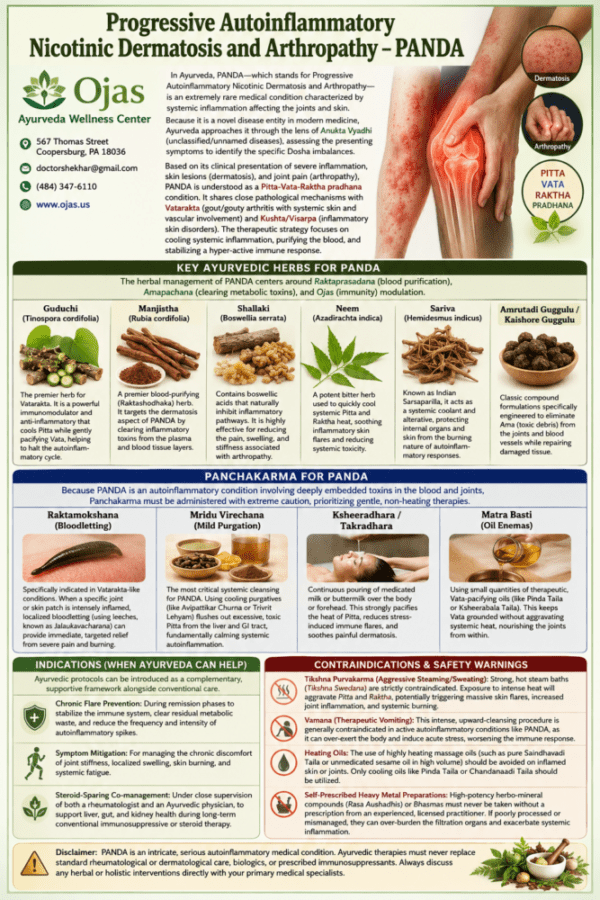
In Ayurveda, PANDA—which stands for Progressive Autoinflammatory Nicotinic Dermatosis and Arthropathy—is an extremely rare medical condition characterized by systemic inflammation affecting the joints and skin. Because it is a novel disease entity in modern medicine, Ayurveda approaches it through the lens of Anukta Vyadhi (unclassified/unnamed diseases), assessing the presenting symptoms to identify the specific Dosha imbalances.
Based on its clinical presentation of severe inflammation, skin lesions (dermatosis), and joint pain (arthropathy), PANDA is understood as a Pitta-Vata-Raktha pradhana condition. It shares close pathological mechanisms with Vatarakta (gout/gouty arthritis with systemic skin and vascular involvement) and Kushta/Visarpa (inflammatory skin disorders). The therapeutic strategy focuses on cooling systemic inflammation, purifying the blood, and stabilizing a hyper-active immune response.
Key Ayurvedic Herbs for PANDA
The herbal management of PANDA centers around Raktaprasadana (blood purification), Amapachana (clearing metabolic toxins), and Ojas (immunity) modulation.
- Guduchi (Tinospora cordifolia): The premier herb for Vatarakta. It is a powerful immunomodulator and anti-inflammatory that cools Pitta while gently pacifying Vata, helping to halt the autoinflammatory cycle.
- Manjistha (Rubia cordifolia): A premier blood-purifying (Raktashodhaka) herb. It targets the dermatosis aspect of PANDA by clearing inflammatory toxins from the plasma and blood tissue layers.
- Shallaki (Boswellia serrata): Contains boswellic acids that naturally inhibit inflammatory pathways. It is highly effective for reducing the pain, swelling, and stiffness associated with arthropathy.
- Neem (Azadirachta indica): A potent bitter herb used to quickly cool systemic Pitta and Raktha heat, soothing inflammatory skin flares and reducing systemic toxicity.
- Sariva (Hemidesmus indicus): Known as Indian Sarsaparilla, it acts as a systemic coolant and alterative, protecting internal organs and skin from the burning nature of autoinflammatory responses.
- Amrutadi Guggulu / Kaishore Guggulu: Classic compound formulations specifically engineered to eliminate Ama (toxic debris) from the joints and blood vessels while repairing damaged tissue.
Panchakarma for PANDA
Because PANDA is an autoinflammatory condition involving deeply embedded toxins in the blood and joints, Panchakarma must be administered with extreme caution, prioritizing gentle, non-heating therapies.
- Raktamokshana (Bloodletting): Specifically indicated in Vatarakta-like conditions. When a specific joint or skin patch is intensely inflamed, localized bloodletting (using leeches, known as Jalaukavacharana) can provide immediate, targeted relief from severe pain and burning.
- Mridu Virechana (Mild Purgation): The most critical systemic cleansing for PANDA. Using cooling purgatives (like Avipattikar Churna or Trivrit Lehyam) flushes out excessive, toxic Pitta from the liver and GI tract, fundamentally calming systemic autoinflammation.
- Ksheeradhara / Takradhara: Continuous pouring of medicated milk or buttermilk over the body or forehead. This strongly pacifies the heat of Pitta, reduces stress-induced immune flares, and soothes painful dermatosis.
- Matra Basti (Oil Enemas): Using small quantities of therapeutic, Vata-pacifying oils (like Pinda Taila or Ksheerabala Taila). This keeps Vata grounded without aggravating systemic heat, nourishing the joints from within.
Indications (When Ayurveda Can Help)
Ayurvedic protocols can be introduced as a complementary, supportive framework alongside conventional rheumatology and dermatology.
- Chronic Flare Prevention: During remission phases to stabilize the immune system, clear residual metabolic waste, and reduce the frequency and intensity of autoinflammatory spikes.
- Symptom Mitigation: For managing the chronic discomfort of joint stiffness, localized swelling, skin burning, and systemic fatigue.
- Steroid-Sparing Co-management: Under close supervision of both a rheumatologist and an Ayurvedic physician, to support liver, gut, and kidney health during long-term conventional immunosuppressive or steroid therapy.
Contraindications & Safety Warnings
Due to the sensitive, hyper-reactive nature of autoinflammatory disorders, certain traditional Ayurvedic treatments can cause severe adverse reactions.
- Tikshna Purvakarma (Aggressive Steaming/Sweating): Strong, hot steam baths (Tikshna Swedana) are strictly contraindicated. Exposure to intense heat will aggravate Pitta and Raktha, potentially triggering massive skin flares, increased joint inflammation, and systemic burning.
- Vamana (Therapeutic Vomiting): This intense, upward-cleansing procedure is generally contraindicated in active autoinflammatory conditions like PANDA, as it can over-exert the body and induce acute stress, worsening the immune response.
- Heating Oils: The use of highly heating massage oils (such as pure Saindhavadi Taila or unmedicated sesame oil in high volume) should be avoided on inflamed skin or joints. Only cooling oils like Pinda Taila or Chandanaadi Taila should be utilized.
- Self-Prescribed Heavy Metal Preparations: High-potency herbo-mineral compounds (Rasa Aushadhis) or Bhasmas must never be taken without a prescription from an experienced, licensed practitioner. If poorly processed or mismanaged, they can over-burden the filtration organs and exacerbate systemic inflammation.
Disclaimer: PANDA is an intricate, serious autoinflammatory medical condition. Ayurvedic therapies must never replace standard rheumatological or dermatological care, biologics, or prescribed immunosuppressants. Always discuss any herbal or holistic interventions directly with your primary medical specialists.