Description
Presbyopia
Ayurveda Wellness Center, 567 Thomas Street, Coopersburg, PA 18036
Email: doctorshekhar@gmail.com
Phone: (484) 347-6110
Web: www.ojas.us
Thank you for your interest in an Ayurvedic Wellness Consultation!
We are delighted that you have chosen to take this important step toward improving your health and well-being through the wisdom of Ayurveda. We look forward to supporting you on your wellness journey.
To schedule your consultation, please complete the online consultation request form and submit it along with your payment using the link below:
Ayurvedic Wellness Consultation Request Form:
https://www.cognitoforms.com/Ayurveda4/AyurvedicWellnessConsultationRequest
Once we receive your completed form and payment, a member of our team will contact you to confirm your appointment and provide any additional information you may need.
If you have any questions before your consultation, please don’t hesitate to reach out. We are here to help and are honored to be part of your path to better health.
We look forward to meeting you and helping you achieve greater balance, vitality, and wellness.
With warm regards,
Ayurveda Wellness Center
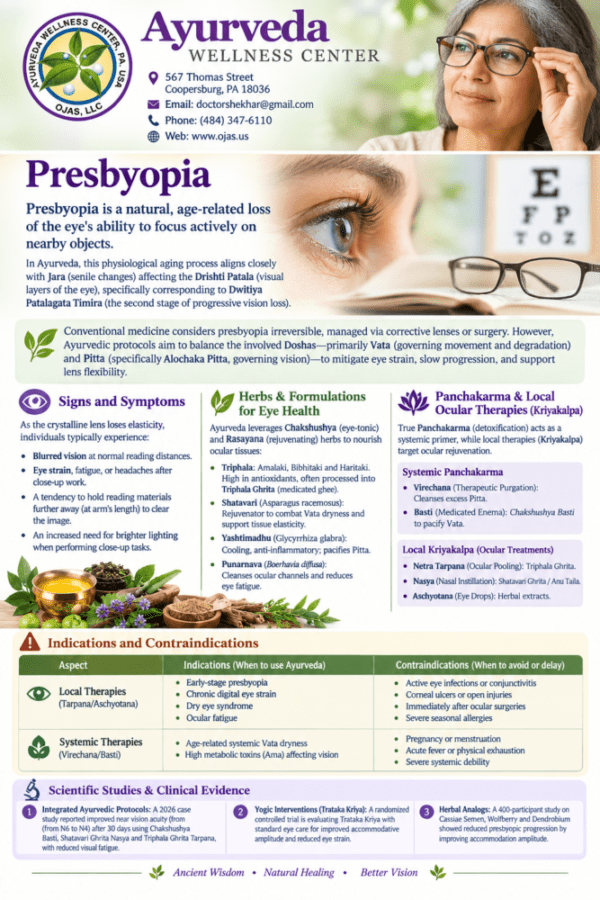
Presbyopia is a natural, age-related loss of the eye’s ability to focus actively on nearby objects. In Ayurveda, this physiological aging process aligns closely with Jara (senile changes) affecting the Drishti Patala (visual layers of the eye), specifically corresponding to Dwitiya Patalagata Timira (the second stage of progressive vision loss).
Conventional medicine considers presbyopia irreversible, managed via corrective lenses or surgery. However, Ayurvedic protocols aim to balance the involved Doshas—primarily Vata (governing movement and degradation) and Pitta (specifically Alochaka Pitta, governing vision)—to mitigate eye strain, slow progression, and support lens flexibility.
👁️ Signs and Symptoms
As the crystalline lens loses elasticity, individuals typically experience:
- Blurred vision at normal reading distances.
- Eye strain, fatigue, or headaches after close-up work.
- A tendency to hold reading materials further away (at arm’s length) to clear the image.
- An increased need for brighter lighting when performing close-up tasks.
🌿 Herbs & Formulations for Eye Health
Ayurveda leverages Chakshushya (eye-tonic) and Rasayana (rejuvenating) herbs to nourish ocular tissues:
- Triphala: A combination of Amalaki, Bibhitaki, and Haritaki. High in antioxidants, it is often processed into Triphala Ghrita (medicated ghee) to nurture visual function.
- Shatavari (Asparagus racemosus): A potent rejuvenator used to combat age-related Vata dryness and support tissue elasticity.
- Yashtimadhu (Glycyrrhiza glabra): Licorice root acts as a cooling, anti-inflammatory agent that pacifies Pitta dosha.
- Punarnava (Boerhavia diffusa): Traditionally utilized to cleanse ocular channels and mitigate eye fatigue.
💆 Panchakarma & Local Ocular Therapies (Kriyakalpa)
True Panchakarma (detoxification) acts as a systemic primer, while local therapies (Kriyakalpa) specifically target ocular rejuvenation.
Systemic Panchakarma
- Virechana (Therapeutic Purgation): Eliminates excess Pitta from the body, cleansing the systemic pathways connected to the eyes.
- Basti (Medicated Enema): Specifically Chakshushya Basti (nourishing enemas using eye-specific herbs) to pacify the systemic Vata dosha that accelerates aging.
Local Kriyakalpa (Ocular Treatments)
- Netra Tarpana (Ocular Pooling): The cornerstone therapy where a dam made of black gram dough is built around the eyes and filled with warm Triphala Ghrita. This provides prolonged hydration, intending to enhance corneal and lens lubrication.
- Nasya (Nasal Instillation): Administering medicated fats like Shatavari Ghrita or Anu Taila via the nostrils to target the Prana Vata and improve near vision tracking.
- Aschyotana (Eye Drops): Instilling warm herbal extracts or medicated liquids as preventive care against dryness and fatigue.
⚠️ Indications and Contraindications
| Aspect | Indications (When to use Ayurveda) | Contraindications (When to avoid or delay) |
| Local Therapies (Tarpana/Aschyotana) | • Early-stage presbyopia • Chronic digital eye strain • Dry eye syndrome • Ocular fatigue | • Active eye infections or conjunctivitis • Corneal ulcers or open injuries • Immediately after ocular surgeries • Severe seasonal allergies |
| Systemic Therapies (Virechana/Basti) | • Age-related systemic Vata dryness • High metabolic toxins (Ama) affecting vision | • Pregnancy or menstruation • Acute fever or physical exhaustion • Severe systemic debility |
🔬 Scientific Studies & Clinical Evidence
While long-term large-scale clinical trials specifically examining Ayurvedic medicine for reversing presbyopia remain limited, several clinical validations highlight its supportive efficacy:
- Integrated Ayurvedic Protocols: A clinical case study published in the International Journal of Advanced Research in Science, Communication and Technology (2026) tracked a patient undergoing a combined regimen of Chakshushya Basti, Shatavari Ghrita Nasya, and Triphala Ghrita Tarpana. Over a 30-day period, the patient experienced progressive reduction in visual fatigue and a measurable improvement in near vision acuity (moving from N6 to N4 on the standard chart).
- Yogic Interventions (Trataka Kriya): A randomized controlled trial protocol registered in India aims to evaluate the efficacy of Trataka Kriya (yogic candlelight gazing) as a non-pharmacological management strategy for presbyopia. The study assesses whether combining this exercise with standard eye care improves accommodative amplitude and eases eye strain.
- Herbal Analogs: Parallel research into traditional herbal mixtures—such as a 400-participant study on traditional Asian botanicals (Cassiae Semen, Wolfberry, and Dendrobium)—demonstrated an ability to retard presbyopic progression by bolstering accommodation amplitude, lending biological plausibility to herbal intervention strategies for aging eyes