Description
Psoriasis
Ayurveda Wellness Center, 567 Thomas Street, Coopersburg, PA 18036
Email: doctorshekhar@gmail.com
Phone: (484) 347-6110
Web: www.ojas.us
Thank you for your interest in an Ayurvedic Wellness Consultation!
We are delighted that you have chosen to take this important step toward improving your health and well-being through the wisdom of Ayurveda. We look forward to supporting you on your wellness journey.
To schedule your consultation, please complete the online consultation request form and submit it along with your payment using the link below:
Ayurvedic Wellness Consultation Request Form:
https://www.cognitoforms.com/Ayurveda4/AyurvedicWellnessConsultationRequest
Once we receive your completed form and payment, a member of our team will contact you to confirm your appointment and provide any additional information you may need.
If you have any questions before your consultation, please don’t hesitate to reach out. We are here to help and are honored to be part of your path to better health.
We look forward to meeting you and helping you achieve greater balance, vitality, and wellness.
With warm regards,
Ayurveda Wellness Center
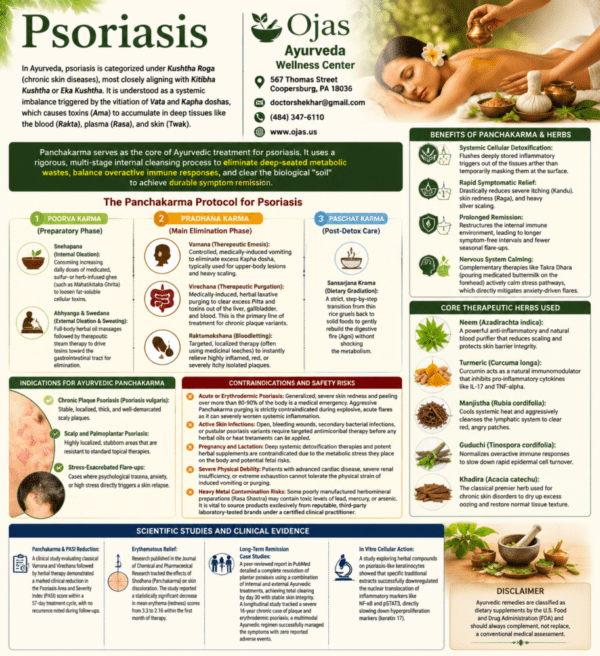
In Ayurveda, psoriasis is categorized under Kushtha Roga (chronic skin diseases), most closely aligning with Kitibha Kushtha or Eka Kushtha. It is understood as a systemic imbalance triggered by the vitiation of Vata and Kapha doshas, which causes toxins (Ama) to accumulate in deep tissues like the blood (Rakta), plasma (Rasa), and skin (Twak).
Panchakarma serves as the core of Ayurvedic treatment for psoriasis. It uses a rigorous, multi-stage internal cleansing process to eliminate deep-seated metabolic wastes, balance overactive immune responses, and clear the biological “soil” to achieve durable symptom remission.
The Panchakarma Protocol for Psoriasis
The classical detoxification process is broken down into three distinct phases:
- Poorva Karma (Preparatory Phase)
- Snehapana (Internal Oleation): Consuming increasing daily doses of medicated, sulfur- or herb-infused ghee (such as Mahatikitaka Ghrita) to loosen fat-soluble cellular toxins.
- Abhyanga & Swedana (External Oleation & Sweating): Full-body herbal oil massages followed by therapeutic steam therapy to drive toxins toward the gastrointestinal tract for elimination.
- Pradhana Karma (Main Elimination Phase)
- Vamana (Therapeutic Emesis): Controlled, medically-induced vomiting to eliminate excess Kapha dosha, typically used for upper-body lesions and heavy scaling.
- Virechana (Therapeutic Purgation): Medically-induced, herbal laxative purging to clear excess Pitta and toxins out of the liver, gallbladder, and blood. This is the primary line of treatment for chronic plaque variants.
- Raktamokshana (Bloodletting): Targeted, localized therapy (often using medicinal leeches) to instantly relieve highly inflamed, red, or severely itchy isolated plaques.
- Paschat Karma (Post-Detox Care)
- Sansarjana Krama (Dietary Gradiation): A strict, step-by-step transition from thin rice gruels back to solid foods to gently rebuild the digestive fire (Agni) without shocking the metabolism.
Benefits of Panchakarma & Herbs
- Systemic Cellular Detoxification: Flushes deeply stored inflammatory triggers out of the tissues rather than temporarily masking them at the surface.
- Rapid Symptomatic Relief: Drastically reduces severe itching (Kandu), skin redness (Raga), and heavy silver scaling.
- Prolonged Remission: Restructures the internal immune environment, leading to longer symptom-free intervals and fewer seasonal flare-ups.
- Nervous System Calming: Complementary therapies like Takra Dhara (pouring medicated buttermilk on the forehead) actively calm stress pathways, which directly mitigates anxiety-driven flares.
Core Therapeutic Herbs Used
- Neem (Azadirachta indica): A powerful anti-inflammatory and natural blood purifier that reduces scaling and protects skin barrier integrity.
- Turmeric (Curcuma longa): Curcumin acts as a natural immunomodulator that inhibits pro-inflammatory cytokines like IL-17 and TNF-alpha.
- Manjistha (Rubia cordifolia): Cools systemic heat and aggressively cleanses the lymphatic system to clear red, angry patches.
- Guduchi (Tinospora cordifolia): Normalizes overactive immune responses to slow down rapid epidermal cell turnover.
- Khadira (Acacia catechu): The classical premier herb used for chronic skin disorders to dry up excess oozing and restore normal tissue texture.
Indications for Ayurvedic Panchakarma
- Chronic Plaque Psoriasis (Psoriasis vulgaris): Stable, localized, thick, and well-demarcated scaly plaques.
- Scalp and Palmoplantar Psoriasis: Highly localized, stubborn areas that are resistant to standard topical therapies.
- Stress-Exacerbated Flare-ups: Cases where psychological trauma, anxiety, or high stress directly triggers a skin relapse.
Contraindications and Safety Risks
- Acute or Erythrodermic Psoriasis: Generalized, severe skin redness and peeling over more than 80-90% of the body is a medical emergency. Aggressive Panchakarma purging is strictly contraindicated during explosive, acute flares as it can severely worsen systemic inflammation.
- Active Skin Infections: Open, bleeding wounds, secondary bacterial infections, or pustular psoriasis variants require targeted antimicrobial therapy before any herbal oils or heat treatments can be applied.
- Pregnancy and Lactation: Deep systemic detoxification therapies and potent herbal supplements are contraindicated due to the metabolic stress they place on the body and potential fetal risks.
- Severe Physical Debility: Patients with advanced cardiac disease, severe renal insufficiency, or extreme exhaustion cannot tolerate the physical strain of induced vomiting or purging.
- Heavy Metal Contamination Risks: Some poorly manufactured herbomineral preparations (Rasa Shastra) may contain toxic levels of lead, mercury, or arsenic. It is vital to source products exclusively from reputable, third-party laboratory-tested brands under a certified clinical practitioner.
Disclaimer: Ayurvedic remedies are classified as dietary supplements by the U.S. Food and Drug Administration (FDA) and should always complement, not replace, a conventional medical assessment.
Scientific Studies and Clinical Evidence
While large-scale, double-blind Western clinical trials are still limited, a growing body of published case series and comparative research supports the efficacy of these protocols:
- Panchakarma & PASI Reduction: A clinical study evaluating classical Vamana and Virechana followed by herbal therapy demonstrated a marked clinical reduction in the Psoriasis Area and Severity Index (PASI) score within a 57-day treatment cycle, with no recurrence noted during follow-ups.
- Erythematous Relief: Research published in the Journal of Chemical and Pharmaceutical Research tracked the effects of Shodhana (Panchakarma) on skin discoloration. The study reported a statistically significant decrease in mean erythema (redness) scores from 3.3 to 2.16 within the first month of therapy.
- Long-Term Remission Case Studies: A peer-reviewed report in PubMed detailed a complete resolution of plantar psoriasis using a combination of internal and external Ayurvedic treatments, achieving total clearing by day 30 with stable skin integrity. Similarly, a longitudinal study tracked a severe 16-year chronic case of plaque and erythrodermic psoriasis; a multimodal Ayurvedic regimen successfully managed the symptoms with zero reported adverse events.
- In Vitro Cellular Action: A study exploring herbal compounds on psoriasis-like keratinocytes showed that specific traditional extracts successfully downregulated the nuclear translocation of inflammatory markers like NF-κB and pSTAT3, directly slowing down hyperproliferation markers (keratin 17)