Description
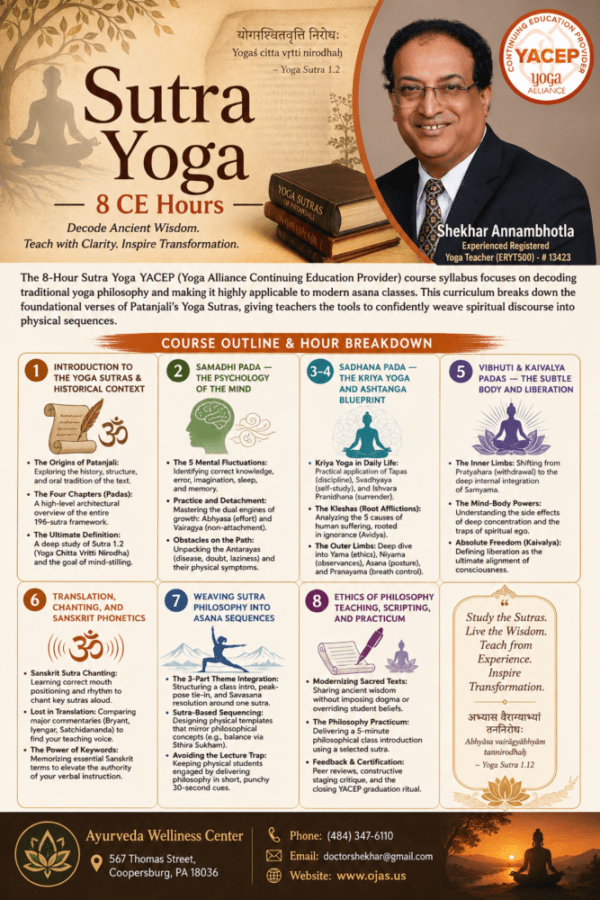
Sutra Yoga Training
8 CE Hours
Instructor: Shekhar Annambhotla
Experienced Registered Yoga Teacher (ERYT500) – # 13423
Ayurveda Wellness Center
567 Thomas Street, Coopersburg, PA 18036
Phone: (484) 347-6110
Email: doctorshekhar@gmail.com
Website: www.ojas.us
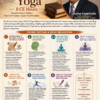
The 8-Hour Sutra Yoga YACEP (Yoga Alliance Continuing Education Provider) course syllabus focuses on decoding traditional yoga philosophy and making it highly applicable to modern asana classes. This curriculum breaks down the foundational verses of Patanjali’s Yoga Sutras, giving teachers the tools to confidently weave spiritual discourse into physical sequences.
Sutra Yoga primarily refers to the structural study of the Yoga Sutras of Patanjali, which serve as the definitive philosophical blueprint for classical yoga practice.
- The Core Philosophy: The Yoga Sutras of Patanjali
The Yoga Sutras of Patanjali is a collection of 196 Sanskrit aphorisms compiled roughly 1,700 to 2,000 years ago. It serves as the ultimate map for the yogic path, defining yoga not as physical exercise, but as “Chitta Vritti Nirodha”—the calming and stilling of the fluctuations of the mind.
- The Four Chapters (Padas): The text is split into four progressive books covering mental absorption (Samadhi), the practice of yoga (Sadhana), extraordinary mental powers (Vibhuti), and absolute spiritual liberation (Kaivalya).
- The Blueprint for Asana: Out of 196 sutras, only three explicitly mention asana (physical postures). Patanjali defines the perfect posture simply as Sthira Sukham Asanam—a position that is perfectly steady, stable, and comfortable, designed entirely to facilitate hours of quiet meditation.
- Study Materials: Modern students typically study translations and masterclasses accompanied by deep traditional commentaries, such as versions by Swami Vivekananda or Edwin F. Bryant.
Course Outline & Hour Breakdown
Hour 1: Introduction to the Yoga Sutras & Historical Context
- The Origins of Patanjali: Exploring the history, structure, and oral tradition of the text.
- The Four Chapters (Padas): A high-level architectural overview of the entire 196-sutra framework.
- The Ultimate Definition: A deep study of Sutra 1.2 (Yoga Chitta Vritti Nirodha) and the goal of mind-stilling.
Hour 2: Samadhi Pada — The Psychology of the Mind
- The 5 Mental Fluctuations: Identifying correct knowledge, error, imagination, sleep, and memory.
- Practice and Detachment: Mastering the dual engines of growth: Abhyasa (effort) and Vairagya (non-attachment).
- Obstacles on the Path: Unpacking the Antarayas (disease, doubt, laziness) and their physical symptoms.
Hours 3–4: Sadhana Pada — The Kriya Yoga and Ashtanga Blueprint
- Kriya Yoga in Daily Life: Practical application of Tapas (discipline), Svadhyaya (self-study), and Ishvara Pranidhana (surrender).
- The Kleshas (Root Afflictions): Analyzing the 5 causes of human suffering, rooted in ignorance (Avidya).
- The Outer Limbs: Deep dive into Yama (ethics), Niyama (observances), Asana (posture), and Pranayama (breath control).
Hour 5: Vibhuti & Kaivalya Padas — The Subtle Body and Liberation
- The Inner Limbs: Shifting from Pratyahara (withdrawal) to the deep internal integration of Samyama.
- The Mind-Body Powers: Understanding the side effects of deep concentration and the traps of spiritual ego.
- Absolute Freedom (Kaivalya): Defining liberation as the ultimate alignment of consciousness.
Hour 6: Translation, Chanting, and Sanskrit Phonetics
- Sanskrit Sutra Chanting: Learning correct mouth positioning and rhythm to chant key sutras aloud.
- Lost in Translation: Comparing major commentaries (Bryant, Iyengar, Satchidananda) to find your teaching voice.
- The Power of Keywords: Memorizing essential Sanskrit terms to elevate the authority of your verbal instruction.
Hour 7: Weaving Sutra Philosophy into Asana Sequences
- The 3-Part Theme Integration: Structuring a class intro, peak-pose tie-in, and Savasana resolution around one sutra.
- Sutra-Based Sequencing: Designing physical templates that mirror philosophical concepts (e.g., balance via Sthira Sukham).
- Avoiding the Lecture Trap: Keeping physical students engaged by delivering philosophy in short, punchy 30-second cues.
Hour 8: Ethics of Philosophy Teaching, Scripting, and Practicum
- Modernizing Sacred Texts: Sharing ancient wisdom without imposing dogma or overriding student beliefs.
- The Philosophy Practicum: Delivering a 5-minute philosophical class introduction using a selected sutra.
- Feedback & Certification: Peer reviews, constructive staging critique, and the closing YACEP graduation ritual.