Description
Tantra Yoga Training
8 CE Hours
Instructor: Shekhar Annambhotla
Experienced Registered Yoga Teacher (ERYT500) – # 13423
Ayurveda Wellness Center
567 Thomas Street, Coopersburg, PA 18036
Phone: (484) 347-6110
Email: doctorshekhar@gmail.com
Website: www.ojas.us
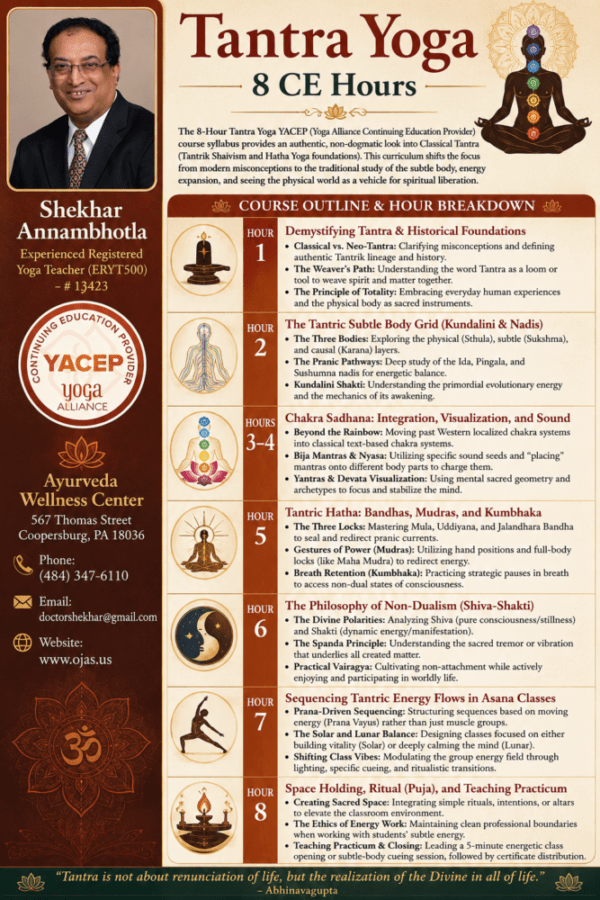
The 8-Hour Tantra Yoga YACEP (Yoga Alliance Continuing Education Provider) course syllabus provides an authentic, non-dogmatic look into Classical Tantra (Tantrik Shaivism and Hatha Yoga foundations). This curriculum shifts the focus from modern misconceptions to the traditional study of the subtle body, energy expansion, and seeing the physical world as a vehicle for spiritual liberation.
Tantra Yoga is an ancient, holistic path of yoga that seeks to expand human consciousness by weaving together the physical, energetic, and spiritual worlds. Unlike ascetic paths that require denying worldly pleasures, Tantra teaches that everything in the universe—including the body, desires, and daily life—can be utilized as a vehicle for spiritual awakening and liberation (Moksha).
The Core Philosophy and Misconceptions
The Sanskrit word Tantra translates to “weave,” “loom,” or “expansion.” In contemporary Western culture, Tantra is frequently misunderstood as being exclusively about sacred sexuality (often called Neo-Tantra). However, in classical spiritual lineages, sexuality is only a tiny fraction of a massive, comprehensive system.
Classical Tantra focuses heavily on:
- The Energy Body: Systematically mapping and activating the chakras (energy centers) and nadis (channels).
- Kundalini Shakti: Awakening the dormant, cosmic spiritual energy coiled at the base of the spine.
- Divine Balance: Integrating the polarities of Shiva (pure consciousness/masculine) and Shakti (dynamic creative energy/feminine) within oneself.
Key Practices of Tantra Yoga
Tantra utilizes a diverse and powerful toolkit to alter consciousness and accelerate spiritual evolution:
- Asana & Pranayama: Practicing physical postures and breathwork to purify the physical body and build a strong container for intense spiritual energy.
- Mantras: Chanting sacred sound frequencies to tune the mind to specific cosmic vibrations.
- Mudras: Using symbolic hand gestures to lock, seal, and direct internal energy flows.
- Yantras & Mandalas: Meditating on complex geometric diagrams to visualize and connect with specific divine archetypes or deities.
- Kundalini Kriyas: Executing precise sequences of movement, breath, and sound to clear energetic blockages.
Course Outline & Hour Breakdown
Hour 1: Demystifying Tantra & Historical Foundations
- Classical vs. Neo-Tantra: Clarifying misconceptions and defining authentic Tantrik lineage and history.
- The Weaver’s Path: Understanding the word Tantra as a loom or tool to weave spirit and matter together.
- The Principle of Totality: Embracing everyday human experiences and the physical body as sacred instruments.
Hour 2: The Tantric Subtle Body Grid (Kundalini & Nadis)
- The Three Bodies: Exploring the physical (Sthula), subtle (Sukshma), and causal (Karana) layers.
- The Pranic Pathways: Deep study of the Ida, Pingala, and Sushumna nadis for energetic balance.
- Kundalini Shakti: Understanding the primordial evolutionary energy and the mechanics of its awakening.
Hours 3–4: Chakra Sadhana: Integration, Visualization, and Sound
- Beyond the Rainbow: Moving past Western localized chakra systems into classical text-based chakra systems.
- Bija Mantras & Nyasa: Utilizing specific sound seeds and “placing” mantras onto different body parts to charge them.
- Yantras & Devata Visualization: Using mental sacred geometry and archetypes to focus and stabilize the mind.
Hour 5: Tantric Hatha: Bandhas, Mudras, and Kumbhaka
- The Three Locks: Mastering Mula, Uddiyana, and Jalandhara Bandha to seal and redirect pranic currents.
- Gestures of Power (Mudras): Utilizing hand positions and full-body locks (like Maha Mudra) to redirect energy.
- Breath Retention (Kumbhaka): Practicing strategic pauses in breath to access non-dual states of consciousness.
Hour 6: The Philosophy of Non-Dualism (Shiva-Shakti)
- The Divine Polarities: Analyzing Shiva (pure consciousness/stillness) and Shakti (dynamic energy/manifestation).
- The Spanda Principle: Understanding the sacred tremor or vibration that underlies all created matter.
- Practical Vairagya: Cultivating non-attachment while actively enjoying and participating in worldly life.
Hour 7: Sequencing Tantric Energy Flows in Asana Classes
- Prana-Driven Sequencing: Structuring sequences based on moving energy (Prana Vayus) rather than just muscle groups.
- The Solar and Lunar Balance: Designing classes focused on either building vitality (Solar) or deeply calming the mind (Lunar).
- Shifting Class Vibes: Modulating the group energy field through lighting, specific cueing, and ritualistic transitions.
Hour 8: Space Holding, Ritual (Puja), and Teaching Practicum
- Creating Sacred Space: Integrating simple rituals, intentions, or altars to elevate the classroom environment.
- The Ethics of Energy Work: Maintaining clean professional boundaries when working with students’ subtle energy.
- Teaching Practicum & Closing: Leading a 5-minute energetic class opening or subtle-body cueing session, followed by certificate distribution.