Description
45 minutes: $175
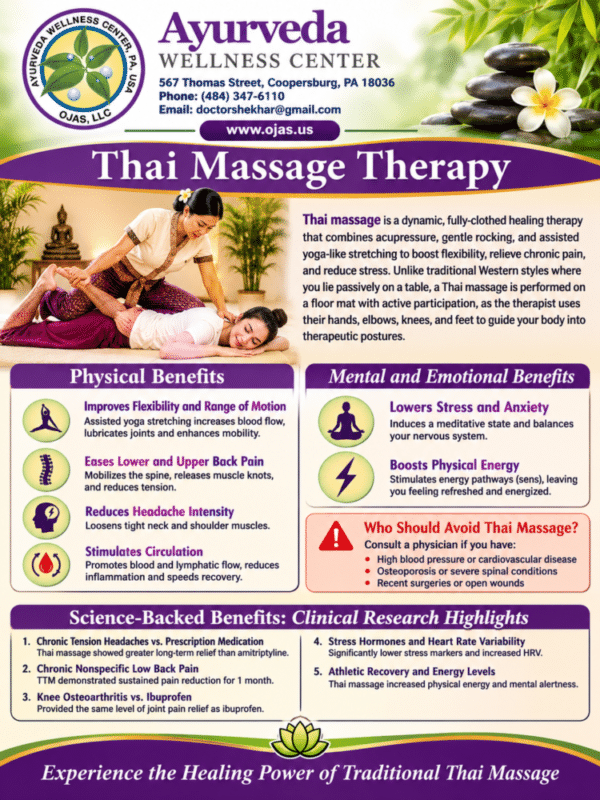
Thai massage is a dynamic, fully-clothed healing therapy that combines acupressure, gentle rocking, and assisted yoga-like stretching to boost flexibility, relieve chronic pain, and reduce stress. Unlike traditional Western styles where you lie passively on a table, a Thai massage is performed on a floor mat with active participation, as the therapist uses their hands, elbows, knees, and feet to guide your body into therapeutic postures.
Science-backed benefits of traditional Thai massage include:
Physical Benefits
- Improves Flexibility and Range of Motion: The integration of passive, assisted yoga stretching increases blood flow and oxygen supply to your muscles. This lubricates the joints, stretches the tendons, and noticeably enhances overall mobility.
- Eases Lower and Upper Back Pain: Because it utilizes poses that target hard-to-reach areas—such as the inner thighs and abdomen—Thai massage effectively mobilizes the spine, releases muscle knots, and reduces lower back tension.
- Reduces Headache Intensity: Clinical studies suggest that the focused compression and upper body stretching of Thai massage can loosen tight neck and shoulder muscles, significantly reducing the frequency and pain of chronic tension headaches or migraines.
- Stimulates Circulation: The rhythmic rocking and deep muscular manipulations promote the circulation of both blood and lymphatic fluid. This aids in reducing systemic inflammation and accelerating muscle recovery.
Mental and Emotional Benefits
- Lowers Stress and Anxiety: The steady, rhythmic movements combined with deep breathing induce a meditative state. This drops your physiological stress markers (like salivary alpha-amylase) and balances your nervous system.
- Boosts Physical Energy: While Swedish massage is primarily designed for sleep and relaxation, Thai massage works to stimulate the body’s energy pathways (sens), leaving you feeling mentally sharp, refreshed, and physically energized.
Who Should Avoid Thai Massage?
Because of its intense, physically rigorous nature, Thai massage is not a passive luxury treatment and may not be safe for everyone. You should consult a physician beforehand if you have underlying conditions such as:
- High blood pressure or cardiovascular disease
- Osteoporosis or severe spinal conditions
- Recent surgeries or open wounds
While complementary therapies are sometimes dismissed as purely anecdotal, Traditional Thai Massage (TTM) has been evaluated in numerous peer-reviewed clinical trials. Researchers, primarily out of university medical faculties in Thailand, have studied its efficacy by comparing it directly to Western pharmaceuticals, physical therapy equipment, and alternative manual treatments.
The primary clinical findings from recent randomized controlled trials (RCTs) and systematic reviews include:
- Chronic Tension Headaches vs. Prescription Medication
A prominent randomized controlled trial published in BMC Complementary and Alternative Medicine investigated the clinical effects of Court-Type Traditional Thai Massage (CTTM) for patients suffering from chronic tension-type headaches.
- The Study: 60 patients were split into two groups. The control group took 25 mg of amitriptyline (a common tricyclic antidepressant prescribed for migraine and headache prevention) daily for 4 weeks. The treatment group received a 45-minute Thai massage twice a week for 4 weeks.
- The Findings: Both groups showed a significant decrease in headache intensity. However, the Thai massage group demonstrated greater long-term improvements in pressure pain thresholds (PPT) and tissue hardness, presenting a viable non-pharmacological alternative with fewer side effects. A separate study in The Journal of Physical Therapy Science also confirmed that TTM significantly increases pressure pain thresholds in both tension headache and migraine sufferers.
- Chronic Nonspecific Low Back Pain
Low back pain is one of the most frequently studied applications of Thai massage, with studies measuring its performance against standard physical therapy protocols.
- The Study: A clinical trial published in the Journal of Physical Therapy Science allocated 120 patients with chronic nonspecific lower back pain into two treatment arms: traditional Thai massage or joint mobilization therapy (a localized physical therapy technique). Treatments were given twice a week for 4 weeks.
- The Findings: Both groups experienced major, statistically equivalent reductions in pain and disability scores. The traditional Thai massage group demonstrated better numbers in long-term pain reduction that sustained for a full month post-treatment, proving that TTM behaves as a safe, highly effective short-term conservative treatment.
- Knee Osteoarthritis vs. Ibuprofen
Clinical trials have examined how Thai massage addresses joint pain and functional mobility impairments in aging populations.
- The Study: Research compared a 3-week regimen of traditional Thai massage against a standard 3-week oral regimen of ibuprofen for 60 patients diagnosed with osteoarthritis of the knee.
- The Findings: The study concluded that traditional Thai massage provided the same level of joint pain relief as the daily course of ibuprofen. In tandem with another study looking at Thai massage mixed with light exercise, participants also showed marked improvements in walking speed, joint flexibility, and self-reported quality of life metrics.
- Stress Hormones and Heart Rate Variability (HRV)
Beyond structural relief, researchers have used biochemical markers to see how the active stretching affects the autonomic nervous system.
- The Study: A study evaluating salivary alpha-amylase (sAA)—an enzyme marker that spikes under psychological and sympathetic nervous system stress—compared healthy individuals receiving TTM against those who simply rested.
- The Findings: Patients receiving Thai massage showed significantly lower levels of salivary stress markers post-treatment compared to the resting group. Concurrently, studies tracking electrocardiograms showed an increase in Heart Rate Variability (HRV), indicating a shift away from the “fight-or-flight” response toward a relaxed parasympathetic state.
- Athletic Recovery and Energy Levels
While Swedish massage is traditionally associated with sedation and sleep, Thai massage has unique data regarding alertness.
- The Study: A randomized crossover trial compared the acute effects of Thai and Swedish massage in individuals experiencing severe mental and physical fatigue.
- The Findings: While both techniques lowered overall muscle tension, Thai massage significantly increased perceived physical energy levels and mental stimulation
*These statements are not evaluated by Food and Drug Administration. These services are not intended to diagnose, treat, cure or prevent any disease.