
Description
45 minutes: $175
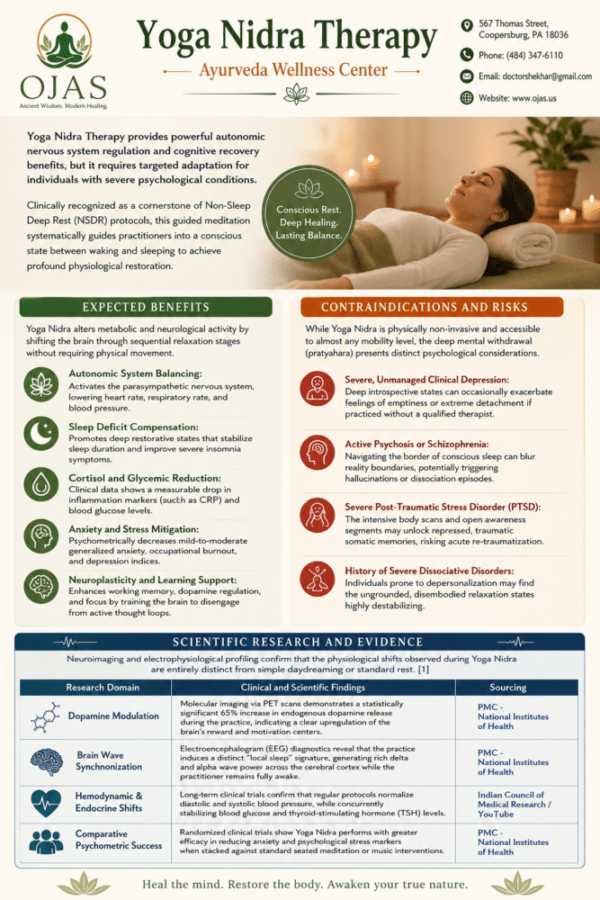
Yoga Nidra Therapy provides powerful autonomic nervous system regulation and cognitive recovery benefits, but it requires targeted adaptation for individuals with severe psychological conditions. Clinically recognized as a cornerstone of Non-Sleep Deep Rest (NSDR) protocols, this guided meditation systematically guides practitioners into a conscious state between waking and sleeping to achieve profound physiological restoration.
Expected Benefits
Yoga Nidra alters metabolic and neurological activity by shifting the brain through sequential relaxation stages without requiring physical movement.
- Autonomic System Balancing: Activates the parasympathetic nervous system, lowering heart rate, respiratory rate, and blood pressure.
- Sleep Deficit Compensation: Promotes deep restorative states that stabilize sleep duration and improve severe insomnia symptoms.
- Cortisol and Glycemic Reduction: Clinical data shows a measurable drop in inflammation markers (such as CRP) and blood glucose levels.
- Anxiety and Stress Mitigation: Psychometrically decreases mild-to-moderate generalized anxiety, occupational burnout, and depression indices.
- Neuroplasticity and Learning Support: Enhances working memory, dopamine regulation, and focus by training the brain to disengage from active thought loops.
Contraindications and Risks
While Yoga Nidra is physically non-invasive and accessible to almost any mobility level, the deep mental withdrawal (pratyahara) presents distinct psychological considerations.
- Severe, Unmanaged Clinical Depression: Deep introspective states can occasionally exacerbate feelings of emptiness or extreme detachment if practiced without a qualified therapist.
- Active Psychosis or Schizophrenia: Navigating the border of conscious sleep can blur reality boundaries, potentially triggering hallucinations or dissociation episodes.
- Severe Post-Traumatic Stress Disorder (PTSD): The intensive body scans and open awareness segments may unlock repressed, traumatic somatic memories, risking acute re-traumatization.
- History of Severe Dissociative Disorders: Individuals prone to depersonalization may find the ungrounded, disembodied relaxation states highly destabilizing.
Scientific Research and Evidence
Neuroimaging and electrophysiological profiling confirm that the physiological shifts observed during Yoga Nidra are entirely distinct from simple daydreaming or standard rest. [1]
| Research Domain | Clinical and Scientific Findings | Sourcing |
| Dopamine Modulation | Molecular imaging via PET scans demonstrates a statistically significant 65% increase in endogenous dopamine release during the practice, indicating a clear upregulation of the brain’s reward and motivation centers. | PMC – National Institutes of Health |
| Brain Wave Synchronization | Electroencephalogram (EEG) diagnostics reveal that the practice induces a distinct “local sleep” signature, generating rich delta and alpha wave power across the cerebral cortex while the practitioner remains fully awake. | PMC – National Institutes of Health |
| Hemodynamic & Endocrine Shifts | Long-term clinical trials confirm that regular protocols normalize diastolic and systolic blood pressure, while concurrently stabilizing blood glucose and thyroid-stimulating hormone (TSH) levels. | Indian Council of Medical Research / YouTube |
| Comparative Psychometric Success | Randomized clinical trials show Yoga Nidra performs with greater efficacy in reducing anxiety and psychological stress markers when stacked against standard seated meditation or music interventions. | PMC – National Institutes of Health |
*These statements are not evaluated by Food and Drug Administration. These services are not intended to diagnose, treat, cure or prevent any disease.