Description
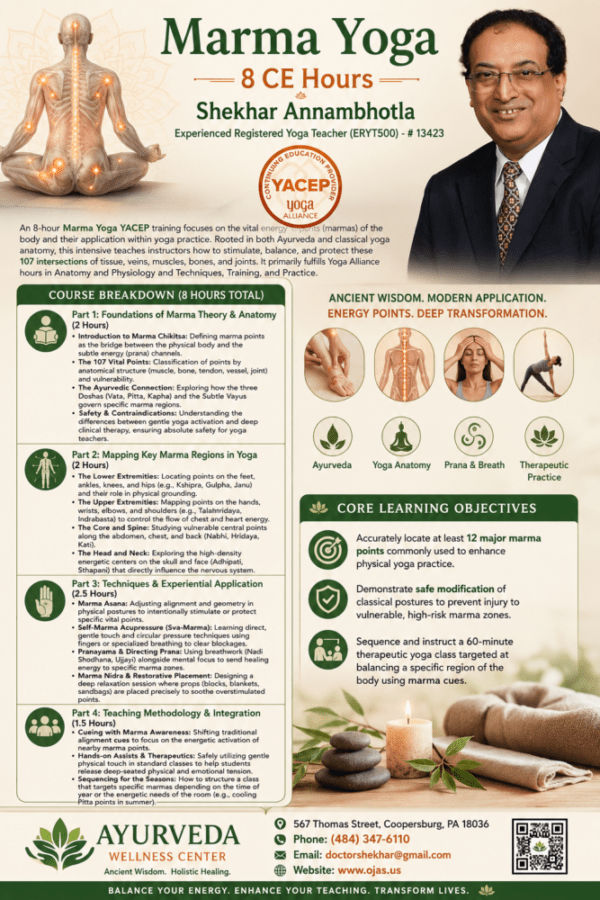
Marma Yoga Training
8 CE Hours
Instructor: Shekhar Annambhotla
Experienced Registered Yoga Teacher (ERYT500) – # 13423
Ayurveda Wellness Center
567 Thomas Street, Coopersburg, PA 18036
Phone: (484) 347-6110
Email: doctorshekhar@gmail.com
Website: www.ojas.us
An 8-hour Marma Yoga YACEP training focuses on the vital energy points (marmas) of the body and their application within yoga practice. Rooted in both Ayurveda and classical yoga anatomy, this intensive teaches instructors how to stimulate, balance, and protect these 107 intersections of tissue, veins, muscles, bones, and joints. It primarily fulfills Yoga Alliance hours in Anatomy and Physiology and Techniques, Training, and Practice.
Here is a structured syllabus blueprint for an 8-hour Marma Yoga intensive:
Course Breakdown (8 Hours Total)
Part 1: Foundations of Marma Theory & Anatomy (2 Hours)
- Introduction to Marma Chikitsa: Defining marma points as the bridge between the physical body and the subtle energy (prana) channels.
- The 107 Vital Points: Classification of points by anatomical structure (muscle, bone, tendon, vessel, joint) and vulnerability.
- The Ayurvedic Connection: Exploring how the three Doshas (Vata, Pitta, Kapha) and the Subtle Vayus govern specific marma regions.
- Safety & Contraindications: Understanding the differences between gentle yoga activation and deep clinical therapy, ensuring absolute safety for yoga teachers.
Part 2: Mapping Key Marma Regions in Yoga (2 Hours)
- The Lower Extremities: Locating points on the feet, ankles, knees, and hips (e.g., Kshipra, Gulpha, Janu) and their role in physical grounding.
- The Upper Extremities: Mapping points on the hands, wrists, elbows, and shoulders (e.g., Talahridaya, Indrabasta) to control the flow of chest and heart energy.
- The Core and Spine: Studying vulnerable central points along the abdomen, chest, and back (Nabhi, Hridaya, Kati).
- The Head and Neck: Exploring the high-density energetic centers on the skull and face (Adhipati, Sthapani) that directly influence the nervous system.
Part 3: Techniques & Experiential Application (2.5 Hours)
- Marma Asana: Adjusting alignment and geometry in physical postures to intentionally stimulate or protect specific vital points.
- Self-Marma Acupressure (Sva-Marma): Learning direct, gentle touch and circular pressure techniques using fingers or specialized breathing to clear blockages.
- Pranayama & Directing Prana: Using breathwork (Nadi Shodhana, Ujjayi) alongside mental focus to send healing energy to specific marma zones.
- Marma Nidra & Restorative Placement: Designing a deep relaxation session where props (blocks, blankets, sandbags) are placed precisely to soothe overstimulated points.
Part 4: Teaching Methodology & Integration (1.5 Hours)
- Cuing with Marma Awareness: Shifting traditional alignment cues from “tuck your tailbone” or “square your hips” to focus on the energetic activation of nearby marma points.
- Hands-on Assists & Therapeutics: Safely utilizing gentle physical touch in standard classes to help students release deep-seated physical and emotional tension.
- Sequencing for the Seasons: How to structure a class that targets specific marmas depending on the time of year or the energetic needs of the room (e.g., cooling Pitta points in summer).
Core Learning Objectives
- Accurately locate at least 12 major marma points commonly used to enhance physical yoga practice.
- Demonstrate safe modification of classical postures to prevent injury to vulnerable, high-risk marma zones.
- Sequence and instruct a 60-minute therapeutic yoga class targeted at balancing a specific region of the body using marma cues