Description
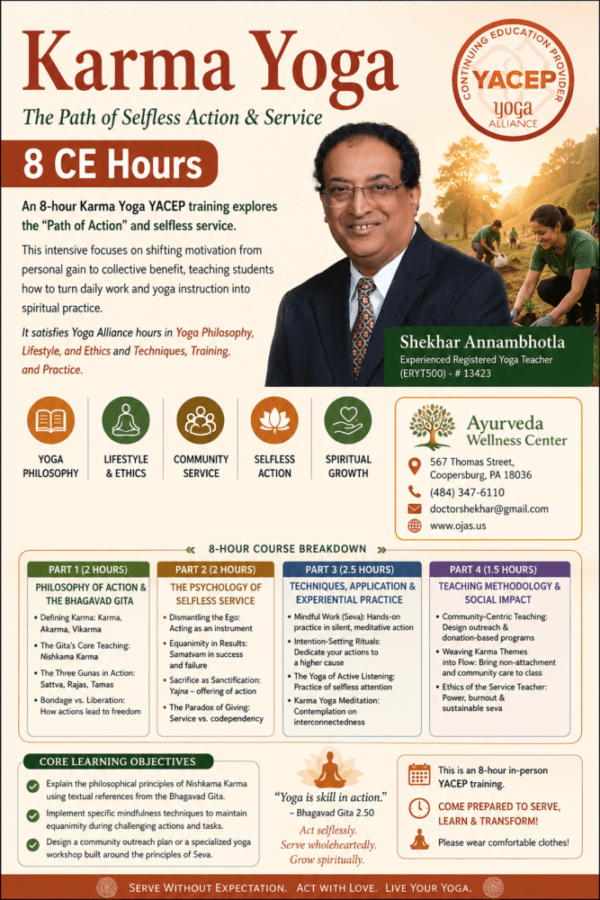
Karma Yoga Training
8 CE Hours
Instructor: Shekhar Annambhotla
Experienced Registered Yoga Teacher (ERYT500) – # 13423
Ayurveda Wellness Center
567 Thomas Street, Coopersburg, PA 18036
Phone: (484) 347-6110
Email: doctorshekhar@gmail.com
Website: www.ojas.us
An 8-hour Karma Yoga YACEP training explores the “Path of Action” and selfless service. This intensive focuses on shifting motivation from personal gain to collective benefit, teaching students how to turn daily work and yoga instruction into spiritual practice. It satisfies Yoga Alliance hours in Yoga Philosophy, Lifestyle, and Ethics and Techniques, Training, and Practice.
- The Concept: Act entirely for the sake of the action itself, never for personal reward, praise, or gain.
- The Shift: You focus 100% of your energy on the quality of your effort, relinquishing the anxiety of the results.
- The Concept: Fulfill your personal, professional, and societal responsibilities with absolute integrity.
- The Shift: Mundane tasks (like washing dishes or filing paperwork) transform into a sacred spiritual practice when done with presence.
- The Concept: Relinquish the idea that you are the sole author of your achievements.
- The Shift: You begin to view your body and mind as a channel or instrument through which cosmic energy serves the world.
- The Concept: Maintain mental balance and peace whether your actions result in absolute success or total failure.
- The Shift: Life’s ups and downs lose their power to disrupt your inner stability.
Here is a structured syllabus blueprint for an 8-hour Karma Yoga intensive:
Course Breakdown (8 Hours Total)
Part 1: Philosophy of Action & The Bhagavad Gita (2 Hours)
- Defining Karma: Understanding the law of cause and effect, and the distinction between Karma (action), Akarma (inaction), and Vikarma (forbidden action).
- The Gita’s Core Teaching: Deep dive into Nishkama Karma—performing one’s duty (Dharma) without attachment to the fruits of action.
- The Three Gunas in Action: Analyzing how Sattva (purity), Rajas (passion), and Tamas (inertia) influence our daily motivations and work.
- Bondage vs. Liberation: How actions can either tie an individual down or serve as a direct path to spiritual freedom.
Part 2: The Psychology of Selfless Service (2 Hours)
- Dismantling the Ego: Identifying the “doer-ship” complex (Ahamkara) and learning to act as an instrument rather than the author of action.
- Equanimity in Results: Developing mental stability (Samatvam) in both success and failure, praise and blame.
- Sacrifice as Sanctification: Exploring the concept of Yajna (sacrifice/offering) and transforming mundane tasks into sacred rituals.
- The Paradox of Giving: Navigating the fine line between true selfless service and codependency or spiritual bypassing.
Part 3: Techniques, Application & Experiential Practice (2.5 Hours)
- Mindful Work (Seva): Practical, hands-on exercises in silent, meditative action (e.g., mindful cleaning, organizing, or preparing space).
- Intention-Setting Rituals: Techniques for dedicating the energy of a physical practice or task to a higher cause or community need.
- The Yoga of Active Listening: Experiential exercises designed to practice selfless attention and deep presence with others.
- Karma Yoga Meditation: Guided contemplation on interconnectedness, tracing the global web of actions that sustain our daily lives.
Part 4: Teaching Methodology & Social Impact (1.5 Hours)
- Community-Centric Teaching: How to design accessible, donation-based, or outreach-focused yoga programs (Seva projects).
- Weaving Karma Themes into Flow: Strategies for introducing themes of non-attachment, community care, and duty into standard studio classes.
- Ethics of the Service Teacher: Navigating power dynamics, savior complexes, and burnout while serving marginalized or vulnerable populations.
Core Learning Objectives
- Explain the philosophical principles of Nishkama Karma using textual references from the Bhagavad Gita.
- Implement specific mindfulness techniques to maintain equanimity during challenging actions and tasks.
- Design a community outreach plan or a specialized yoga workshop built around the principles of Seva.