Description
Prana Yoga Training
8 CE Hours
Instructor: Shekhar Annambhotla
Experienced Registered Yoga Teacher (ERYT500) – # 13423
Ayurveda Wellness Center
567 Thomas Street, Coopersburg, PA 18036
Phone: (484) 347-6110
Email: doctorshekhar@gmail.com
Website: www.ojas.us
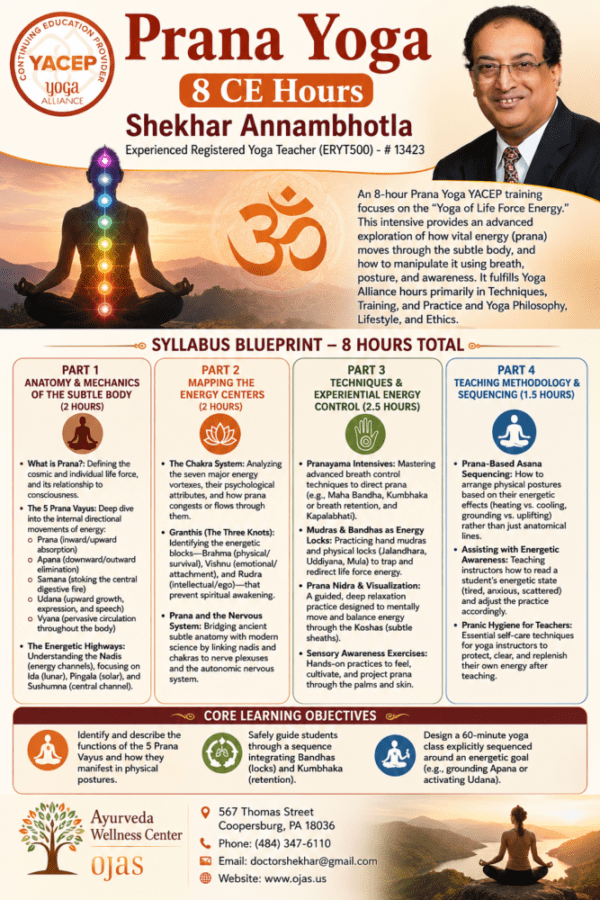
An 8-hour Prana Yoga YACEP training focuses on the “Yoga of Life Force Energy.” This intensive provides an advanced exploration of how vital energy (prana) moves through the subtle body, and how to manipulate it using breath, posture, and awareness. It fulfills Yoga Alliance hours primarily in Techniques, Training, and Practice and Yoga Philosophy, Lifestyle, and Ethics.
In Vedic and Yogic philosophy, Prana is the universal life force energy that permeates all creation and flows through everything alive. It is the energetic equivalent of the Chinese concept of Qi or Chi.
- The Movement of Energy: Prana moves through the subtle body via thousands of energetic channels called nadis. The three main nadis are Ida, Pingala, and Sushumna, which run along the spine.
- Pranayama: This is the fourth limb of Patanjali’s Ashtanga Yoga, translating directly to the “expansion or control of life force.” Through specific breathing techniques (like Alternate Nostril Breathing or Ujjayi breath), practitioners learn to clear energetic blockages and direct the flow of prana.
- Signs of Balanced Prana: High physical vitality, a calm and centered mind, mental clarity, and emotional resilience.
Here is a structured syllabus blueprint for an 8-hour Prana Yoga intensive:
Course Breakdown (8 Hours Total)
Part 1: Anatomy & Mechanics of the Subtle Body (2 Hours)
- What is Prana?: Defining the cosmic and individual life force, and its relationship to consciousness.
- The 5 Prana Vayus: Deep dive into the internal directional movements of energy:
- Prana (inward/upward absorption)
- Apana (downward/outward elimination)
- Samana (stoking the central digestive fire)
- Udana (upward growth, expression, and speech)
- Vyana (pervasive circulation throughout the body)
- The Energetic Highways: Understanding the Nadis (energy channels), focusing on Ida (lunar), Pingala (solar), and Sushumna (central channel).
Part 2: Mapping the Energy Centers (2 Hours)
- The Chakra System: Analyzing the seven major energy vortexes, their psychological attributes, and how prana congests or flows through them.
- Granthis (The Three Knots): Identifying the energetic blocks—Brahma (physical/survival), Vishnu (emotional/attachment), and Rudra (intellectual/ego)—that prevent spiritual awakening.
- Prana and the Nervous System: Bridging ancient subtle anatomy with modern science by linking nadis and chakras to nerve plexuses and the autonomic nervous system.
Part 3: Techniques & Experiential Energy Control (2.5 Hours)
- Pranayama Intensives: Mastering advanced breath control techniques to direct prana (e.g., Maha Bandha, Kumbhaka or breath retention, and Kapalabhati).
- Mudras & Bandhas as Energy Locks: Practicing hand mudras and physical locks (Jalandhara, Uddiyana, Mula) to trap and redirect life force energy.
- Prana Nidra & Visualization: A guided, deep relaxation practice designed to mentally move and balance energy through the Koshas (subtle sheaths).
- Sensory Awareness Exercises: Hands-on practices to feel, cultivate, and project prana through the palms and skin.
Part 4: Teaching Methodology & Sequencing (1.5 Hours)
- Prana-Based Asana Sequencing: How to arrange physical postures based on their energetic effects (heating vs. cooling, grounding vs. uplifting) rather than just anatomical lines.
- Assisting with Energetic Awareness: Teaching instructors how to read a student’s energetic state (tired, anxious, scattered) and adjust the practice accordingly.
- Pranic Hygiene for Teachers: Essential self-care techniques for yoga instructors to protect, clear, and replenish their own energy after teaching.
Core Learning Objectives
- Identify and describe the functions of the 5 Prana Vayus and how they manifest in physical postures.
- Safely guide students through a sequence integrating Bandhas (locks) and Kumbhaka (retention).
- Design a 60-minute yoga class explicitly sequenced around an energetic goal (e.g., grounding Apana or activating Udana)