Description
Ayurvedic (Abhyanga) Massage Training
18 CE Hours
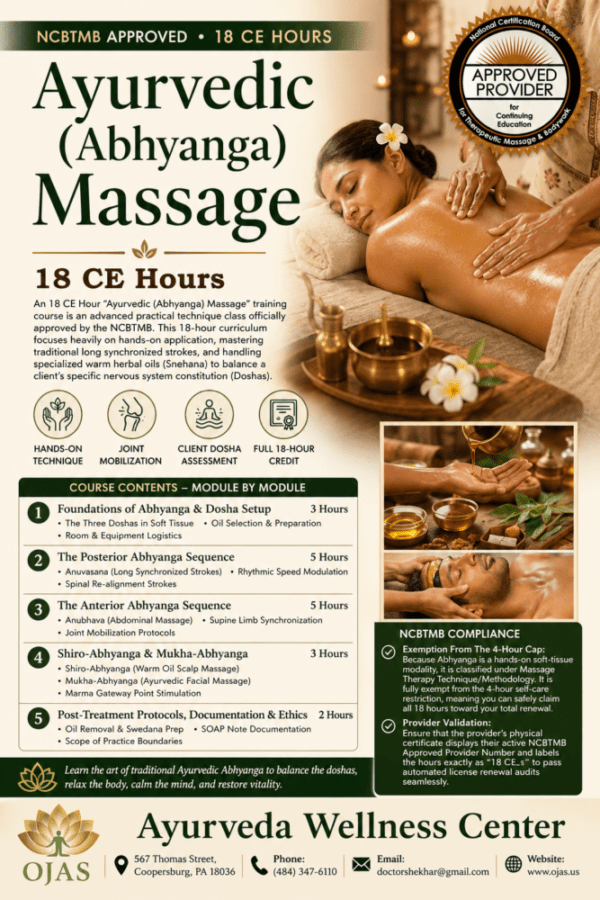
An 18 CE Hour “Ayurvedic (Abhyanga) Massage” training course is an advanced practical technique class officially approved by the NCBTMB. This 18-hour curriculum focuses heavily on hands-on application, mastering traditional long synchronized strokes, and handling specialized warm herbal oils (Snehana) to balance a client’s specific nervous system constitution (Doshas).
🗺️ Module-by-Module Course Contents
Module 1: Foundations of Abhyanga & Dosha Setup (3 Hours)
This opening module bridges basic Ayurvedic theory with the immediate physical environment of the treatment room.
- The Three Doshas in Soft Tissue: Identifying how Vata, Pitta, and Kapha exhibit tension, temperature differences, and specific muscle guarding patterns.
- Oil Selection & Preparation: Learning the chemistry of transdermal oil absorption, selecting baseline carrier oils (sesame for Vata, coconut for Pitta, sunflower for Kapha), and maintaining proper oil temperature.
- Room & Equipment Logistics: Setting up specialized draping for heavy oil applications, table protection protocols, and safety measures to prevent slipping hazards in the workspace.
Module 2: The Posterior Abhyanga Sequence (5 Hours)
The first major practical application block, focusing entirely on the back, legs, and feet.
- Anuvasana (Long Synchronized Strokes): Mastering continuous, fluid, full-body friction strokes that run from the ankles up to the shoulders and back down to the fingertips.
- Rhythmic Speed Modulation: Practicing pace variations based on the client’s needs:
- Vata Pacifying: Slow, heavy, deeply grounding, continuous pressure.
- Pitta Pacifying: Moderate speed, smooth, soothing, medium-light pressure.
- Kapha Pacifying: Fast-paced, vigorous, deep, stimulating friction movements to shift stagnant fluids.
- Spinal Re-alignment Strokes: Utilizing specific thumb and palm friction passes along the bladder meridian and spine to release localized structural tension.
Module 3: The Anterior Abhyanga Sequence (5 Hours)
Transitioning the client to the supine position to address the chest, abdomen, arms, and lower limbs.
- Anubhava (Abdominal Massage): Performing gentle, clockwise, circular strokes over the abdominal cavity to aid digestion, reduce systemic tension, and honor the flow of Samana Vayu (internal winds).
- Supine Limb Synchronization: Coordinating long strokes that seamlessly connect the hands to the chest and the feet to the hips, maintaining a continuous flow of contact.
- Joint Mobilization Protocols: Integrating passive joint movement (Sandhi Chalan) with heavy oil application to lubricate the joint capsules of the wrists, elbows, ankles, and knees.
Module 4: Shiro-Abhyanga & Mukha-Abhyanga (3 Hours)
Targeting the head, face, neck, and shoulders, where emotional and neurological stress heavily accumulates.
- Shiro-Abhyanga (Warm Oil Scalp Massage): Techniques for applying warm oils directly into the hair and scalp using vigorous, clearing friction strokes followed by soothing pressure.
- Mukha-Abhyanga (Ayurvedic Facial Massage): Utilizing precise, upward, gentle facial strokes to ease jaw tension (TMJ) and clear sinus passages without over-stretching delicate skin.
- Marma Gateway Point Stimulation: Locating and gently stimulating the key facial and cranial marma points (e.g., Adhipati at the crown, Ajna between the eyebrows, and Shankha at the temples) to induce deep parasympathetic relaxation.
Module 5: Post-Treatment Protocols, Documentation & Ethics (2 Hours)
The final hours focus on safely transitioning the client off the table and documenting the clinical outcomes.
- Oil Removal & Swedana Prep: Safely wiping excess oil with warm towels, utilizing natural powders (like chickpea flour) to absorb residue, or prepping the client for an optional herbal steam treatment.
- SOAP Note Documentation: Translating Eastern Ayurvedic visual assessment data and soft-tissue feedback into standard Western clinical SOAP notes for legal and professional tracking.
- Scope of Practice Boundaries: Defining communication boundaries to avoid giving illegal nutritional prescriptions, diagnosing medical diseases, or claiming the massage will cure internal pathologies.
📜 NCBTMB Compliance & Board Certification Rules
To guarantee these 18 hours apply cleanly to your 24-hour NCBTMB Board Certification Renewal, ensure your course meets these strict guidelines:
Hands-on Technique
Joint Mobilization
Client Dosha Assessment
Full 18-Hour Credit
- Exemption From The 4-Hour Cap: Because Abhyanga is a hands-on soft-tissue modality, it is classified under Massage Therapy Technique/Methodology. It is fully exempt from the 4-hour self-care restriction, meaning you can safely claim all 18 hours toward your total renewal.
- Provider Validation: Ensure that the provider’s physical certificate displays their active NCBTMB Approved Provider Number and labels the hours exactly as “18 CEs” to pass automated license renewal audits seamlessly.
💳 NCBTMB Provider Information
- Approved Provider Number: 451878-12
- CE Hours Awarded: 18 CEs
- Approval Body: National Certification Board for Therapeutic Massage & Bodywork (NCBTMB)
- Target Audience: Licensed Massage Therapists (LMTs), Certified Bodyworkers, and Estheticians.
- Certificate: Issued immediately upon successful completion of the course and practical evaluation.