
Description
5 days / $2500
Fertility
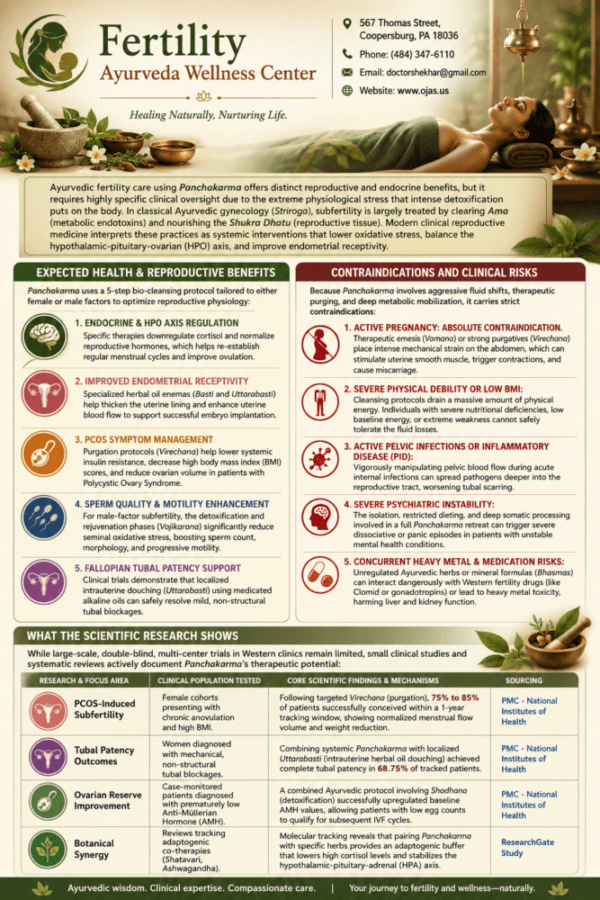
Ayurvedic fertility care using Panchakarma offers distinct reproductive and endocrine benefits, but it requires highly specific clinical oversight due to the extreme physiological stress that intense detoxification puts on the body. In classical Ayurvedic gynecology (Striroga), subfertility is largely treated by clearing Ama (metabolic endotoxins) and nourishing the Shukra Dhatu (reproductive tissue). Modern clinical reproductive medicine interprets these practices as systemic interventions that lower oxidative stress, balance the hypothalamic-pituitary-ovarian (HPO) axis, and improve endometrial receptivity.
Expected Health & Reproductive Benefits
Panchakarma uses a 5-step bio-cleansing protocol tailored to either female or male factors to optimize reproductive physiology:
- Endocrine & HPO Axis Regulation: Specific therapies downregulate cortisol and normalize reproductive hormones, which helps re-establish regular menstrual cycles and improve ovulation.
- Improved Endometrial Receptivity: Specialized herbal oil enemas (Basti and Uttarabasti) help thicken the uterine lining and enhance uterine blood flow to support successful embryo implantation.
- PCOS Symptom Management: Purgation protocols (Virechana) help lower systemic insulin resistance, decrease high body mass index (BMI) scores, and reduce ovarian volume in patients with Polycystic Ovary Syndrome.
- Sperm Quality & Motility Enhancement: For male-factor subfertility, the detoxification and rejuvenation phases (Vajikarana) significantly reduce seminal oxidative stress, boosting sperm count, morphology, and progressive motility.
- Fallopian Tubal Patency Support: Clinical trials demonstrate that localized intrauterine douching (Uttarabasti) using medicated alkaline oils can safely resolve mild, non-structural tubal blockages.
Contraindications and Clinical Risks
Because Panchakarma involves aggressive fluid shifts, therapeutic purging, and deep metabolic mobilization, it carries strict contraindications:
- Active Pregnancy: Absolute contraindication. Therapeutic emesis (Vamana) or strong purgatives (Virechana) place intense mechanical strain on the abdomen, which can stimulate uterine smooth muscle, trigger contractions, and cause miscarriage.
- Severe Physical Debility or Low BMI: Cleansing protocols drain a massive amount of physical energy. Individuals with severe nutritional deficiencies, low baseline energy, or extreme weakness cannot safely tolerate the fluid losses.
- Active Pelvic Infections or Inflammatory Disease (PID): Vigorously manipulating pelvic blood flow during acute internal infections can spread pathogens deeper into the reproductive tract, worsening tubal scarring.
- Severe Psychiatric Instability: The isolation, restricted dieting, and deep somatic processing involved in a full Panchakarma retreat can trigger severe dissociative or panic episodes in patients with unstable mental health conditions.
- Concurrent Heavy Metal & Medication Risks: Unregulated Ayurvedic herbs or mineral formulas (Bhasmas) can interact dangerously with Western fertility drugs (like Clomid or gonadotropins) or lead to heavy metal toxicity, harming liver and kidney function.
What the Scientific Research Shows
While large-scale, double-blind, multi-center trials in Western clinics remain limited, small clinical studies and systematic reviews actively document Panchakarma’s therapeutic potential:
| Research & Focus Area | Clinical Population Tested | Core Scientific Findings & Mechanisms | Sourcing |
| PCOS-Induced Subfertility | Female cohorts presenting with chronic anovulation and high BMI. | Following targeted Virechana (purgation), 75% to 85% of patients successfully conceived within a 1-year tracking window, showing normalized menstrual flow volume and weight reduction. | PMC – National Institutes of Health |
| Tubal Patency Outcomes | Women diagnosed with mechanical, non-structural tubal blockages. | Combining systemic Panchakarma with localized Uttarabasti (intrauterine herbal oil douching) achieved complete tubal patency in 68.75% of tracked patients. | PMC – National Institutes of Health |
| Ovarian Reserve Improvement | Case-monitored patients diagnosed with prematurely low Anti-Müllerian Hormone (AMH). | A combined Ayurvedic protocol involving Shodhana (detoxification) successfully upregulated baseline AMH values, allowing patients with low egg counts to qualify for subsequent IVF cycles. | PMC – National Institutes of Health |
| Botanical Synergy | Reviews tracking adaptogenic co-therapies (Shatavari, Ashwagandha). | Molecular tracking reveals that pairing Panchakarma with specific herbs provides an adaptogenic buffer that lowers high cortisol levels and stabilizes the hypothalamic-pituitary-adrenal (HPA) axis. | ResearchGate Study |
The provided Panchakarma cancellation policy outlines specific financial penalties and credits based on when a cancellation notice is submitted. The policy structures its fees strictly around the mandatory 50% upfront deposit rather than the total program cost.
Below is a clear structural breakdown of how this policy applying to your registration:
💳 Registration & Arrival Payments
- At Registration: A mandatory 50% deposit of the total Panchakarma program cost is due immediately to secure your dates.
- Upon Arrival: The remaining 50% balance is due in full. Once paid at arrival, this final amount is completely non-refundable.
📅 Cancellation Timelines & Financial Penalties
If you must cancel your program prior to your arrival date, your 50% deposit will be handled based on the following three distinct windows:
| Cancellation Window | Processing Fee (Kept by Center) | Remaining Balance Allocation |
| 30+ Days before start | 10% of your deposit is withheld | Credited toward a future program |
| 21 to 30 Days before start | 20% of your deposit is withheld | Credited toward a future program |
| Less than 21 Days before start | 100% of your deposit is withheld | Zero credit; the entire deposit is forfeited |
🧮 Hypothetical Scenario (For Clarity)
If your total Panchakarma program cost is $2,000, your upfront deposit at registration is $1,000. If you cancel:
- 35 days out: The center keeps $100 (10% of deposit). You receive a $900 credit for a future program.
- 25 days out: The center keeps $200 (20% of deposit). You receive an $800 credit for a future program.
- 15 days out: The center keeps the full $1,000 deposit. You receive zero credit.
If you would like help calculating the exact processing fees and future program credits for a specific package price, or if you need to review the scheduling availability for a future date, please let me know.