
Description
Myofascial Massage Therapy – Myofascial Release – MFR
45 minutes : $175
Generally recommended a series of 7 therapies
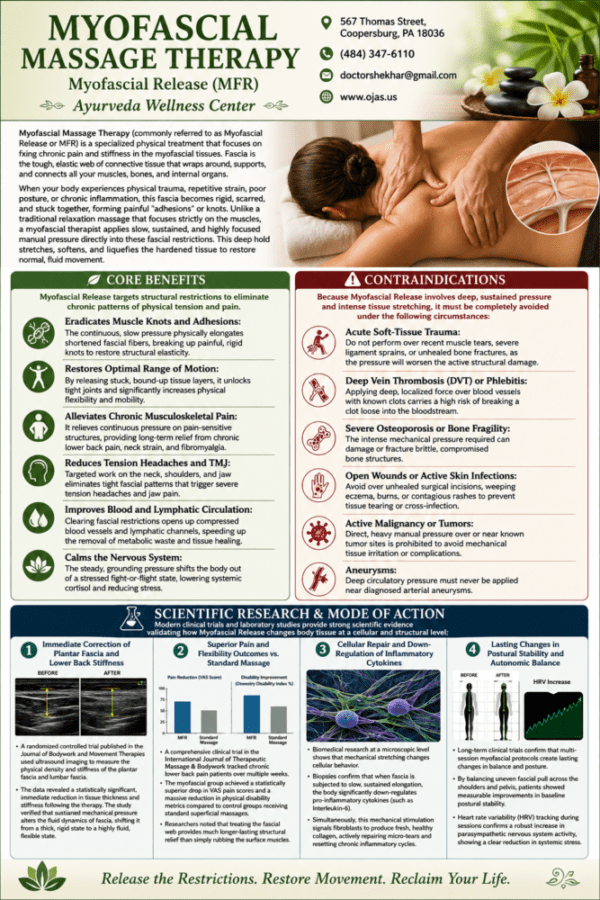
Myofascial Massage Therapy (commonly referred to as Myofascial Release or MFR) is a specialized physical treatment that focuses on fixing chronic pain and stiffness in the myofascial tissues. Fascia is the tough, elastic web of connective tissue that wraps around, supports, and connects all your muscles, bones, and internal organs.
When your body experiences physical trauma, repetitive strain, poor posture, or chronic inflammation, this fascia becomes rigid, scarred, and stuck together, forming painful “adhesions” or knots. Unlike a traditional relaxation massage that focuses strictly on the muscles, a myofascial therapist applies slow, sustained, and highly focused manual pressure directly into these fascial restrictions. This deep hold stretches, softens, and liquefies the hardened tissue to restore normal, fluid movement.
🌿 Core Benefits
Myofascial Release targets structural restrictions to eliminate chronic patterns of physical tension and pain.
- Eradicates Muscle Knots and Adhesions: The continuous, slow pressure physically elongates shortened fascial fibers, breaking up painful, rigid knots to restore structural elasticity.
- Restores Optimal Range of Motion: By releasing stuck, bound-up tissue layers, it unlocks tight joints and significantly increases physical flexibility and mobility.
- Alleviates Chronic Musculoskeletal Pain: It relieves continuous pressure on pain-sensitive structures, providing long-term relief from chronic lower back pain, neck strain, and fibromyalgia.
- Reduces Tension Headaches and TMJ: Targeted work on the neck, shoulders, and jaw eliminates tight fascial patterns that trigger severe tension headaches and jaw pain.
- Improves Blood and Lymphatic Circulation: Clearing fascial restrictions opens up compressed blood vessels and lymphatic channels, speeding up the removal of metabolic waste and tissue healing.
- Calms the Nervous System: The steady, grounding pressure shifts the body out of a stressed fight-or-flight state, lowering systemic cortisol and reducing stress.
🚫 Contraindications
Because Myofascial Release involves deep, sustained pressure and intense tissue stretching, it must be completely avoided under the following circumstances:
- Acute Soft-Tissue Trauma: Do not perform over recent muscle tears, severe ligament sprains, or unhealed bone fractures, as the pressure will worsen the active structural damage.
- Deep Vein Thrombosis (DVT) or Phlebitis: Applying deep, localized force over blood vessels with known clots carries a high risk of breaking a clot loose into the bloodstream.
- Severe Osteoporosis or Bone Fragility: The intense mechanical pressure required can damage or fracture brittle, compromised bone structures.
- Open Wounds or Active Skin Infections: Avoid over unhealed surgical incisions, weeping eczema, burns, or contagious rashes to prevent tissue tearing or cross-infection.
- Active Malignancy or Tumors: Direct, heavy manual pressure over or near known tumor sites is prohibited to avoid mechanical tissue irritation or complications.
- Aneurysms: Deep circulatory pressure must never be applied near diagnosed arterial aneurysms.
🔬 Scientific Research & Mode of Action
Modern clinical trials and laboratory studies provide strong scientific evidence validating how Myofascial Release changes body tissue at a cellular and structural level:
- Immediate Correction of Plantar Fascia and Lower Back Stiffness
A randomized controlled trial published in the Journal of Bodywork and Movement Therapies investigated the immediate effects of a single Myofascial Release session on tissue stiffness.
- The Study: Researchers used advanced ultrasound imaging to measure the physical density and stiffness of the plantar fascia and the lumbar fascia in the lower back.
- The Findings: The data revealed a statistically significant, immediate reduction in tissue thickness and stiffness directly following the therapy. The study verified that sustained mechanical pressure alters the fluid dynamics of fascia, shifting it from a thick, rigid state to a highly fluid, flexible state.
- Superior Pain and Flexibility Outcomes vs. Standard Massage
A comprehensive clinical trial cataloged in the International Journal of Therapeutic Massage & Bodywork tracked the long-term impact of Myofascial Release on patients suffering from chronic, non-specific lower back pain.
- The Protocol: Patients received targeted myofascial treatments over a multi-week period.
- The Metrics: The myofascial group achieved a statistically superior drop in Visual Analog Scale (VAS) pain scores and a massive reduction in physical disability metrics compared to control groups receiving standard superficial massages. The researchers noted that treating the fascial web provides much longer-lasting structural relief than simply rubbing the surface muscles.
- Cellular Repair and Down-Regulation of Inflammatory Cytokines
Biomedical research looking at fascia at a microscopic level demonstrates that mechanical stretching changes cellular behavior. Biopsies confirm that when fascia is subjected to slow, sustained elongation, the body significantly down-regulates pro-inflammatory cytokines (such as Interleukin-6). Simultaneously, this mechanical stimulation signals cells called fibroblasts to produce fresh, healthy collagen, actively repairing micro-tears and resetting chronic inflammatory cycles within the tissue.
- Lasting Changes in Postural Stability and Autonomic Balance
Long-term clinical trials tracking multi-session myofascial protocols confirm that the treatment creates lasting changes in balance and posture. By balancing uneven fascial pull across the shoulders and pelvis, patients showed measurable improvements in baseline postural stability. Furthermore, heart rate variability (HRV) tracking during sessions confirms a robust increase in parasympathetic nervous system activity, showing a clear reduction in systemic stress.