Description
Dhyana Yoga Training
8 CE Hours
Instructor: Shekhar Annambhotla
Experienced Registered Yoga Teacher (ERYT500) – # 13423
Ayurveda Wellness Center
567 Thomas Street, Coopersburg, PA 18036
Phone: (484) 347-6110
Email: doctorshekhar@gmail.com
Website: www.ojas.us
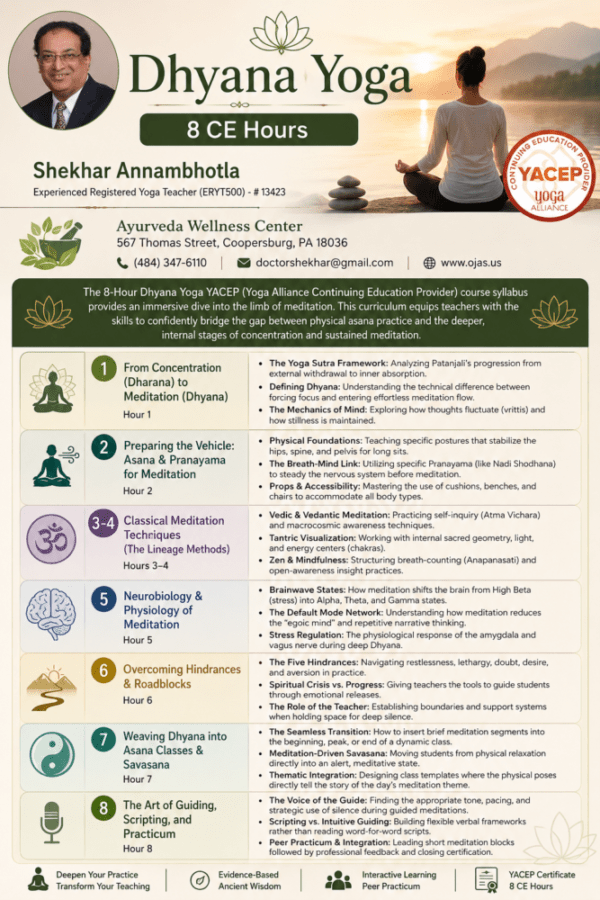
The 8-Hour Dhyana Yoga YACEP (Yoga Alliance Continuing Education Provider) course syllabus provides an immersive dive into the limb of meditation. This curriculum equips teachers with the skills to confidently bridge the gap between physical asana practice and the deeper, internal stages of concentration and sustained meditation.
Course Outline & Hour Breakdown
Hour 1: From Concentration (Dharana) to Meditation (Dhyana)
- The Yoga Sutra Framework: Analyzing Patanjali’s progression from external withdrawal to inner absorption.
- Defining Dhyana: Understanding the technical difference between forcing focus and entering effortless meditation flow.
- The Mechanics of Mind: Exploring how thoughts fluctuate (vrittis) and how stillness is maintained.
Hour 2: Preparing the Vehicle: Asana & Pranayama for Meditation
- Physical Foundations: Teaching specific postures that stabilize the hips, spine, and pelvis for long sits.
- The Breath-Mind Link: Utilizing specific Pranayama (like Nadi Shodhana) to steady the nervous system before meditation.
- Props & Accessibility: Mastering the use of cushions, benches, and chairs to accommodate all body types.
Hours 3–4: Classical Meditation Techniques (The Lineage Methods)
- Vedic & Vedantic Meditation: Practicing self-inquiry (Atma Vichara) and macrocosmic awareness techniques.
- Tantric Visualization: Working with internal sacred geometry, light, and energy centers (chakras).
- Zen & Mindfulness: Structuring breath-counting (Anapanasati) and open-awareness insight practices.
Hour 5: Neurobiology & Physiology of Meditation
- Brainwave States: How meditation shifts the brain from High Beta (stress) into Alpha, Theta, and Gamma states.
- The Default Mode Network: Understanding how meditation reduces the “egoic mind” and repetitive narrative thinking.
- Stress Regulation: The physiological response of the amygdala and vagus nerve during deep Dhyana.
Hour 6: Overcoming Hindrances & Roadblocks
- The Five Hindrances: Navigating restlessness, lethargy, doubt, desire, and aversion in practice.
- Spiritual Crisis vs. Progress: Giving teachers the tools to guide students through emotional releases.
- The Role of the Teacher: Establishing boundaries and support systems when holding space for deep silence.
Hour 7: Weaving Dhyana into Asana Classes & Savasana
- The Seamless Transition: How to insert brief meditation segments into the beginning, peak, or end of a dynamic class.
- Meditation-Driven Savasana: Moving students from physical relaxation directly into an alert, meditative state.
- Thematic Integration: Designing class templates where the physical poses directly tell the story of the day’s meditation theme.
Hour 8: The Art of Guiding, Scripting, and Practicum
- The Voice of the Guide: Finding the appropriate tone, pacing, and strategic use of silence during guided meditations.
- Scripting vs. Intuitive Guiding: Building flexible verbal frameworks rather than reading word-for-word scripts.
- Peer Practicum & Integration: Leading short meditation blocks followed by professional feedback and closing certification.