Description
Schedule Your Follow-up Ayurvedic Wellness Consultation Here
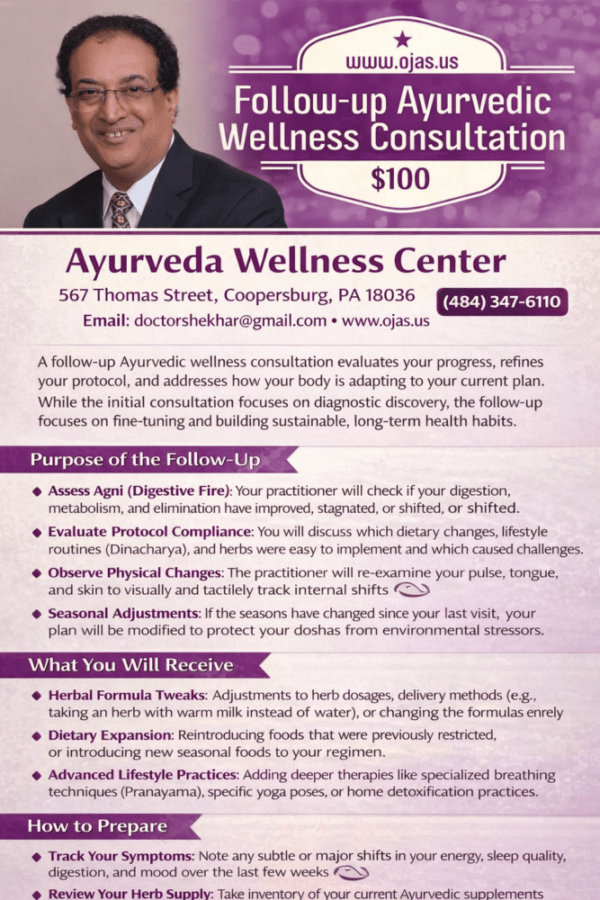
A follow-up Ayurvedic wellness consultation evaluates your progress, refines your protocol, and addresses how your body is adapting to your current plan. While the initial consultation focuses on diagnostic discovery, the follow-up focuses on fine-tuning and building sustainable, long-term health habits.
Here is what to expect, how to prepare, and what you will achieve during your follow-up session.
Purpose of the Follow-Up
The primary goal of a follow-up is to measure changes in your Vikriti (current state of imbalance) and adjust your therapies accordingly:
- Assess Agni (Digestive Fire): Your practitioner will check if your digestion, metabolism, and elimination have improved, stagnated, or shifted.
- Evaluate Protocol Compliance: You will discuss which dietary changes, lifestyle routines (Dinacharya), and herbs were easy to implement and which caused challenges.
- Observe Physical Changes: The practitioner will re-examine your pulse, tongue, and skin to visually and tactilely track internal shifts.
- Seasonal Adjustments: If the seasons have changed since your last visit, your plan will be modified to protect your doshas from environmental stressors.
What You Will Receive
Instead of a brand-new blueprint, a follow-up yields highly specific refinements to your existing routine:
- Herbal Formula Tweaks: Adjustments to herb dosages, delivery methods (e.g., taking an herb with warm milk instead of water), or changing the formulas entirely as your body heals.
- Dietary Expansion: Reintroducing foods that were previously restricted, or introducing new seasonal foods to your regimen.
- Advanced Lifestyle Practices: Adding deeper therapies like specialized breathing techniques (Pranayama), specific yoga poses, or home detoxification practices.
How to Prepare
To ensure your practitioner gets an accurate picture of your progress, follow these steps before your appointment:
- Track Your Symptoms: Note any subtle or major shifts in your energy, sleep quality, digestion, and mood over the last few weeks.
- Review Your Herb Supply: Take inventory of your current Ayurvedic supplements so you can request refills or adjustments.
- Maintain Appointment-Day Rules: Just like the first visit, avoid caffeine, heavy meals, and tongue scraping for at least two hours before your pulse and tongue reading
During a personalized consultation, I work with each client to analyze his or her unique ayurvedic constitution (Prakriti), determine any imbalances in the three biological rhythms or forces according to ayurveda (Vata, Pitta, Kapha), and educate clients in ayurvedic living.
Clients working with me for the first time can expect the following:
Each client fills out a health history questionnaire and self-evaluation of his or her present health condition. During an initial consultation, we discuss the questionnaire and evaluation and address any questions or concerns. I use the ancient art of ayurvedic pulse technique to detect the causes of any deep-rooted imbalances in each client’s physiology. I then educate my client on holistic ayurvedic approaches to health, with individualized guidance according to his or her constitution and any Vata, Pitta and Kapha imbalances.
In Ayurveda, by taking a pulse examination, energy imbalances such as the three Doshas (Vata, Pitta, and Kapha) can be analyzed. The ayurvedic pulse also claims to determine the balance of prana, tejas, and ojas.
Ayurvedic pulse measurement is done by placing index, middle and ring finger on the wrist. The index finger is placed below the wrist bone on the thumb side of the hand (radial styloid). This finger represents the Vata dosha. The middle finger and ring finger are placed next to the index finger and represents consequently the Pitta and Kapha doshas of the client. Pulse can be measured in the superficial, middle, and deep levels thus obtaining more information regarding energy imbalance of the client.
Any of the following may be suggested for healthier living:
- Individualized dietary and herbal food supplement recommendations
- Breathing exercises (Pranayama)
- Hatha Yoga exercises (Asanas)
- Meditation techniques
- Gentle home detoxification techniques
- Integrated bodywork and massage
- Pranic Healing
- Physiological detoxification techniques (Panchakarma)