Description
Mantra Yoga Training
8 CE Hours
Instructor: Shekhar Annambhotla
Experienced Registered Yoga Teacher (ERYT500) – # 13423
Ayurveda Wellness Center
567 Thomas Street, Coopersburg, PA 18036
Phone: (484) 347-6110
Email: doctorshekhar@gmail.com
Website: www.ojas.us
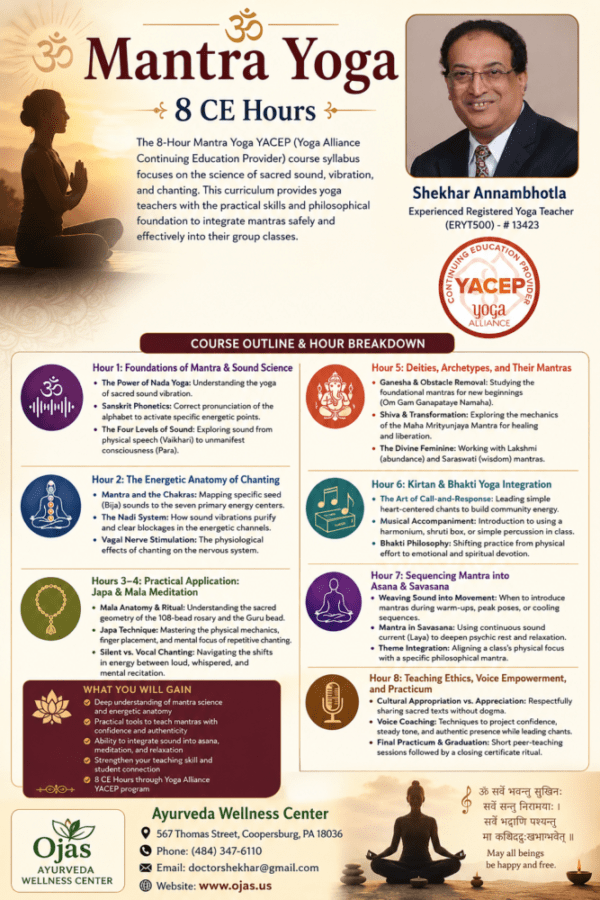
The 8-Hour Mantra Yoga YACEP (Yoga Alliance Continuing Education Provider) course syllabus focuses on the science of sacred sound, vibration, and chanting. This curriculum provides yoga teachers with the practical skills and philosophical foundation to integrate mantras safely and effectively into their group classes.
Mantra Yoga is the path of liberation through the science of sacred sound, vibration, and repetition. It utilizes the power of the voice and mental focus to quiet the fluctuations of the mind, shift brainwave states, and awaken the subtle energy centers (chakras).
Derived from the Sanskrit roots man (mind) and tra (tool or instrument), a mantra is literally an “instrument of the mind” used to dissolve mental conditioning.
The Four Stages of Sound (Vani)
In Mantra Yoga, sound transitions from the external world into the deepest layers of human consciousness across four distinct stages:
- Vaikhari – Spoken Aloud
- Madhyama – Whispered / Mental
- Pashyanti – Visual / Feeling
- Para – Pure Silence
Vaikhari: Audible sound spoken or chanted aloud. This balances the physical body and engages the sensory mind.
Madhyama: Whispered sound or intermediate mental speech. The vibration moves into the throat and nervous system.
Pashyanti: The telepathic or visual stage of sound. The mantra is not heard as words, but experienced as an internal color, form, or deep feeling.
Para: Unmanifest, transcendental sound. This is the ultimate stage of pure consciousness and silence where the chanter and the mantra become one.
Core Mechanics of the Practice
- Japa (Repetitive Chanting)
- The Practice: Repetitive recitation of a mantra, traditionally performed 108 times using a mala (prayer beads).
- The Effect: Anchors the wandering mind to a single point of focus, starving racing thoughts of attention.
- Bija Mantras (Seed Sounds)
- The Practice: Chanting single-syllable sounds that lack literal translations but carry dense energetic frequencies.
- The Effect: Resonates directly with the energetic anatomy, such as the chakra seeds (Lam, Vam, Ram, Yam, Ham, Om).
- Kirtan (Bhakti Integration)
- The Practice: Call-and-response devotional chanting accompanied by music.
- The Effect: Shifts the practice from intellectual concentration to emotional purification and community connection.
Physiological and Energetic Benefits
- Vagus Nerve Stimulation: The physical vibration of vocal chanting stimulates the vagus nerve, instantly triggering the parasympathetic nervous system to lower heart rate and reduce cortisol.
- Nadi Purification: The sonic frequencies act like ultrasound waves on the subtle body, clearing energetic blockages within the 72,000 psychic channels (nadis).
- Neuroplasticity: Repetitive mental focus on a sacred sound shrinks the amygdala (fear center) and strengthens the prefrontal cortex (focus and emotional regulation).
Course Outline & Hour Breakdown
Hour 1: Foundations of Mantra & Sound Science
- The Power of Nada Yoga: Understanding the yoga of sacred sound vibration.
- Sanskrit Phonetics: Correct pronunciation of the alphabet to activate specific energetic points.
- The Four Levels of Sound: Exploring sound from physical speech (Vaikhari) to unmanifest consciousness (Para).
Hour 2: The Energetic Anatomy of Chanting
- Mantra and the Chakras: Mapping specific seed (Bija) sounds to the seven primary energy centers.
- The Nadi System: How sound vibrations purify and clear blockages in the energetic channels.
- Vagal Nerve Stimulation: The physiological effects of chanting on the nervous system.
Hours 3–4: Practical Application: Japa & Mala Meditation
- Mala Anatomy & Ritual: Understanding the sacred geometry of the 108-bead rosary and the Guru bead.
- Japa Technique: Mastering the physical mechanics, finger placement, and mental focus of repetitive chanting.
- Silent vs. Vocal Chanting: Navigating the shifts in energy between loud, whispered, and mental recitation.
Hour 5: Deities, Archetypes, and Their Mantras
- Ganesha & Obstacle Removal: Studying the foundational mantras for new beginnings (Om Gam Ganapataye Namaha).
- Shiva & Transformation: Exploring the mechanics of the Maha Mrityunjaya Mantra for healing and liberation.
- The Divine Feminine: Working with Lakshmi (abundance) and Saraswati (wisdom) mantras.
Hour 6: Kirtan & Bhakti Yoga Integration
- The Art of Call-and-Response: Leading simple heart-centered chants to build community energy.
- Musical Accompaniment: Introduction to using a harmonium, shruti box, or simple percussion in class.
- Bhakti Philosophy: Shifting practice from physical effort to emotional and spiritual devotion.
Hour 7: Sequencing Mantra into Asana & Savasana
- Weaving Sound into Movement: When to introduce mantras during warm-ups, peak poses, or cooling sequences.
- Mantra in Savasana: Using continuous sound current (Laya) to deepen psychic rest and relaxation.
- Theme Integration: Aligning a class’s physical focus with a specific philosophical mantra.
Hour 8: Teaching Ethics, Voice Empowerment, and Practicum
- Cultural Appropriation vs. Appreciation: Respectfully sharing sacred texts without dogma.
- Voice Coaching: Techniques to project confidence, steady tone, and authentic presence while leading chants.
- Final Practicum & Graduation: Short peer-teaching sessions followed by a closing certificate ritual.